Find Your Center: A Legacy of Community
Graduates reflect on the lessons of student leadership.

For Maggie Anderson, leadership was steering a dragon boat full of students through the choppy Charles River. For João Marcos Copertino, it was organizing an event that explored the many dimensions of Afro-Brazilian martial arts and dance. And Hope Merens led by teaching burgeoning scientists how to communicate their work to a lay audience. As they receive their degrees and move on from Harvard, the three new graduates look back at their time as student leaders at the Student Center at Harvard Griffin GSAS, the life and career skills they learned, and the legacy of community that they leave behind for those who will follow.
Keeping Community Afloat
Craving in-person community after long months on Zoom during the pandemic, November 2025 graduate Maggie Anderson joined the Harvard Griffin GSAS Dragon Boat Team in summer 2021. Nervous at first, she soon found the kind of connection she was looking for. “I am so glad that I came that first day,” she says. “After a hard day in the lab, paddling along the river with everybody working together to move the boat forward. It was just a great environment.”
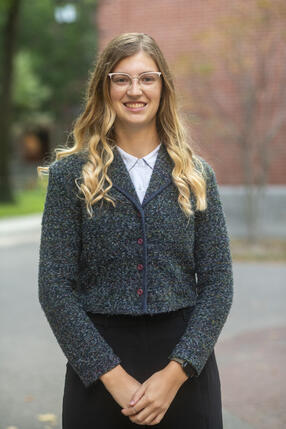
The team, which was founded in 1999, carries a rich history that Anderson is proud to have helped sustain. “To my knowledge, it is the oldest dragon boat team in Boston,” she says. Today, it draws students of medicine, law, education, literature, and more, serving as a way to meet others outside of their field, fulfilling the mission of Student Groups at Harvard Griffin GSAS.
The team soon became a central part of Anderson’s graduate experience. Encouraged by another student leader, she agreed to take on the responsibilities of group vice president in 2022, then of president in 2023, organizing practices, securing funding, working with the Student Center, and signing up for races like Boston’s Dragon Boat Festival, the oldest such event in North America. “You put so much effort into working together and building up your stamina, strength, and coordination,” she says of the team’s many hours of practice. “To have it pay off on race day is very exciting!”
While leading, Anderson tried to maintain a low barrier to entry for those interested in joining the group by keeping costs down and maintaining a welcoming atmosphere. “It can be so terrifying to show up to something new where you don’t know anybody,” she says, speaking from her own experience. “You don’t have to be good, you just have to try. Just have fun and do your best. That’s all we care about. You’ll find a place here, and other people will support you.”
It can be so terrifying to show up to something new where you don’t know anybody. . . . You’ll find a place here, and other people will support you.
—Maggie Anderson
As she settles into Copenhagen, where she started work after graduating in November 2025, Anderson finds herself looking for a new community as well. “It's difficult to meet people outside of work," she says. "I'm looking for a group like the dragon boat team that is welcoming and provides a way to meet people. If there were an actual dragon boat team here, I would join without question!”
Enabling Students to Tell Their Stories
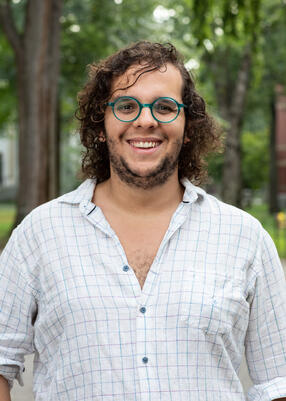
One of a larger group of Student Center Fellows, who create events and programming for their peers, Student Center Literary Fellow João Marcos Copertino's leadership experience involved editing The Graduate Review, the annual literary journal the Center has published for decades, hosting literature-centered events, and more.
One event that Copertino organized explored narrative, embodiment, and community through capoeira, the Afro-Brazilian martial art that combines acrobatics, music, and dance. “I'm not a capoeiraista, but one of the ideas of capoeira is having a narrative with another person, and I was trying to claim that there are other forms of storytelling,” he says, explaining the event’s literary relevance. Though the logistics were complicated and he had to navigate through the snow in a cast after breaking his foot, Copertino, who is originally from Brazil, was gratified to see the surprisingly large crowd that showed up for the event.
Copertino also hosted recurring open mic sessions that provided students with space to share their creative work. “I think that the events were particularly meaningful because people were really putting themselves out there,” he says. “To me, that is a very moving thing, because there was this earnestness.”
I think that the events were particularly meaningful because people were really putting themselves out there. To me, that is a very moving thing, because there was this earnestness.
—João Marcos Copertino
Calling his time as a Student Center Fellow “a life-changing thing,” Copertino says he learned to navigate Harvard’s complicated administrative structure and developed important communications and diplomatic skills that will make him an effective leader long after he graduates. What he appreciated most about the experience, though, was “a sense of community and belonging” that contrasted with the sometimes isolating rhythms of department life. "It's nice to have a key that leads you to an office in Lehman Hall, and having a place where you’re there not to work in academics, but to work for the students,” he says.
Bringing Science to Nonscientists
As co-director of the Harvard Griffin GSAS Student Group Science in the News (SITN), graduating molecular and cellular biology PhD student Hope Merens spent years teaching her peers to share their research in terms the general public could understand. Under her leadership, SITN held public lectures, created articles for the group’s website, and organized Science by the Pint, an event series that brought lab members into local bars for informal conversations. “We would invite labs to come out to bars in Cambridge, Brookline, or downtown Boston, and random nonscientists would come to hear about the research and ask questions,” she recalls.
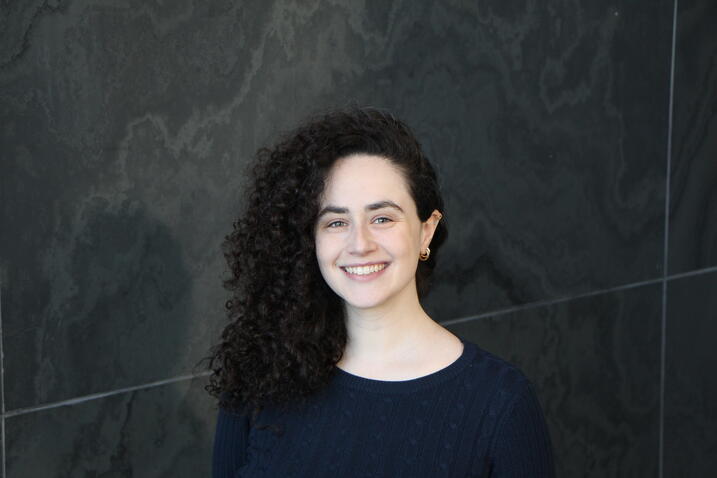
Merens takes pride in the way the group encouraged student scientists to build communication skills and try new platforms. As head of SITN, she helped launch a science communication podcast, training students to do interviews, come up with ideas for shows, and keep the programs entertaining. “We had really smart, amazing scientists, who were shy people and didn’t want to do a live interview,” she says of the students she worked with. “All of a sudden, they were hosting podcasts with their mentors on fly research, for example, making it really funny and interesting for anyone to listen to. It was really cool to see people do something different and discover a whole new side of themselves.”
As she looks back on her time at Harvard Griffin GSAS, which spanned the pandemic years, Merens says she has a deep appreciation for the importance of SITN’s ongoing work. “I watched scientists often struggle to explain vaccines or ongoing research during COVID,” she says. “I realized that, in addition to explaining the actual science of what’s going on, it’s important to explain the scientific process, and how we deal with uncertainty, new data, and evidence as it comes in.”
It was really cool to see people do something different and discover a whole new side of themselves.
—Hope Merens
SITN was also an invaluable part of Merens’s community as a graduate student. “To get networks of people together who are interested in the same kind of thing, like science communication, was a really nice way to meet this community and make some nice friends and work together to put on these events.” In addition to making friends, Merens also met important mentors through the group. “At least one of those mentors became someone who, even after I started being a director, we would still get coffee, and advice on science communication turned into science advice, and grad school advice, and just being friends. I hope others have that same experience.”
Keeping It Going
As they leave campus, Anderson and Merens, in particular, encourage the Harvard Griffin GSAS students who remain to get involved at the Student Center, ideally in a leadership role. In addition to the skills they learned and the connections they made, all find satisfaction in their legacy of service and the fact that the groups they led are still strong. “It’s still a really active group,” Merens says of SITN. “I’m happy I was able to help keep it in the right direction and keep it going.” Anderson says she takes pleasure in seeing that “the Dragon Boat team keeps itself moving forward, even after I’ve moved on as a student group leader, and that I helped keep that going.” Copertino sums up the value and satisfaction of his work even more simply: “It’s a moment where you’re supposed to take care of your community.”
Learn more about the Student Center Fellows, student groups, and Student Center programming on Engage or contact the Student Center staff directly.