Constant Innovation
Students from Harvard Griffin GSAS and the John A. Paulson School of Engineering and Applied Sciences build on past advancements for a sustainable future.

Inventive men laboriously reinvent what has been produced before. Ignorant men fight against the laws of nature with a vain energy, and purchase their experience at great cost. Why should not all these start where their predecessors ended, and not where they began?
In 1847, Abbot Lawrence, a mill owner in the eponymous city of Lawrence, Massachusetts, donated $50,000 to Harvard University for the establishment of an advanced scientific school. Driven in part by his friendship with Harvard President Edward Everett, Lawrence wanted to address what he saw as a lack of individuals trained in the “practical applications of science” whom he could hire to work at his mill.
“Inventive men laboriously reinvent what has been produced before,” Lawrence wrote at the time of his donation. “Ignorant men fight against the laws of nature with a vain energy, and purchase their experience at great cost. Why should not all these start where their predecessors ended, and not where they began?”
The resulting Lawrence Scientific School—which would undergo multiple transformations from a graduate school in applied sciences to the Harvard Engineering School and the Division of Engineering and Applied Sciences before coming full circle as the Harvard John A. Paulson School of Engineering and Applied Sciences—was founded on the idea of building a professional school where advances would not be made in a vacuum, but rather provide inspiration for the work of those who would come later.
After study in Europe, he returned to join Harvard’s faculty and taught physics from 1903 to 1940 while conducting multiple research projects, some of which would lay the foundation for electrical communication—most famously the Pierce Oscillator. Simplifying the design and adding several modifications, he developed the Pierce Oscillator, which could easily be added to medium wave and shortwave radios to ensure that a broadcast remained in its transmitted frequency. His innovation led to advances in radio, telephony, and more.
Tiny Radio
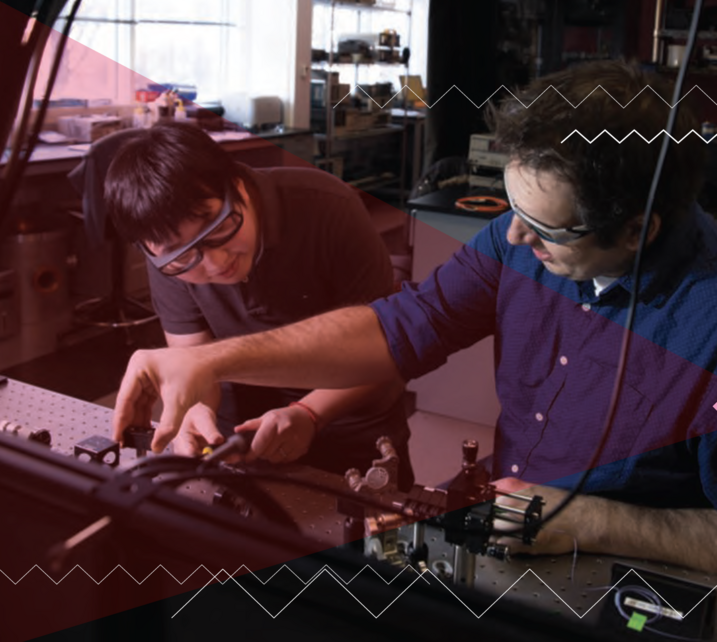
In a basement lab in the Gordon McKay building, Linbo Shao checks the connections leading to a golden metal plate placed beneath a microscope. On the bench in front of him, several monocle-sized lenses direct a beam of green light in a zigzag pattern while another lens placed near the microscope is fixed on a tiny device imbedded in the center of the plate. Shao, a PhD student in engineering sciences, powers up a portable speaker, turns to his laptop, and taps a few keys. Viewed through the lens, the device emits a red light as the theme from Star Wars plays through the speakers.
The device is an assembly of two atom-sized radio receivers, transmitting from the center of a pink diamond. To make such a unique device, Shao takes advantage of defects inside the diamond that are formed by removing one carbon atom and replacing a second with a nitrogen atom. This creates a nitrogen-vacancy (NV) center—basically a nitrogen atom next to an empty space—that can sense radio waves. Shao uses green laser light to power the NV center, which then receives the FM signal from his laptop, converts it, and emits it as red light.
Based in the lab of Marko Lončar, the Tiantsai Lin Professor of Electrical Engineering, Shao enjoys working in an applied physics environment, a departure from his studies of microelectronics as an undergraduate at Peking University. He aims to expand his knowledge of physics during his graduate career, and the radio gave him the perfect opportunity to test a complex quantum physics phenomenon. “I’m an engineering guy in an applied physics group,” he smiles. “Usually I’m looking to find interesting applications for my work.”
In addition to being the hardest naturally occurring mineral, diamonds have properties that make them ideal candidates for other applications. They can withstand extreme heat and cold, for example, and are also compatible with living tissue. This means that they are the perfect material for researchers who are developing instruments to be used in space, in deep-sea hydrothermal vents, or in the human body. Soon after Shao and Lončar published the results of this experiment in the journal Physical Review Applied, they noted broader implications.
“With computer chips being manufactured globally, it is easy for someone to add a piece to the hardware that is designed to monitor what the computer does,” he says. “Adding a sensor could measure increases in processing activity at unexpected times and warn of possible hacking.”
Power Up
American desire for easily accessible entertainment and news has not waned since Pierce patented his oscillator. In the 21st century, we expect immediate access to the information we want, often in the palms of our hands. Whereas in the 1920s, finding a way to stabilize a signal was important, nowadays, ensuring that enough power is available to handle the proliferation of devices is now of paramount concern. And this aim is becoming increasingly challenging. Little has changed from the generation and transmission systems developed in Pierce’s time, which delivered the electricity needed to light a home or power a radio. Today, increasingly sophisticated appliances, smartphones, and computers tax an energy infrastructure designed for much less.
In addition to saving energy, the sensors would accumulate data to help predict peak usage times, to effectively inform the generation of electricity. “Such a connected community will give the system a better way to know what’s happening, and when.”
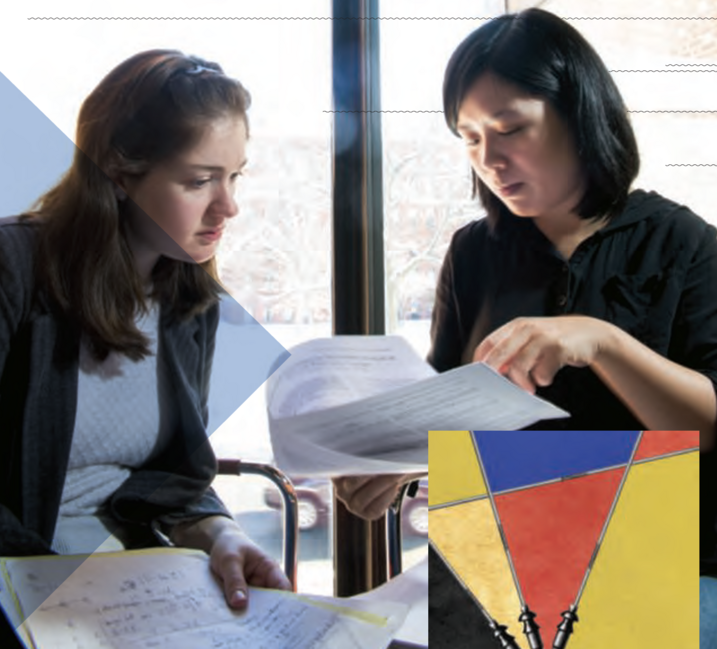
Much of the work accomplished by Li and Minot concerns the development of algorithms aimed at predicting the most efficient method for distributing energy, whether it is generated traditionally through power plants or through renewable sources, and then testing them on real systems. Because the system currently estimates usage through one central control area of the grid, Minot focuses on how to make the system more resilient and able to make estimations at more local levels. In an article they co-published in fall 2016, Minot and Li proposed an algorithm that demonstrated improved state estimation of power systems, one step closer to developing a power grid that supports Li’s vision of a sustainable future.
“How can different systems affect and help each other?” asks Li. Li sees a world where smart urban planning can reduce energy consumption while benefiting citizens, for example, by using sensors to detect traffic and turn on streetlights to light the way, then powering them down when no longer necessary.
“I hope in a decade or two we can say we are really living in the future, in that smart neighborhood,” she smiles.
New Ideas
One hundred and seventy years ago, Abbott Lawrence envisioned a place where research would not be conducted in a vacuum, but rather in an environment of collaboration and ongoing development. Pierce’s improvement to the piezoresonator ultimately built a better radio. Shao and Lončar’s two-atom radio created a transmitter with numerous applications. Minot and Li strive to create systems that enable technological advances to succeed in a sustainable way.
Other SEAS researchers start with ideas that would have seemed fantastical when Lawrence made his gift. Soft robots, lungs on a chip, a robot that helps a heart beat—all exciting developments taking place in an interdisciplinary environment. Lawrence’s vision and investment have borne fruit, and have assured that Harvard’s engineering school remains a place of constant innovation.
Illustrations by David Plunkert; Portraits by Mark Ostow