Cristián Samper: 2026 Centennial Medal Citation
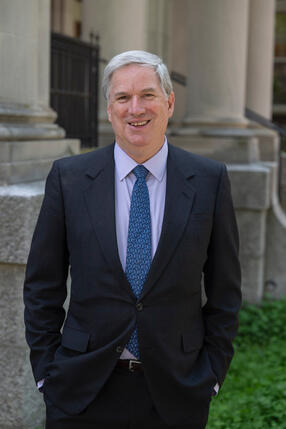
Cristián Samper is a tireless champion of the environment—and a gifted leader of some of the world’s top organizations that celebrate and protect it. A renowned conservation biologist, a pioneer in some of the earliest efforts to address climate change on a global scale, and an innovative director of world-leading institutions like the Smithsonian Museum of Natural History and the Wildlife Conservation Society, Samper has been extraordinarily effective in bringing people together to serve the best interests of our planet.
Samper was born in Costa Rica and grew up in Colombia, where he developed a lifelong fascination with nature and tropical ecology. He studied at the Universidad de los Andes in Bogotá and first came to Harvard in 1985 as a visiting undergraduate, taking biology classes with the legendary Stephen Jay Gould and E. O. Wilson. Samper went on to pursue graduate studies at Harvard in organismic and evolutionary biology, with a dissertation on tropical forest ecology, completing his PhD in 1992.
Samper’s research on the evolutionary ecology and biodiversity of Andean cloud forests, focusing on species relationships and conservation, provided an ideal foundation for what would become a lifetime of climate advocacy work. Shortly after graduating from Harvard, he returned to his home country of Colombia to help create the national Ministry of the Environment and became founding director of Colombia’s Alexander von Humboldt Biodiversity Institute. On the international stage, he chaired the science advisory body of the United Nations Convention on Biological Diversity and launched the Millennium Ecosystem Assessment, which analyzed the impact of human actions on ecosystems worldwide.
Building on his consequential early leadership of efforts to protect biodiversity and fight climate change, Samper went on to lead a number of the world’s highest-profile environmental organizations and institutions. He served as deputy director of the Smithsonian Tropical Research Institute in Panama, as director of the Smithsonian National Museum of Natural History in Washington, D.C., and for a year as acting secretary of the entire Smithsonian Institution, the world’s largest museum, education, and research complex. Samper then became president and CEO of the Wildlife Conservation Society, which manages the world’s largest network of urban wildlife parks, anchored by the Bronx Zoo, along with long-term research and field conservation programs in more than 60 countries. Since 2022, Samper has served as managing director and leader for nature solutions at the Bezos Earth Fund, where he helps direct the impact of the largest-ever philanthropic commitment to fight climate change and protect and restore the natural world. He is also a member of the Council on Foreign Relations and a Fellow of the American Academy of Arts and Sciences, where he has been a member of the “Public Face of Science” project, a multiyear initiative exploring the evolving relationship between scientists and the public, and where he currently serves as chair of the Scientific, Cultural, and Nonprofit Leadership Section Panel.
“Cristián has promoted biodiversity and conservation in each of his leadership positions,” observes Don Pfister, Asa Gray Research Professor of Systematic Botany and former director of the Harvard University Herbaria. “His goal has been to make the world a safer place for organisms, and he’s done that quite well. He has always been a great proponent of natural history collections, of nature, and of conservation.”
Samper has spearheaded many ambitious projects over the course of his career. One such project was the Encyclopedia of Life—an undertaking inspired by E. O. Wilson, who proposed creating a comprehensive online portal with information about all living organisms on Earth. Samper played a leading role in establishing this resource, which lives on today through the Biodiversity Heritage Library, providing digital access to critical resources previously available only in print. “Cristián is interested in championing biodiversity and bringing biodiversity to the masses,” says James Hanken, Professor of Biology, Emeritus, and former director of Harvard’s Museum of Comparative Zoology. “The Biodiversity Heritage Library has helped expedite further discovery and has been a godsend to scientists in every corner of the world—and ultimately it was Cristián who made it succeed. He makes policy decisions, he launches initiatives, and because he’s also a trained scientist and biologist, everyone is confident in his leadership.”
Samper’s leadership has also extended to Harvard. He served on the University’s Governing Boards as an Overseer from 2009 to 2015 and chaired the Overseers’ committee on science and engineering, working closely with then-provost Alan Garber, President of Harvard University. “Cristián is an exemplary University citizen,” Garber says. “He deserves a great deal of credit for his role in spurring the University-wide review of the life sciences, an ambitious undertaking that led to consequential advances in one of Harvard’s most prominent areas of research and teaching. Cristián is endlessly curious, tenacious, unfailingly diplomatic, and a powerful advocate for the environment and for institutions that contribute to knowledge and its dissemination worldwide.”
Cristián Samper, for your superlative leadership of some of the world’s finest institutions for natural history, conservation, and ecology, and for your lifelong commitment to leveraging the best of science and policy to fight climate change and safeguard biodiversity, we are proud to award you the 2026 Centennial Medal.