Telescopic Vision
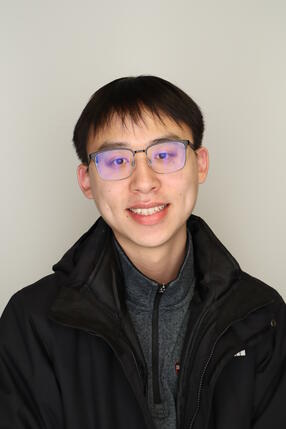
Zihao Wu, PhD student

Zihao Wu is a fourth-year PhD student in the Department of Astronomy who uses the James Webb Space Telescope to explore the early universe. He talks about discovering the most distant galaxies yet observed, their surprising concentration, and his path from Sichuan Province, China, to Harvard Griffin GSAS.
Looking Back
It’s a very exciting time for astronomers. The James Webb Space Telescope (JWST) opened a new window so that we can, for the first time, see the very early universe.
The light from very distant galaxies is stretched into the infrared as the universe expands, and much of that infrared light is absorbed by Earth’s atmosphere. That makes these galaxies very difficult to observe from the ground. JWST is above the atmosphere, and its large mirror makes it extremely sensitive to this faint infrared light. Before JWST, we had hints of galaxies from this very early period, but much of our understanding still came from theory. Now we can directly study some of the earliest galaxies in details. These first galaxies ignite the universe from the cosmic dark ages.
Looking at distant galaxies also allows us to look back in time. This is because light travel takes time. So the farther we observe, the earlier it corresponds to. If we can detect very, very far galaxies, the light we detect is actually not from the present time of the galaxy, but from the very distant past. Using the JWST, we’ve been able to look back over 13 billion years.
Baby Universe
At the time of the galaxies we discovered, the universe was just 500 million years old. Now, the universe is about 13.8 billion years old. If you imagine the universe as a person, then we are observing the really baby stage, when the child has just been born. We are trying to detect the first galaxies.
People have found many galaxies in the very early universe by using the JWST. But most of them are spread out across the sky. In our work, we were surprised to find 18 galaxies concentrated in a small area. That area is only one-tenth of our survey, but half the star formation is happening there. People have found similar structures in the later universe, but never anything this early and this extreme.
Before the observations, people had done many simulations of how galaxies are formed. In these simulations, they modeled the hydrodynamics and so on, and evolved galaxies from the Big Bang to the current day. But when we compared our observations with those simulations, the simulations did not produce nearly as many galaxies in such a small region. People are still trying to understand this phenomenon.
At the time of the galaxies we discovered, the universe was just 500 million years old. Now, the universe is about 13.8 billion years old. If you imagine the universe as a person, then we are observing the really baby stage, when the child has just been born.
We think there are a few explanations for this concentration. One is that galaxy formation is much more efficient than people previously thought. Another is that this region may contain an unusually large amount of dark matter. Dark matter provides gravity, so a region with more dark matter can pull in more gas and help more galaxies form. We still do not know the full answer. But that is what makes this discovery exciting: we are seeing a part of the early universe that formed structure much faster than we expected.
Far-Sighted
I think scientific discovery is usually driven by both scientific insight and technical development, so I've spent some of my time on technical development. In my work, my colleagues and I try to measure distant galaxies precisely. They are actually just small dots in the images generated by the JWST. We try to identify those small dots and confirm that they are indeed galaxies using astrophysical information to validate this.
To really see the distant galaxies, we need very high-quality data. One of the challenges is that the telescope will sometimes have a scattered-light effect that can contaminate the observation. This has been a puzzle for quite a few years, and people cannot subtract that effect cleanly. I designed a data-driven method that can properly model and capture the morphology and variation of the scattered-light effect, and that has improved the image quality on the JWST, so we can see distant galaxies more clearly.
Recently, we developed a clever way of taking spectra of galaxies with an efficiency that can be improved by almost one order of magnitude, meaning that we can take spectra of many more galaxies at the same time. I'm also working on a method of measuring the dark matter halo mass in the early universe that will benefit from this new technique.
A Strong Advocate
My advisor is Daniel Eisenstein. He's very supportive and insightful. For example, when I first found this huge concentration of galaxies in that small region, I thought it was very interesting but hadn't fully appreciated its significance. Daniel immediately knew this would be very important to cosmic reionization, the last phase change of the Universe and a critical problem in astronomy. We immediately decided to write a proposal to use the James Webb Space Telescope to study it.
The proposal deadline was only days away, and I wasn't sure if we had enough time. Daniel strongly advocated for my work within our collaboration. On the final day, we had 10 people working together on my proposal, using their own expertise to express how important this discovery was. The JWST is very competitive; less than 10 percent of proposals can be accepted. But this joint work finally allowed us to succeed despite fierce competition.
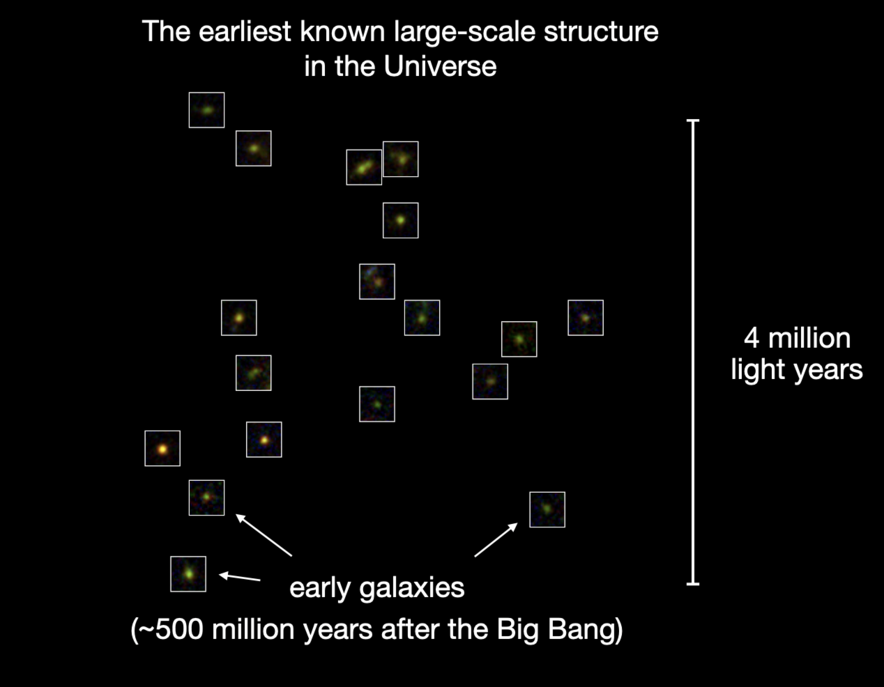
We were surprised to find 18 galaxies concentrated in a small area. That area is only one-tenth of our survey, but half the star formation is happening there. People have found similar structures in the later universe, but never anything this early and this extreme.
Under the Microscope
I was born and grew up in Sichuan Province in China. My father teaches Chinese literature, but he likes science. In my childhood, he provided many scientific encyclopedias for me. He even managed to get a microscope for me. At that time, I was young. I was curious. In primary school, the science teacher showed us what we could see with a microscope, and I was really amazed. My father bought a small microscope, which was not very fancy, but with that, I explored almost everything on my balcony: every leaf, every insect, and even everything that happened to be on my desk or in my bathroom. It was amazing to see how beautiful the world is.
My father also bought an amateur telescope for me. I was amazed when I first saw the craters on the Moon. I saw the first solar eclipse when I was seven. I was really surprised when the sky suddenly got dark. I asked my dad. He explained the whole thing to me using just a torch, a ping-pong ball, and a tellurian. That's the first time I knew the universe could be understood.
In high school, I studied for the Physics Olympiad, learning basic theories. After that, I felt my vision of the whole world changed because I could understand things using the laws of physics. I fell in love with astronomy as an undergraduate at Peking University in China. My undergraduate advisor, Luis Ho, was very passionate about astronomy. We occasionally had lunch together, and during lunch he introduced many exciting frontiers in astronomy to me. That made me passionate about the astronomy too.
How Do You Like Them Apples?
I think the biggest challenge for me initially coming from China to Harvard was the language barrier. Sometimes I cannot express my thoughts naturally or fluently, but my Harvard cohort is very helpful. We also went apple picking together, and went to see the solar eclipse in New Hampshire, which was really warm and amazing. We have a group of friends who hang out for dinner together every few months. I feel that friendship not only helped me get used to life here, but also made me feel warm about the place.