A Better Look at Hunger
Berry uses satellite data to assess food insecurity in Africa

In the smallholder communities of Madagascar, households grow and raise their own food, bringing little to market. Both farmers and pastoralists (who tend cattle) rely on rain to nourish crops or water livestock. The way of life is shaped by long-term weather patterns, making these communities particularly vulnerable to environmental shocks that proliferate in an era of climate change, including droughts and floods. As a result, the status of food security in Madagascar is bleak.
“The last estimate was that about 1.9 million people in southern Madagascar were experiencing the most extreme level of food insecurity,” says climate scientist Alexandria Berry. “That means having to move or find food outside the household in order to get a meal that night. For context, there are about 33.5 million people in the entire country.”
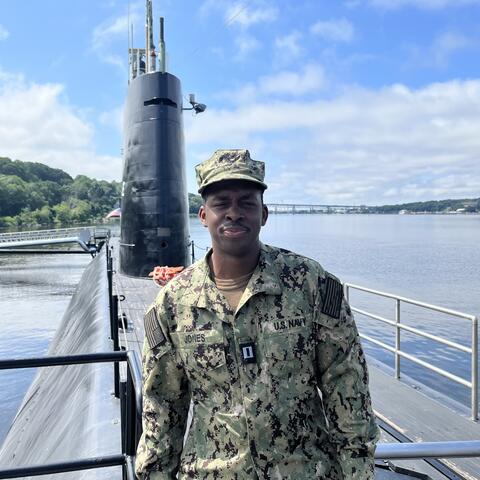
Berry, a Navy veteran and a PhD student in Earth and planetary sciences (EPS) at the Harvard Kenneth C. Griffin Graduate School of Arts and Sciences, wants to make efforts to address hunger more effective. A member of the research group led by Professor Peter Huybers of EPS, Berry uses satellite imaging data to complement reporting on the ground and more accurately assess food insecurity in places like Madagascar and the nations of the Horn of Africa. Her work is more important than ever in light of changes caused by climate and conflict—and more challenging than ever in light of the 2025 shutdown of the US Agency for International Development (USAID).
Matching Eyes in the Sky with Boots on the Ground
Berry says that 70 percent of people experiencing hunger in Africa are smallholder farmers. In Madagascar and nearby Ethiopia, another site of Berry’s work, climate change, conflict, and food insecurity are deeply intertwined.
“Smallholder farmers are very sensitive to changes in climate,” she says. “Their income, and therefore their food security, is tied directly to how much water they receive during the rainy season, which in turn determines their crop yields and how much food they have to put on the table. People fight over water resources for their cattle, and they fight over land rights and better land to farm. There is also a greater risk of conflict when people are hungry.”
Existing food-security indices developed by organizations such as the World Food Program and the World Bank provide data from countries that may report once a year at most, making it difficult to monitor climate impacts through the seasonal cycle. Catholic Relief Services (CRS), a major provider of aid in the region, wanted to monitor food security on a more granular level. The organization worked with Cornell University agricultural economist Joanna Upton to develop a more frequent survey called the Monthly Interval Resilience Analysis (MIRA). The tool launched in southern Madagascar in 2018.
Smallholder farmers are very sensitive to changes in climate. Their income, and therefore their food security, is tied directly to how much water they receive during the rainy season, which in turn determines their crop yields and how much food they have to put on the table.
– Alexandria Berry
“They monitor roughly 600 households every month, which allows much more in-depth statistical analysis,” Berry says. “It is helpful for us as climate scientists because we can incorporate seasonality and see droughts during the rainy season—something we could not do if we received data only once every two years.”
In collaboration with CRS and Upton of Cornell, the Huybers Group sought to develop a climate element that would complement MIRA and more precisely detail how environmental change influences food insecurity. “Southern Madagascar is among the most food-insecure regions in the world, in part because of limited trade networks, so we expected to find a close relationship between growing conditions and diet,” Huybers explains.
From Simple to Sobering
Using satellite data from NASA’s Moderate Resolution Imaging Spectroradiometer (MODIS) and the Normalized Difference Vegetation Index (NDVI), Huybers’ team—led by postdoctoral researcher Angela Rigden and collaborating with coauthor Chris Golden, a professor at the Harvard T.H. Chan School of Public Health—examined how green farms were and compared that information with monthly changes in MIRA.
“Initially, we thought it would be simple,” Berry says. “We receive a picture of how green the ground is every 16 days. For instance, after the harvest, things are less green. We would take the food-security indices and see whether changes in those indices matched the climate data.”
It wasn’t simple.
USAID, a major funder of CRS and of food aid in the region, shut down in July 2025. Overnight, the food-security data collected by MIRA enumerators on the ground dried up. Information became even harder to obtain later that year when Madagascar’s military seized power from the civilian government, installing a new one in its place. In 2026, Colonel Michaël Randrianirina, the country’s military leader, abruptly dissolved that government as well.
“Something like 53 to 60 percent of Catholic Relief Services’ funding came from USAID,” Berry says. “That funding simply turned off. Then the government of Madagascar collapsed several months after, when the country was already in a huge food crisis. As scientists, we could still use historical data, but we couldn’t monitor things live, check our results against live conditions, or talk to people on the ground and ask whether what we’re seeing is what they were actually experiencing. That really complicated the task. We couldn’t improve the model because we weren’t adding any new data.”
In response, Berry’s project evolved to help address the loss of on-the-ground reporting. “Alex began by working with monthly survey data whose collection was led by Professor Upton to understand in greater detail how environmental change influences diet,” Huybers says. “With the dismantling of USAID and the surveys it funded, we asked, more specifically, how well diet could be inferred from ongoing satellite observations.”
Using a data-compression method called singular value decomposition, the group generated a time series that revealed what people in Madagascar were actually eating. The results were sobering.
“The biggest change was from people eating staple foods such as maize and sorghum—foods that people want to eat—to eating foods that are less nutritious or can have a negative health impact, such as red cactus and cassava root,” Berry says. “Red cactus has little nutritional value and can cause stomach upset and diarrhea. That change matches the satellite data, and we see it as a signal of food insecurity.”
Huybers says that Berry’s work helped confirm the data from collaborators at Cornell.
“The standard indices of food security did not account for the type of substitutes that Professor Upton’s surveys documented prior to the collapse of USAID funding,” Huybers observes. “Alex led the study in terms of analyses, developing insights, and writing the paper. It represents the culmination of years of her work.”
Alex began by working with monthly survey data whose collection was led by Professor Joanna Upton of Cornell University to understand in greater detail how environmental change influences diet. With the dismantling of USAID and the surveys it funded, we asked, more specifically, how well diet could be inferred from ongoing satellite observations.
–Peter Huybers, Professor of Earth and Planetary Sciences
Jumping Ship
Berry grew up in a military family. Her mother and father, both from Massachusetts, spent their careers in the US Army, where they met and married. “My parents met in the Gulf War. My dad walked out of a building and heard a Boston accent, which he hadn’t heard in a long time. And it was my mom. They knew each other for thirty days and eloped to Manama, Bahrain.”
Born in Berlin, Germany, Berry lived all over the world as her parents went from one posting to another. Throughout the moves, one constant for her was a love of the outdoors and of science. “My younger brother and I always played outside,” she says. “We were always playing in the creek. We loved animals. We read National Geographic for my entire childhood. I still subscribe to the magazine. Climate science was always a part of my life, just being outside.”



Berry likes to joke that she “jumped ship” when she became the first in her Army family to attend the US Naval Academy in Annapolis, Maryland. Admitted to the US Military Academy at West Point as well, she chose Annapolis in part because “I always wanted to be an astronaut, and the Naval Academy has graduated more astronauts than any other college.”
Berry describes the academics at Annapolis as “extremely rigorous,” with an emphasis on science and engineering. The most challenging part of the experience, though, may have been balancing schoolwork with the other responsibilities of a midshipman. “The academics, the athletics, and the military obligations—every second from the moment you wake up between 5:00 and 7:00 in the morning, even 4:30 sometimes, until you go to bed at around midnight is very regimented and very scheduled.”
After graduation, Berry served as a naval officer for a few years, then tried the private sector. She found that she missed learning and doing science. Through a friend pursuing a PhD at MIT, Berry met Harvard’s Peter Huybers, himself a graduate of West Point. “I had no idea what I was doing,” she says. “I didn’t know how to code or anything. Peter told me that if I persevered, I could do the work. And so, for two years, I worked in his lab off and on in my free time. Eventually he convinced me to apply to graduate schools, and I ended up at Harvard.”
The transition to Harvard from the military and the private sector was challenging for Berry at first. The intimidation she felt when surrounded by her many brilliant classmates and colleagues was intensified by her expectation of the kind of “cutthroat” competition encouraged at the Naval Academy. She soon learned, however, that the University is “a very special place.”
“At the Naval Academy, there’s a specific mission: to graduate naval officers who have a technical background,” she explains. “But at Harvard you have the freedom to explore any question your mind can come up with. I’ve had a blast being able to learn how to become a scientist.”
As she looks to her career after graduation, Berry says her experience at Harvard Griffin GSAS has enabled her to think about problems from new perspectives.
“I really enjoy my classes,” she says. “They’ve challenged me and really stretched my brain in ways that maybe I didn’t appreciate in the moment. But now that I’m writing my thesis and trying to actually go out on my own as a scientist, I really do.”
At the Naval Academy, there's a specific mission: to graduate naval officers who have a technical background. But at Harvard you have the freedom to kind of explore any question your mind can come up with, which is really cool and not something you get to do everywhere. I've had a blast being able to learn how to become a scientist.
–Alexandria Berry
Research to Help Feed the World
Berry knows that influencing how national governments address hunger—both foreign and domestic—is well beyond the purview of an aspiring climate scientist. But she does hope that her work can ultimately build a better rapport between experts in her field and those who study food insecurity.
“This work has to be interdisciplinary, which can be difficult when you are collaborating across fields,” Berry says. “But we need information from our colleagues to develop the climate component. That’s why, in addition to the agricultural economists at Cornell, I also work with Professor Golden at the Chan School of Public Health.”

On a more practical level, Berry hopes both governments and nongovernmental organizations will eventually use her research to better help the hungry.
“I hope that, when we further these results and verify them in other places, we will be able to say that satellite data can help inform decision-making about delivering aid to food-insecure regions,” she says. “The overarching question is, how are we going to feed the world as the climate changes and as the places where we can grow food change? It’s an important question, and I hope this work contributes in a small way.”