Monuments Man
Jones explores just war theory and the ways we commemorate conflict

The wall at the center of the new National Desert Shield and Desert Storm Memorial in Washington, DC, tells the story in images of the military build-up, combat, and then liberation of Kuwait by US-led forces after the Iraqi invasion of 1990. The monument may be most notable, though, for what it lacks, particularly in contrast to the black granite Vietnam Veterans Memorial only steps away: the names of the service members who lost their lives.
“The Desert Shield and Desert Storm Memorial is not intended to measure the impact of the conflict by casualties,” explains the National Desert Storm Memorial Association website. “Instead, it honors a collective legacy of service, unity, and sacrifice,” one that “reflects a decisive moment in history when America stood at its best.”
“The organizers made a conscious choice to move away from typical memorials that focus on those who died in the conflict,” says the scholar and ethicist Elam Jones. “They’re trying to promote a redemptive narrative. There will be a museum attached, and visitors will learn something, but this is a clear refocusing. It’s a purpose-driven monument, and it isn’t centered on the people who were involved or on their families and communities.”
As a PhD student at the Harvard Kenneth C. Griffin Graduate School of Arts and Sciences (Harvard Griffin GSAS), Elam Jones explores how wars are justified and remembered. An ordained Baptist minister, hospital chaplain, and an eight-year veteran of the US Navy Reserve, Jones says that, when done poorly, memorialization can become a seedbed for future conflict. When done well, it can foster the kind of reflection, healing, and even growth that makes the sacrifice and suffering monuments often commemorate less likely to recur.
Justice After War
Jones’s PhD dissertation centers conflict and memorialization—specifically, within just war theory. Often associated with the fourth-century Christian saint, Augustine, the doctrine has two primary components: jus ad bellum, or what justifies going to war, and jus in bello, the laws of war. Jones focuses on a third component, jus post bellum, or justice after war.
“Jus post bellum is underdeveloped,” he says. “Whatever happens after a war is often shaped by the victors: how they define and pursue justice, what reparative measures they impose or support, and whether they seek to rebuild or reform an aggressor regime to prevent future conflict.”
Memorialization is an essential component of jus post bellum thought for Jones. Doing it well requires a critical approach that enables participants to be self-reflective and consider the future in a way that leads to peace rather than fostering continued strife. “My larger claim is that memorialization should allow communities to forget war,” Jones asserts. “By forgetting, I don’t mean erasing the historical record or denying responsibility. I mean loosening the hold of narratives that require communities to continually rehearse war’s antagonisms. The question isn’t merely whether societies remember war, but what their forms of remembrance enable them to do going forward.”
In the case of the National Desert Storm and Desert Shield Memorial, Jones says the monument pushes forward a narrative that does not necessarily reflect the memories and experiences of many who fought in those campaigns—or the 20 years that followed them. Jus post bellum assumes a conflict has a clear beginning and an end. In Iraq as with several other modern conflict zones, however, the boundaries of war were far less defined: military operations evolved over time, formal combat operations ended without bringing a clear end to the conflicts, and the country continues to face insurgencies that complicate efforts at reconstruction and stabilization.
Whatever happens after a war is often shaped by the victors: how they define and pursue justice, what reparative measures they impose or support, and whether they seek to rebuild or reform an aggressor regime to prevent future conflict.
–Elam Jones
“Many people would consider Desert Shield and Desert Storm a relatively just portion of the war in Iraq: an aggressive regime invaded Kuwait, a united front responded, and then the coalition was able to withdraw and consider what should come next for Iraq,” Jones explains. “There was hope that lasting peace would take hold in the region. Since then, however, it hasn’t. The war in Iraq escalated dramatically, and we went back in. But the memorial ignores, and almost denies, that 20 years of history, while focusing on redemption.”
Jones’s PhD adviser, Kimberley C. Patton, professor of the comparative and historical study of religion at Harvard Divinity School, says her student’s research calls scholars and citizens to ask a hard question about memorials in America: Do they actually create conditions of collective vengeance and perpetuate war, rather than heal and resolve its wounds?
“Through its deluding political symbolization in the iconography and language of heroic sacrifice, memorialization veils a citizen’s ability to see the truth of the political structure that governs and ideologically encompasses them,” she says. “Jones’s work urges us to turn towards—rather than away from—war’s legacy in our public war memorials. Only such a full embrace can allow genuine post-war restoration.”
Putting the Past to Rest
Jones grew up in a region of the country fundamentally shaped by the effort to promote a narrative of war through memorialization: the American South. In the wake of the murder of George Floyd, a Black man, at the hands of police, the Confederate monument outside the Rockdale County Courthouse in Conyers, Georgia, was one of hundreds removed throughout the country in 2020. Erected in 1913 by the United Daughters of the Confederacy, the tall, gray column topped by a steely-eyed soldier staring to the horizon was part of the effort to recast the US Civil War as a “noble lost cause” to preserve states’ rights, rather than defend the institution of slavery.
The dismantling of the memorial—stored still in a publicly undisclosed location—was hailed as a victory by campaigners for racial justice. But in his dissertation, Jones wonders whether removal is the best response to a monument that doesn’t serve the needs of its community. “Ultimately, are we better off for removing it or is there another way?” he asks. “Monuments are transformations of ideas and, often, of the people they represent. When they are active in a community and have existed for a long time, people tend not to notice them—or to remember that they were ever absent.”
As an alternative, Jones explores so-called counter-monuments, notably the Monument Against Fascism in Hamburg, Germany. A large metal column, 30 or 40 feet high, the memorial was gradually lowered into the ground over the course of a year. While it was above ground, passersby could etch messages into it—memories, thoughts, graffiti. The monument was periodically lowered farther, until it was ultimately enclosed underground. A plaque and a sign mark the site, and a small window allows visitors to see part of the column inside.
“It became ugly immediately,” Jones says. “People began drawing on it, and children in the community came by to tag it and write real thoughts and responses to fascism. Then it became less present, gradually absent, and almost forgotten, while remaining part of the community in many ways. It acknowledges from the beginning that monuments don’t last forever. That’s a truth we’ll have to accept. On a shorter timescale, a community may decide that a monument no longer serves a productive purpose. In that case, we can engage in counter-memory and find ways to repurpose it.”
I imagined [a monument that] would become less important once it was lowered into the ground. What mattered would be the message on top—the grave marker. I imagined burying it as though it were a living being or something the community had respected and cherished, regardless of the message it conveyed.
–Elam Jones
Patton says that, in his thoughtful consideration of other counter-monuments including the Vietnam Veterans Memorial, Jones offers alternative paths of commemoration that can support rather than undermine the realization of jus post bellum. “Jones especially lifts up the subdued and inclusive nature of this memorial, which counters and undermines the grandiose apotheosis of the imagery of—to take an example at Harvard—the mirroring ‘Death and Victory’ figures clasped by the dying soldier in John Singer Sargent’s 1922 WWI commemorative mural on the landing of the main Widener Library staircase.”
Inspired by the Monument Against Fascism, Jones created his own idea for alternative memorialization during coursework at the Harvard Graduate School of Design. “I imagined that the monument itself would become less important once it was lowered into the ground,” he says. “What mattered would be the message on top—the grave marker. I imagined burying it as though it were a living being or something the community had respected and cherished, regardless of the message it conveyed.”
Jones concludes that communities can productively remove monuments that no longer embody their ideals. “As they fade, there can be a ritual or ceremony associated with their release from society—a dust-to-dust process in which they are returned to the material from which they came.”
Ministry of Ideas
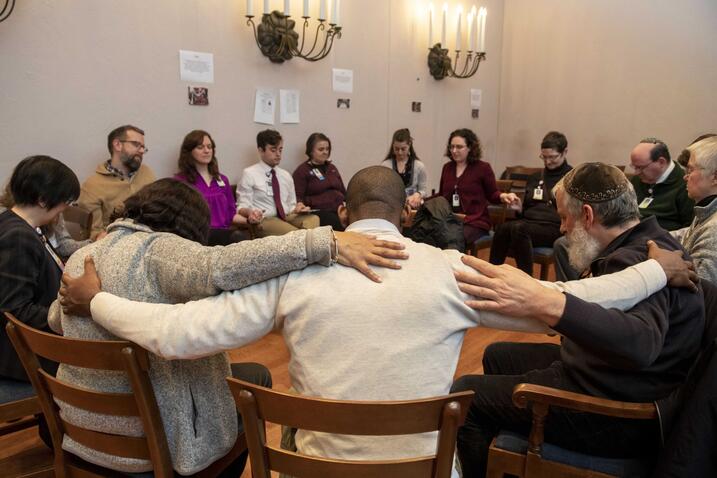
The son of a mother with a PhD in mathematics and a father who is a politician and businessman, Jones grew up in a vibrant church community. After receiving a bachelor’s degree in religion from DePaul University, Jones wanted to pursue ministry as a way to serve, be present, and engage with people, but outside the context of a church or formal religious institution. He joined the Navy and entered the Chaplain Candidate Program as an officer while he enrolled at Harvard Divinity School (HDS).
“During every break in the three-year master of divinity program, I went through the Navy’s officer and Chaplain Corps trainings, where I learned about deck-plate ministry—going out and talking with sailors—and practiced delivering quick and impromptu messages of encouragement,” Jones says. “I also practiced spiritual care and counseling, which were important for service members experiencing ordinary life and for those going through serious crises and transitions.”
After graduating from HDS, Jones took a year off from school while still in the military and completed a chaplaincy residency at Massachusetts General Hospital (MGH), formally beginning hospital chaplaincy during the 2019–2020 COVID year. During this time, he applied to Harvard’s PhD program to continue writing on questions of theology and philosophy, as he had at HDS. He was admitted, but before long felt the need to understand those questions more practically—in terms of international and humanitarian law. Jones decided to enroll concurrently at Harvard Law School.
“I wanted to blend the study of law with the research I was already doing at Harvard Griffin GSAS,” he explains. “Specifically, I wanted to better understand the rules governing the use of force and how just war thinking continues to shape international humanitarian law. Jus ad bellum and jus in bello are real legal frameworks that leaders consider at the international level. Whether they are being followed, especially now, is an open question. Public international law has been in the hot seat, with many questions about whether the international legal regime will hold.”
Jones’s work urges us to turn towards—rather than away from—war’s legacy in our public war memorials. Only such a full embrace can allow genuine post-war restoration.
–Kimberley Patton, Professor of the Comparative and Historical Study of Religion
Honorably discharged from the Navy in 2025, Jones continues to serve as a chaplain at Massachusetts General Hospital, often taking several shifts a week while completing his PhD. In fact, it was an interaction with a dying patient that helped solidify his desire to attend law school.
“I met a woman who had an intestinal bleed that could not be repaired,” he remembers. “She was receiving about three blood transfusions a day and knew that wasn’t sustainable. She was also worried that she was taking blood away from other people who needed it. So, we talked practically about the situation. We also talked theologically. At the end, she was surrounded by her family and friends. But the situation raised difficult questions. Who ultimately makes decisions about right and wrong in a case like this? That was a question I hoped law school would better equip me to answer.”
Reverend Erica Rose Long, head of chaplains at Mass General Brigham Integrated Health Care System, says that Jones’s desire to be present for people—particularly those who are sick and suffering—lies at the core of his interest both in scholarship and the law.
“Elam has a great respect for the people he meets and the stories they share with him,” she says. “I love hearing about how his work here informs the ways he thinks about his academic and legal work. When I first heard he was attending law school, I thought it would be an entirely separate endeavor from his chaplaincy. But for Elam, they are connected, and it makes sense.”
Jones looks forward to considering legal questions in greater depth as a member of the Boston law firm of Goodwin Procter LLP, which he joined in October 2026. Ordained a Baptist minister three years ago, Jones still identifies as a chaplain and hopes to continue serving patients in the future. All three parts of his life—scholarship, law, and ministry—are deeply interconnected.
“The greatest gift of doing chaplaincy—whether in a hospital or in the military—is learning what it means to be a scholar-practitioner,” he says. “I thought about moral injury and whether people felt that they were still good people at the end of their lives after engaging in war and returning home in the context of the Navy. I thought about collective memory and whether people actually cared about how conflicts are memorialized, as well as how those who fought and died in them are remembered. These ideas take root in practice. They may not matter in exactly the way you think they do, but they shape how you understand people and how you engage with them. That’s why you have to take them seriously.”