Public Health, Personal Stakes
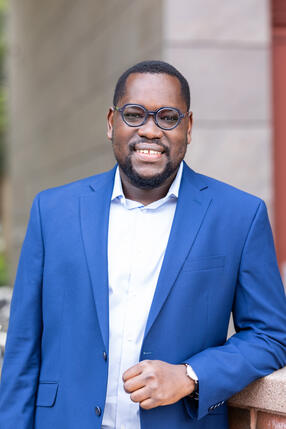
Ibou Dieye, PhD ’26

Ibou Dieye is a graduating PhD student in health policy at the Harvard Kenneth C. Griffin Graduate School of Arts and Sciences. An applied health economist, his research uses econometric tools and randomized controlled trials to evaluate universal health coverage policies and maternal healthcare quality in Sub-Saharan Africa. He reflects on the childhood memories that drive his work, his journey from Dakar to Singapore and Minnesota, and why proving the real-world impact of healthcare financing is a matter of life and death.
A Motivation Closer to Home
I grew up in a family of five children in Dakar, Senegal. I am the oldest, and I have four younger sisters. My parents had almost no formal education at all. My father had some basic instruction through an Arabic Quranic school, but neither of them ever went through the standard Francophone public school system. They cannot read or write. For work, my father was trained as a car mechanic, later became a taxi driver, and eventually worked as a personal chauffeur. My mom was primarily a housewife, but she also did a lot of small-scale commerce work on the side to help my dad support the family financially.
About seven years ago, in 2019, my mom died of cardiac arrest. She was only 49 years old. A couple of weeks before, she wasn’t feeling very well and went to a local healthcare facility for a checkup. When she came back, she told us the doctors didn't find anything and that she should just go home and rest. My sense is that they probably missed something structural, and she may have been severely misdiagnosed. Cardiac arrest does not just happen overnight without warnings, especially in healthy 49-year-old women. I think there was a definitive failure in the quality of care she received.
Part of the deep motivation for my research in healthcare access and outcomes stems directly from this personal experience. It is not just my mother’s passing, but the broader reality of growing up in a low-income, very modest family in the suburbs of Dakar. We dealt with multiple chronic conditions in my household, and we faced constant financial hardships whenever we tried to access basic health services. I remember episodes of asthma with my younger sisters, watching them struggle to breathe, while my parents tried to figure out how we would pay for their care at the clinic.
All of this background made the academic work I do far more meaningful for me. A PhD is a grueling process for everybody who goes through it, but having that deep personal motivation—along with the support of my community—is what kept me moving forward when the work got heavy.
The Laboratory of Universal Health Coverage
The core question driving my research is centered on healthcare access and the starkly different health outcomes we see around the world. If you look closely at global health metrics, for instance, Sub-Saharan African countries bear a disproportionate share of the global disease burden. Over 70 percent of all global maternal deaths and over 60 percent of all deaths of children under the age of five occur in the region. There are structural reasons for this, but it largely comes down to limited financial access to care and poor clinical quality of care at the point of service. Access is constrained because formal health insurance has an incredibly limited reach, forcing the vast majority of citizens to pay for life-saving care entirely out of pocket.
My dissertation uses Senegal and Kenya as a clinical laboratory to evaluate three distinct policies aimed at achieving universal health coverage, where every single individual can access high-quality medical services without facing catastrophic financial hardship. The first two papers of my dissertation evaluate healthcare financing interventions launched nationally by the Senegalese government since 2013.
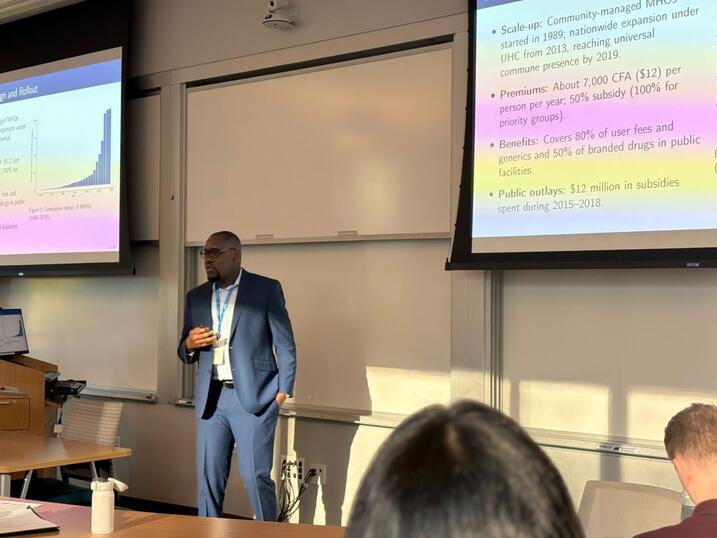
First, I examine Community-Based Health Insurance (CBHI) schemes. In countries like Senegal, traditional employer-based insurance models fail because more than 80 percent of the population works informally, primarily in rural areas. CBHI fills this gap by allowing community members to voluntarily pool their financial resources via small annual contributions—about twelve dollars a year—to protect themselves against health-related financial shocks. The government sought to scale up these informal mutuals by offering a 50 percent premium subsidy for working families and fully paying the premiums for the poorest citizens.
Second, I evaluate Senegal's policy of providing completely free healthcare for children under five in public medical facilities. Both papers analyze whether eliminating financial barriers actually shifts health outcomes. When the government expanded these mutuals, it set an incredibly ambitious target of reaching 75 percent national health insurance coverage by 2017. They fell short, reaching about 45 percent in 2017 and currently standing at approximately 53 percent.
In my dissertation, I wanted to move past simple enrollment tallies to measure actual causal impacts using advanced econometric tools. Looking at survey data for maternal services, I found that while CBHI improved self-reported insurance coverage by nearly 7 percentage points and reduced the likelihood of facing high out-of-pocket costs by 23 percentage points, it did not significantly move the needle on actual healthcare utilization or reduce pregnancy loss and neonatal mortality. The financial relief was real when women arrived at a clinic, but the overall take-up simply wasn't large enough to alter regional health trajectories. This shows us that small, voluntary, localized insurance pools may not be a viable path forward for universal coverage, which is why the Senegalese government is now working to aggregate these tiny mutuals into much larger departmental-level pools to make risk-pooling functionally effective.
Personalizing Care in Kenya
The third strand of my dissertation moves from healthcare financing to the clinical quality of care, focusing on a postpartum contraceptive counseling intervention in Kenya. Clinical observation shows that women often do not receive high-quality counseling at the point of service; providers frequently complete only about 50 percent of standard guideline checklists. To address this, we partnered with Jacaranda Health, an innovative organization in Kenya managing an SMS-based digital platform that sends targeted educational materials to pregnant and postpartum women.
Through our randomized controlled trial, we discovered that women who received these personalized interventions demonstrated substantially better knowledge of postpartum family planning methods and reported a much higher perception of message and counseling quality. And yet, this did not translate into a higher statistical uptake of contraceptives compared to the control group.
When we examined the platform data to understand the underlying mechanisms, we found two fascinating realities. First, actual user engagement with the core interactive features was quite low. For instance, while 20 percent of women began the text conversation for support with contraceptive choice, only about 6 percent completed the entire interactive pipeline to receive the algorithmic recommendation before their final antenatal visit. Second, our follow-up interviews revealed that nearly 50 percent of the non-users simply did not want to use family planning because they preferred high fertility and wanted to expand their families. Because our intervention was strictly non-coercive and respected personal fertility preferences, it didn't alter their behavior, which perfectly aligns with recent studies in Burkina Faso showing that structural preferences for larger families often outweigh digital public health nudges.
The Crucial Focus on "So What?"
I am profoundly grateful to my dissertation committee for helping me operationalize these complex questions over the last five years. My primary advisor, Jessica Cohen at the Harvard T.H. Chan School of Public Health, provided mentorship in managing the randomized controlled trial in Kenya alongside our coauthors Maggie McConnell and Slawa Rokicki. [FAS Professor] David Cutler, an applied economist, and Professor Kevin Croke at the School of Public Health, pushed me continuously to refine my methodology and data sources for the standalone papers in Senegal. Harvard also provided financial support that made my travel to West Africa possible, including the Harvard Griffin GSAS Summer Predissertation Fellowship and grants from the Harvard Ministerial Leadership Program and the Kennedy School’s Health Equity Funds.
Beyond the research, campus has been a welcoming space for me personally. As an observant, practicing Muslim, I regularly attend Friday prayers, participate in undergraduate and graduate Islamic Society events, and gather for Ramadan iftars on campus. The past couple of years have been emotionally challenging for everyone on campus due to the heightening of global conflicts, but my overall experience within the vibrant Harvard Muslim community has been deeply comforting and positive.
Following graduation, I will rejoin Analysis Group as an associate health economist, while continuing my research agenda on universal health coverage in Sub-Saharan Africa. Academic research can occasionally run the risk of becoming too abstracted from the immediate "so what?" of human life. By evaluating real-world healthcare delivery, my goal is to remember the structural financial barriers my own family faced in Dakar, and ensure that public health policy remains centered on the lives it’s meant to save.