How Should We Commemorate the American Revolution?
Revolution 250 chair Robert Allison discusses the effort to honor the ideals of the country’s founding without ignoring its failures.

Citizens throughout the United States are marking the 250th anniversary of the country’s founding this year with celebrations, commemorations, and conversations. But what exactly are we celebrating? The founding of a nation based on new ideas of liberty, civil rights, and self-government? An empire based on the conquest of Indigenous peoples and the enslavement of Africans? Or some combination of these, no part of which necessarily compensates for or outweighs another?
Suffolk University historian Robert Allison, PhD ’92, grapples with these questions every day. As chair of Revolution 250, Allison leads a consortium of organizations dedicated to celebrating “the founding of our country, while exploring the complexities that brought our nation into being and that continue to impact our culture and values.” He sat down recently with Harvard Griffin GSAS Communications to discuss what an honest commemoration of the 250th anniversary of American independence should look like.
What is the mission of Revolution 250, and what’s the strategy for making historical events resonate with a modern, diverse public?

Revolution 250 was created because many different organizations were working independently on their own stories connected to the American Revolution. About 15 years ago, we realized it would be better to bring everyone together so that we could collaborate. Initially, the effort was limited to Boston; then it expanded throughout Massachusetts. It brings together local historical societies and large institutions such as the National Park Service, the Massachusetts Historical Society, and the American Antiquarian Society.
All of us can work together to tell these stories and engage people with them. We are not thinking only about the past; we are also thinking about the future. Who will tell this story in 50 years, for the 300th anniversary? Our mission is to build a community of people engaged in the same work who often would not otherwise talk to one another.
For example, we recently completed a series of events commemorating Henry Knox and the “noble train of artillery.” Knox brought artillery from Fort Ticonderoga to Boston, a critical development that helped end the siege of Boston in March 1776. Knox, a 25-year-old Boston bookseller, set out on the mission with George Washington’s blessing. Washington recognized Knox’s character and ability. Knox hired teamsters to bring 60 pieces of artillery down the Hudson River and across the mountains.
Our effort to bring that alive in the 21st century began at Fort Ticonderoga in December 2025. In each community along the route, local organizations and historians came together with reenactors and professional historians like me to tell and promote the story. It was a phenomenal series of events that connected communities across the Commonwealth.
We also had a fascinating commemoration of the Boston Tea Party, which drew more than 20,000 people. There is real interest in and engagement with history. Revolution 250 brings people together so that we can tell these stories and, we hope, inspire new generations not only of historians but also of citizens.
In some ways, we modeled [Revolution 250] on the organizations that, from 1760 to 1775, brought together different people who recognized a common interest.
What is your role as chair of the consortium?
We recognized that there was a degree of tension among the organizations. Some held the view that if someone visited your museum, that person would not visit mine. The organizations were often competing for the same, frequently minuscule, grants. We thought we could do better by working together.
My job as a historian was not to dictate but to listen to people and determine how we could best collaborate—to get them to sit at the same table and recognize how much they had in common. In some ways, we modeled this on the organizations that, from 1760 to 1775, brought together different people who recognized a common interest.
It has been challenging, but we have gotten people to sit down, talk, and collaborate. For instance, a group of amateur historians in Otis, in western Massachusetts, made it their mission to map exactly where Knox’s noble train of artillery passed. They have an eight-foot-long US Geological Survey map showing the route. In Otis State Forest, they found cleft rocks mentioned in Jeffery Amherst’s journal from the 1750s. They also found documents in the state archives that enabled them to identify the route precisely. That will be exciting for people to see in the future, and the researchers also have the satisfaction of uncovering and sharing the story.
Sometimes we think, “I am the only person who cares about this.” Then we discover that there is an audience and that other people are connected to the story. The American Revolution is one of those stories that should connect all of us.
As both a historian and the chair of Revolution 250, what do you find is the most widely misunderstood aspect of the nation’s founding?
The greatest misconception about the American Revolution is that the Americans were rebelling against a tyrannical king bent on governing by divine right. I recently heard a member of Congress say that, but it is simply wrong. They were rebelling against Parliament. The king did not believe that he governed by divine right. He was defending the prerogative of Parliament, which he understood to be the lawmaking body in the empire. For the Americans, the problem was that Parliament did not represent them.
It would have been easy for a small group of men in Virginia or Massachusetts to say, “We do not want Parliament to govern us; we want to run things here.” They could have replaced the Hutchinsons and Olivers in Massachusetts with the Adamses and Otises, Governor Dunmore and the Fairfaxes in Virginia, or one South Carolina elite with the Rutledges. Instead, they began with the idea that people could govern themselves. That did not mean only the “better sort” of people. It meant that they had to give ordinary people a voice in choosing their representatives.
That is one reason we are having these conversations now: the nature of our polity has changed since 1776. Women and people of color vote. Native Americans gained US citizenship in 1924. What is the nature of the polity? Who are the people being represented? Who are “we, the people”? Those have always been fundamental questions.
The founders began with the idea not of “we, the better sort, who know best,” but of “we, the people of the United States.” Samuel Adams said there really was no such thing. One of the great developments of the past 250 years is that we now understand ourselves as the people of the United States.
One reason we are having these conversations now [is that] the nature of our polity has changed since 1776. Women and people of color vote. Native Americans gained US citizenship in 1924. What is the nature of the polity? Who are the people being represented? Who are “we, the people”? Those have always been fundamental questions.
In the eighteenth century, Philadelphia and New York were larger cities, and the South had considerable economic influence. Why did the Revolution begin in Massachusetts?
People in Massachusetts had more power over municipal affairs than anyone else in the British Empire. In fact, they had more power over their local governments than almost anyone else in the world. Because of this long experience of self-government, they resisted when Parliament began tightening its control.
We also cannot separate that tradition from the fact that many people in Massachusetts were devout Congregationalists. Each congregation governed itself, and ministers answered to—and often spoke for—the congregation. British officials remarked on the sermons being preached in Massachusetts. One member of Parliament (MP) told of knocking on a door in Boston. A servant answered, and the MP said, “I have come to see your master.” The servant replied, “I have no master but Jesus Christ.” The other members of Parliament laughed because the idea seemed ridiculous: She was a servant. But she did not see herself that way.
In the 1740s, there was a riot in Boston over impressment. The governor sent a message to the Lords of Trade saying that something had to be done about the democratic nature of the colony’s constitution. Any 10 men—even 10 men of the “meanest sort,” meaning poor rather than nasty—could request a town meeting, and whatever the meeting decided became law. The governor warned that unless something was done, trouble lay ahead.
Nothing was done because Parliament had other things on its mind. What happens in Massachusetts is always a surprise to us because people in the rest of the world are not watching carefully. Sure enough, trouble followed, because people here believed that they governed themselves.
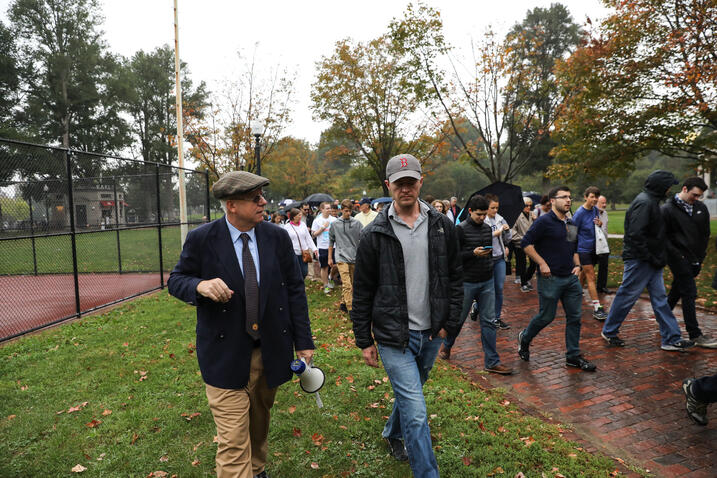
Your book The Essential Debate on the Constitution shows how divided the founders of the US were about how best to safeguard the rights of citizens, and what sorts of powers the federal government should have. What can we learn today from the way they navigated fundamental disagreements? Can we do so without sacrificing the rights—and sometimes the humanity—of marginalized groups, as some founders did with enslaved people?
I certainly hope so. One misconception about the founding is that everyone basically agreed. They did not.
Think of the Constitutional Convention. The Federalists proposed the Constitution in 1787 and thought they had done a good job. Almost immediately, however, people attacked and criticized it in ways the framers had not expected. When I teach the Constitution, I look at some of the powers it grants and think, “That could be dangerous.” People at the time saw those dangers too.
Even Thomas Jefferson found much to dislike. He objected that the president could be reelected indefinitely and believed the Senate might have too much power. John Adams worried about the balance of power as well. But the great public objection was the absence of a bill of rights.
The Federalists argued that a bill of rights was unnecessary because the new government had only limited, enumerated powers; any power not granted was reserved to the people or the states. People did not accept that argument. Any government, they said, would abuse its power, so the Constitution needed to specify fundamental rights that could not be abridged.
The Federalists countered that if the Constitution protected freedom of speech, for example, the government might claim the power to regulate any right that had been omitted. That argument did not persuade enough people. The real accomplishment was that the Federalists came around and agreed to adopt a bill of rights. They listened to the other side instead of dismissing its members as cranks and insisting that those who had attended the convention knew better. They recognized merit in their opponents’ argument.
That is something we need to do now. We should stop demonizing one another over disagreement and ask why someone holds a particular view and what that person hopes to achieve. We should not assume that everyone who disagrees with us is motivated by malice. People will disagree, and we have to allow them to do so. We must argue with and persuade them. It is not enough to wave a sign in the street, send an angry social media post, or try to get someone canceled. We must engage with why people think as they do and what they are trying to achieve, without assuming the worst possible motives.
The purpose [of the 250th anniversary commemoration] is not to suggest that the founders were better people than we are or merely to put up statues of Washington, Jefferson, and Madison . . . It is to learn from their experience.
What do you hope will come out of the 250th anniversary of the US’s founding? How can looking back help us become a better country today and in the future?
My great hope is that, 50 years from now, someone who watched the Henry Knox Trail commemorations will remember them. (That person will have to be considerably younger than I am!) In the meantime, I hope people will think about that kind of civic engagement—about a moment when ordinary people invested themselves in the political process and found a way to create a self-governing republic in which citizens could disagree. I hope they will become engaged in that process themselves.
The purpose is not to suggest that the founders were better people than we are or merely to put up statues of Washington, Jefferson, and Madison, although we should certainly commemorate them. It is to learn from their experience. They were not plaster models or demigods. They were people trying to understand a very complicated world and determine how to ensure that not only they but also their children and grandchildren would be able to govern themselves.
We need to keep that idea alive. We were fortunate to have the framers and founders. I know some scholars dislike those terms, but we use them so that we do not have to recite a list of names every time we discuss the founding. These people created something, and all of us are part of it.