Colloquy Podcast: What Was the Boston Tea Party Really About?
Vanessa Williamson, PhD ’15, says that the Boston Tea Party was indeed a protest about taxes—but not the way most people think. A tax policy scholar at the Brookings Institution, Williamson points out that the Patriots who dumped 342 crates of tea into Boston Harbor on December 16, 1773, were actually protesting a corporate tax break for the British East India Company, which had an effective monopoly on the sale of tea to consignees in the colonies. She discusses how the fight for taxation has been central to American democracy, liberty, and the pursuit of equality since the founding.
You begin your book with the story of the Boston Tea Party. Why doesn’t it demonstrate that anti-tax sentiment is in the country’s DNA?
I think most of us remember the story of the Boston Tea Party, right? The mechanics and artisans who went down to Griffin’s Wharf, boarded three ships in Boston Harbor, and took on the strongest, most powerful empire the world had ever known. But what most people probably don’t know is why the people of Boston were so angry.
I think most people would say it was about taxes, and that’s certainly true. But I think most people would assume it was about a tax increase. Quite the opposite. It was about a tax cut. The people of Boston were angry about a corporate tax break for the East India Company. And this tax break was intended to prop up a company—the East India Company—deemed too big to fail.
And there was a bailout. But along with that was a special tax break that gave this company an advantage selling in the colonies. And Sam Adams and the leaders of the Sons of Liberty said that this policy was “introductory of monopolies” and therefore a threat to public liberty. And so when the Bostonians boarded the ships in the harbor, they weren’t complaining that their taxes were too high. They were, in fact, complaining that taxes were too low.
Let’s take a step back from that specific episode and talk about your motivation for the book writ large. Why did you want to set the record straight on taxation in American history?
I think there’s a sort of common conception that we’re a nation of Grover Norquists, but in fact that is certainly not true. Americans are often willing to pay for tax increases. For example, they vote for tax increases directly in ballot measures all across the country on a regular basis. And so I wrote that book to talk about how Americans actually think about taxation.
And I realized that there was this parallel, right, that part of the myth that Americans hate taxes rested on the idea that our history is a long story of people fighting against taxes, when in fact our history is a long story of people fighting for taxes an awful lot of the time. And so correcting the record struck me as terribly important, because I think it really narrows our conception of what we can be if we don’t understand what we have been.
So the argument I make in the book is that people have fought for taxation when they have been fighting for democracy. And often that includes taxation of the rich, but it includes broad-based taxation as well. You see this, for example, during the Reconstruction period, our first experiment with multiracial democracy in America. The Reconstruction governments were dedicated to building a public school system for all children.
Most Southern states didn’t have a public school system, even for white children, before the war. And so now that we’re going to build this public school system, well, that took tax money, right? So critical to the idea of building a functioning democracy is being able to raise revenue. And again and again, wealthy people who did not believe in democracy have sought to undermine democracy, both directly by undermining elections, but also by undermining a tax system so that even if they lose an election, the government is too poor to threaten the power of private interests.
And that’s the story that’s been lost. And it’s the story that I think is crucially important at this moment in particular, even more than when I wrote the book only a year ago.
You’ve already started to talk at length about at least one historical episode, the Reconstruction years, and you argue more broadly that taxation shows up over and over at our country’s most consequential moments. I’d love you to talk about a couple of other episodes that you mention in the book, and we can start at the beginning. How does the question of taxation, particularly demands to make it more egalitarian, become central to US politics in the years after the Revolutionary War?
So there were sort of two threads to our politics in that period that are really significant. The first one you actually see in the development of the Constitution, right? Remember, we were in the Revolutionary War, and it was a number of years before we get the Constitution. We’re operating under the Articles of Confederation in that time, a weak system. Back then, Congress didn’t even have the power to raise revenue directly; it had to requisition money from the states. New York was at war with Vermont. There were any number of reasons that we really needed to build a stronger union. So it was clearly the case that we needed a constitution that united the states more completely.
But what happened was that the people who came together to write the Constitution came together in a particular moment when farmers had been revolting again, much in the way they had revolted against the British. They were revolting again, and again it was about taxes specifically, that they were being asked to pay taxes in what was called specie, which meant gold or silver coin, and they didn’t have any money.
You can imagine if you’re a frontier farmer, money doesn’t actually come into your daily life very often. You make most of what you need. You can trade with your neighbors. You can have a long-running account. But it’s not actually necessary to carry around cash the way that, obviously, would be true for more modern people.
So they didn’t need money very often except for tax time, and there wasn’t very much actual money. So what you had was a problem with deflation, or the opposite problem we have today. Let’s just say that money became much more valuable, and that’s a huge problem. For one thing, it made any debt you held more expensive. And it also meant that if you suddenly needed to pay a tax bill, over the year that tax bill would become more onerous because you would have to trade a larger amount of farm produce, let’s say, in order to get your hands on coins.
So this was a recurring problem. It had been a problem before the Revolutionary War. It was still a problem. And many of the states recognized this problem and allowed people to, for example, use paper money or pay their taxes in farm goods or use any number of other solutions that were possible. Some states did not do that. And where they did not make it easy for people to pay despite the currency shortage, they had revolts. People blocked roads. They tarred and feathered tax collectors, much like the stuff that they were familiar with doing when they were under British control.
And so it was with those revolts in mind, in particular Shays’s Rebellion and the one that occurred right before the meeting of the Constitutional Convention, that the members of the Constitutional Convention were designing a new government. And so they thought that they needed, for sure, a stronger government, but they also thought that they needed, with absolute certainty, a less democratic government because they did not trust these farmers. And they thought that if the power of the purse were in the hands of the people, they would print lots of paper money and taxes wouldn’t get paid.
And so they wrote a far more conservative Constitution federally than the states had. And so that has long-standing implications for the country, right? So that’s why you have a Senate with six-year terms. Hamilton once wanted the president to be elected for life. I mean, that’s how conservative the moment was. I think he was not in the majority in that view, but it gives you an idea of how much they wanted to consolidate power in the elite.
So taxes play into the early part of our history in that way. But at the same time, even though everyone sort of agrees that we need a stronger central government with the power to tax, in the Southern states there is a deep fear, because if the federal government has a strong power to tax, even if suffrage is limited only to propertied white men, most propertied white men are not slave owners.
And so there was a fear in the South that the power to tax would give the federal government the power to achieve abolition. “Abolition by taxation” is, in fact, a major argument that Southerners made against supporting the Constitution. And other Southerners said, no, no, no, we have adequate protections against that. And it was true. Madison said there were adequate protections against abolition by taxation. He was quite right. Every tax limitation in our federal Constitution was put in place by slave owners to prevent abolition.
So, for example, if you’ve ever heard that a wealth tax would be unconstitutional, the pretext for that is the direct tax clause, part of the compromise right there next to the three-fifths clause, part of the compromise that was intended to give Southerners an adequate feeling of protection that their enslavement of other people would be protected under this new government.
And so was the thinking then, when you say abolition through taxation, because enslaved people were treated as property and wealth, that that property would be taxed to the point where you simply couldn’t afford to have it anymore?
That was, in fact, eventually precisely the plan of a man named Hinton Helper, who was himself a white man and a Southerner from North Carolina. And he proposed precisely that: that we would simply raise taxes on the holding of slaves to a level where enslavers would have to free enslaved people.
And Helper is decried across the South. It was seen as this terrible, anarchistic policy. But Helper made that argument not because—and he’s very explicit about this in his book—he did not make it because he cared about Black people. He was very, very explicitly racist in this. But he makes this argument for abolition by taxation because he cares about white people, specifically white men, who he thought, and probably correctly from an economic perspective, couldn’t get ahead if they were not a part of the slave-owning class. How are you going to compete with people who literally weren’t paid?
So there’s this growing slave oligarchy in the South, right? And it was making life harder and harder for free whites. And it was those people he sought to protect. But Hinton Helper is fifty years later. The earlier generations absolutely foresaw this potential. Pro-slavery owners foresaw this potential. They imagined what would happen because slaves are very easy to tax. People are very easy to tax, right? There’s a poll tax, right? And so nowadays we think about the poll tax, and we mention it as being about voting. And that’s eventually how it’s used. But it’s a tax that dates back to antiquity. It just means that everyone pays the same amount, and “poll” was a synonym for “head.”
And so you would simply set an amount that every—usually male—person of working age would have to pay. It’s a very regressive tax, obviously, because it doesn’t take into account whether you are a poor man or a rich man. But it’s very simple, and it’s easy to count people. It doesn’t require a great bureaucracy. For example, if you actually want to assess the value of land, that requires a lot of expertise. If you want to keep an eye on paper wealth or the holdings of merchants, that requires a ton of expertise. But just going and counting a bunch of people was pretty easy. Almost anyone can do that.
And so it was easy to envision a tax that could achieve abolition. And because slave owners were terrified of that prospect, they undermined not only the tax capacity of our federal government, but also the tax capacity of their own states. Measures like the three-fifths clause reappear in state constitutions as well. And tax caps specifically and exclusively limited to enslaved people were also common, because there was this widespread understanding that if non-slave-owning white men recognized their economic interest, they would tax slavery out of existence.
So, there’s this inherent association of taxation with upsetting the racial hierarchy. Does that also carry into and through the Reconstruction years?
Black liberation has regularly been tied to questions of taxation. That was true from the beginning with the slave owners who were terrified of abolition by taxation. It’s true in the Reconstruction period when the goal was to use taxation to make public education broadly available and to encourage former slave owners to have to sell small portions of their land so that they could pay their land taxes.
It amounts all the way through the civil rights era, right? When we talk about the big investments of the War on Poverty, these are liberation goals, right? These are emancipatory goals. Taxation has that capacity and was used that way, of course. And I think what we’ve forgotten, but what is very obvious when you think about it, is that public goods—things like, let’s say, Social Security—can be emancipatory because they free you from the market.
If you are an elderly person today, you are freed from having to work until death. You’re freed from feeling yourself a burden on your children. These are freedoms, right? They are a way of achieving a kind of independence that—in fact, Social Security is obviously a very modern matter—but the earliest Americans would have understood that there was an independence necessary to be a citizen.
This is why Jefferson wanted everyone to have a small farm, because the idea was that it was with economic independence—when you didn’t have a boss, right, when no one owned you, when you weren’t in debt to anyone—that you were free enough to be a citizen because no one could intimidate you.
And so this idea of economic independence is something that can be achieved with taxation through welfare programs, and it is something that is central to a very, very common idea of what it means to really be politically free. And of course, in America, no conversation about political freedom can occur without discussing a long history of unfreedom that we imposed on certain people.
I’d love now to talk about a federal tax that I think impacts most people: the Sixteenth Amendment to the Constitution, the establishment of the federal income tax. So how was this a testament to, as you write in your book, popular demand for a more powerful role for the federal government in the economy? And how did the tax make that possible?
So I have to take a step back. In the Civil War, we had an income tax, right? And the courts deemed it constitutional. We had an income tax in the North, in the United States, and it was deemed constitutional. Right after the war, it was allowed to expire. But obviously the revenue needs of the federal government declined pretty substantially after winning the Civil War.
So some years later, the more populist elements of the country want to bring an income tax back. And the reason that people wanted an income tax—which was at the time a class tax, a tax that applied only to the really quite wealthy—is because you could offset the cost of the tariffs.
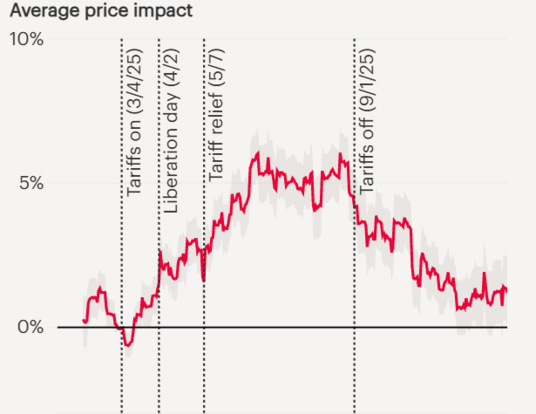
Now, I will say I spent seven years writing this book, and I genuinely did not foresee that the chapter on tariffs would be relevant. This is one of the chapters where, when you have to write a book, some of the chapters are like, oh, this really speaks to the contemporary moment. But no, I did not foresee this.
In any case, the federal government was funded largely by tariffs. And those tariffs do a couple of things. One, they fell heavily on consumers. Again, this will sound more familiar to Americans than I anticipated in writing the book. But tariffs fell heavily on consumers. And back then, because there were very, very high tariffs, they also encouraged monopolies. They were a huge advantage to domestic companies, obviously, and those companies tended to be companies that had an enormous share of the market—things like Standard Oil, the big trusts.
And so tariffs fell heavily on consumers. They fell heavily on farmers, who didn’t need tariffs to protect their goods. They could sell on a free market and be very effective. And so the income tax was understood as an alternative. It was a way of taxing those people who had benefited from all the tariffs, the wealthy industrial elite of the Northeast.
And so by the 1890s, the West and the South have come together to try and put in place an income tax. And it wasn’t a very high income tax. It was very close to the one that had existed during the Civil War. Well, times had changed on the Supreme Court in the intervening years. Even though the Supreme Court had ruled the income tax constitutional only a few years earlier, now we’re getting into the era of Plessy v. Ferguson. We’re getting into the era of the Lochner Court. We’re almost there. So we’re dealing with a vastly more conservative Supreme Court.
And the Supreme Court looks at the income tax and decides that this is the first step on the way to class warfare. And they declare unconstitutional the income tax that they had declared constitutional only a few years earlier. And they used what clause? The direct tax clause, the one that had been put in the Constitution as a compromise with slavery.
And this is a little bit in the weeds, but I’ll go through it. The direct tax clause says that any direct tax has to be apportioned by the population of the states. That is to say, larger states with a larger population have to pay more of any direct tax. Once the direct tax clause got into the Constitutional Convention, they never defined it. Someone asked, and no one answered. So then it’s left to the courts to decide what is a direct tax.
And the early courts looked at this issue and said, well, assigning a tax by the number of people in the state doesn’t make any sense. If you tax something that doesn’t vary with state population, it’s going to produce all these bizarre effects. So they decided that basically only two things were direct taxes: taxes directly on people—that was a poll tax, which would then be assigned by population, that’s fine—or taxes on land.
And that’s the rule for it until the 1890s, when suddenly they say, oh no, an income tax is a direct tax, and it has to be apportioned according to the states, which means that any state with a large number of people owes a large amount of tax whether or not they have anyone in the state who earns enough money to pay the income tax. It’s crazy. It doesn’t make any sense.
So they declare the income tax unconstitutional on the grounds that it would need to be apportioned, and it can’t be apportioned without being completely nonsensical. And that’s how they kill the income tax.
Well, you might think this was the end of the story, and they certainly thought it was at the time. But the Westerners and the Southerners did not give up. And there was, through the Populist Era and through the Progressive Era, a concerted campaign to bring back the income tax. And they’d have to amend the Constitution.
Eventually they get an amendment through Congress, mostly because Congress thinks there’s no way it’s going to get through the states, so they can put this in and look good, like they care about regular people, without actually having to ever see an income tax. But the income tax is enormously popular. It passes some state legislatures by acclamation; then they don’t even count the vote. Everyone loved it. They cheered in Oregon. It took them longer to decide who would be the third guy in line to open the door for the chamber. They loved the income tax so much.
And socialism in the West is strong too. The states that love the income tax are similar to the states that loved Eugene Debs. In any case, we end up getting the income tax a lot further through the states than some of the conservatives might well have thought. They’re sure they’ve got a bulwark in the Northeast, right? States like New York, states like Ohio, where there are genuinely very, very rich industrialists—John D. Rockefeller, for example—these states are going to hold the line.
But the income tax is too popular. Even for all of John D. Rockefeller’s wealth, which he poured into anti-tax campaigns, even with Rockefeller behind it, the income tax was simply too popular with regular people not to win. And so eventually—it took twenty years—but eventually we got an income tax, and it was just in time for that income tax to play a major role in the funding of World War I.
You’ve made a historical case for the popular support of taxation in US history. But if all you say is true, where does this anti-tax narrative come from, and why has it been so powerful, really since the anti-tax revolt of the late 1970s?
The anti-tax rhetoric that played an important role in helping overthrow Reconstruction after the Civil War reemerges almost instantly after the second Reconstruction, the civil rights movement. All that talk about lazy government workers and how benefits that you earned, you taxpayer, are going to welfare queens—right? Exactly the way that the phrase “welfare queen” is racialized, “taxpayer” becomes racialized.
And that rhetoric is something that for decades egalitarian, racial egalitarian, economic egalitarian movements struggled to overcome. And so you see this great shifting of the white middle class. And that class had benefited hugely, right? The existence of the white middle class is due in large part to vast government interventions, things like the GI Bill, in the midcentury.
But now, when those benefits are at least in principle the kind of benefits that midcentury white Americans were used to, and they might be extended to Black Americans, suddenly they’re taxpayers. Suddenly that’s taken from me and given to someone else whom I do not see as part of my community.
And you see that rhetoric, of course, first with Goldwater. And Ronald Reagan was a huge fan of Goldwater. He was one of the few people who would support him. Goldwater was very extreme in his time. By the late 1970s, as the sort of boom of the midcentury years declines, the kind of coded racist rhetoric that attacks the idea that government can help people becomes something very mainstream.
At the same time, you’re seeing the beginning of that consolidation of wealth. It’s reached unimaginable proportions today, but you see the beginning of that by the late 1970s. So you’re seeing business interests that are becoming more powerful, labor interests that are becoming weaker, and this poisonous rhetoric that on its surface is just complaints about taxation. And who doesn’t have complaints about tax? It’s very irritating to pay taxes. You do the paperwork. It’s very annoying. Everyone has a reason to be annoyed about one thing or another through taxation.
But channeling those very normal irritations into a startlingly broad critique of the concept of government—and not just the concept of government, the concept of democratic government, the concept that the people could be trusted to assign money, right, because that’s what taxes are. Taxation is the only money in our economy that is allocated, at least in principle, according to the popular will.
And what the rhetoric of the Reagan era, which grew ever more extreme in the decades that followed, said was that that wasn’t possible. And we couldn’t trust the people. The government that was supposed to belong to us wasn’t for us; it was for some nebulous other. And increasingly, I think the nebulousness has faded, but the idea remained, right? And you see that get stronger and stronger.
You can look even at moderates like Mitt Romney, who talked about the 47 percent, right? Forty-seven percent of Americans didn’t pay net federal income taxes. This is true of about 47 percent of households. And he said that he didn’t have to worry about them and that these were the people who were always asking for something from government and never paying in. That’s a huge percentage of Americans. But somehow it had become normalized to treat a large swath of the American public as undeserving, both of benefits and eventually of representation at all. And I think that’s how we got to where we are today.
I’m wondering how you see the present moment and going forward. On the one hand, it seems like concerns about inequality on both the left and the right are rising. Could we be moving beyond the anti-tax era? And if we were, what would that mean for the economy and for democracy in the US?
To go back to Reconstruction, which in broad strokes I think is a really valuable way to think about the contemporary moment, at first the Redeemers, the people who overthrew the Reconstruction governments, talked about themselves as taxpayers, right? But over time they became more and more explicit about what they really meant. And what they really meant was that they wanted to exclude Black people and poor whites from government.
So you see all-white primaries. You see grandfather clauses. And increasingly it’s made clear that this is supposed to be government for the few. And the taxpayer rhetoric falls by the wayside. And I think you’ve seen a similar pattern here.
I think it is the challenge of our time to defeat that. I also think there’s no two ways around it, right? The challenge of our time is to preserve the rule of law, preserve the basic sense that the people who live in the United States are all equal before the law, and that is our great challenge.
But I think one part of the effort to rebuild a functioning democracy in this country will require not the right to change its rhetoric on taxes, but the left. Even to this day—I should say at a state and local level, governments deal with this all the time. Do they say they have to raise taxes? Yes, because they do, or else they will have to shut down the schools or turn off the sewer system or something like this, right? So state and local governments are regularly honest and open about the fact that sometimes everyone needs to pay taxes.
The federal government, they have pretended that this is not true for generations now. Democrats talk about raising taxes on the rich, which is certainly a good idea, you know, because of economic inequality and so forth. But they are extremely hesitant—in fact, it is anathema—to ever say you ought to raise taxes on regular people.
But if you’re going to defend the idea that government is worthwhile, you have to say it’s worth paying for. And to me, that’s the fight over taxes to come, right? Are we ever going to have a party that actually defends government? If you want to rebuild things that were destroyed by Trump, if you want to have the kind of science that America funded since the Cold War, if you want to have any of those things again, we’re going to have to explain to the American people that they were worth paying for.
And so that, to me, is the great challenge ahead.