A Big Picture Approach to the Brain
Kranz brings the creativity and holistic thinking she developed growing up in a Hasidic Jewish community to research on the neurological health of children.

The study of Rett syndrome, a rare neurological disorder, became deeply personal to neuroscientist Devorah Kranz after she became pregnant in the last year of her PhD program. Her research required her not only to collect and work with data but also to meet families participating in her study, including many children with the disorder.
“These children often do not speak, and they have issues with movement, autonomic function, and many other things,” she says. “Life ends up looking very different from what their parents thought it would look like. And Rett syndrome is usually caused by a de novo mutation, meaning it arises spontaneously rather than being passed down from a parent. It is not something you necessarily know is coming. Running that study, interacting with those children and their families, and seeing what they had gone through while I was pregnant myself was—I don’t even know the word for it. But it was an experience.”
All went well for Kranz, who delivered a healthy baby girl in October 2025, only days after she defended her PhD dissertation at Harvard Griffin GSAS. Today, she brings her concern for the health of children—as well as the creativity and big-picture thinking developed during her upbringing in a Hasidic Jewish community—to the study of the brain at Boston Children’s Hospital and Harvard Medical School (HMS). By identifying biomarkers of Rett syndrome, Kranz is deepening scientists’ understanding of a much more common condition: autism.
Found in Translation
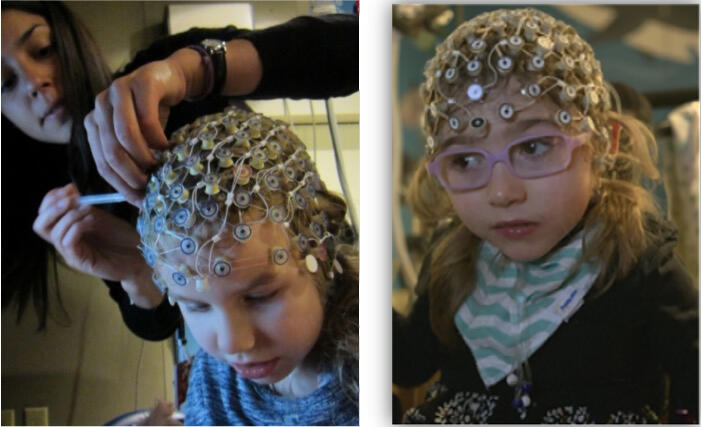
Rett syndrome is most commonly caused by a mutation in the MECP2 gene. Mouse models recapitulate many key features of the disorder, making it a strong candidate for studies that aim to translate systems-level insights from animal models to humans. Focusing on electroencephalography (EEG)-based biomarkers, Kranz searched for clues about the underlying neurobiology of sensory-processing differences that could be observed behaviorally.
“The brain has to be exquisitely coordinated when it responds to a stimulus,” she explains. “Sometimes, you can see that a stimulus has an outsized effect—for example, certain sounds may be overwhelming, while another stimulus, maybe even hearing one’s own name, may produce very little response.”
In some cases, Kranz notes, individuals can show both heightened and diminished responses to different sensory stimuli, or even to the same type of stimulus at different times. “Some of it has to do with salience, but some of it may also have to do with differences in how the brain balances excitation and inhibition, which may in turn reflect differences in how consistently the brain processes sensory input and coordinates its responses across regions and over time.”
Kranz’s research identified differences that may serve as candidate biomarkers of underlying circuit dysfunction. Many were related to increased variability and reduced temporal consistency in how individuals with Rett syndrome process stimuli compared with typically developing individuals. Other findings pointed to specific circuit mechanisms, including VIP interneuron dysfunction, creating opportunities to go back and test those mechanisms in animal models.
[Kranz] revealed previously hidden features of brain dynamics that may serve as scalable biomarkers for clinical trials and precision therapeutics.
—Harvard Medical Professor Michela Fagiolini
Michela Fagiolini, associate professor of neurology at HMS and Kranz’s PhD adviser, says that her former student’s work helped demonstrate that altered temporal coordination of neural activity—not simply weaker brain responses—may underlie sensory abnormalities in Rett syndrome. “Through advanced analyses such as inter-trial phase coherence and phase–amplitude coupling, she revealed previously hidden features of brain dynamics that may serve as scalable biomarkers for clinical trials and precision therapeutics.”
One of the reasons scientists are interested in Rett syndrome is that many individuals with the disease have symptoms that overlap with autism and meet criteria for autism spectrum disorder. Because idiopathic autism is genetically complex and heterogeneous, with contributions from many genes rather than a single cause, it can be challenging for scientists to study. So, researchers often focus on monogenic disorders like Rett syndrome that are related to autism in order to better understand the underlying neurobiology and potentially identify biologically defined subgroups within the spectrum.
“You can work with a more genetically defined group of individuals and also use a corresponding mouse model based on the same gene,” says Kranz. “The hope is that studying those systems can tell us something about underlying neurobiology that is relevant to some subgroups within autism spectrum disorder, and perhaps help identify those subgroups based on objective neural signatures.”
Charles Nelson, professor of pediatrics and neuroscience at Harvard Medical School and another of Kranz’s mentors, says her discovery of sensory sensitivities in the auditory and visual domains does indeed have important implications for understanding autism. “We know a great deal about the molecular biology of Rett and the pathways the mutation in the MECP2 gene impacts,” he notes. “Having worked this out in animal models, Devorah’s dissertation demonstrated how these alterations impact sensory functioning. Many children with Rett look as though they are autistic; Devorah’s work unpacks a defining feature of autism.”
With this work, Kranz also hopes to bridge the gap between laboratory and clinical research. “Sometimes we talk about this in my lab as ‘forward and back translation,’” she explains. “Rather than having one world of functional magnetic resonance imaging and cognitive neuroscience in humans and another world of neurobiology in animal systems, what if we could really move back and forth between them—take what we know from animal models, test it in humans, and then bring those insights back again?”
This translational research—integrating clinical EEG recordings with computational and mathematical modeling—was one of Kranz’s most important contributions to her field, according to Fagiolini. “By combining human neurophysiology with biophysically grounded models of cortical circuits, Devorah helped connect large-scale brain signals measured in patients to specific cellular and circuit mechanisms that could be tested experimentally in preclinical models,” she says. “Her work exemplifies truly bidirectional translational neuroscience. This iterative approach is exactly what the field needs to accelerate therapeutic development.”
Many children with Rett look as though they are autistic; Devorah’s work unpacks a defining feature of autism.
—Harvard Medical School Professor Charles Nelson
Finding Her Footing
Kranz’s work and life path are great departures from her upbringing in a Hasidic Jewish community that stressed religious education and provided relatively little exposure to science. “I grew up in Virginia in what is called a Chabad house, a center or outpost that my parents ran, and that involved community building,” she says. “My dad is a rabbi. My mom ran a Jewish preschool. My life was full of holiday-related activities, conversations with people, programs, and big Friday night dinners for Shabbat.”
Kranz says she started at “a fairly regular” Jewish day school, but when she and her older brothers reached high school age, they were sent away for an education more closely aligned with the values of Chabad and Hasidic Judaism. “There came a point when the expectation was that I would go immerse myself in that world and be part of it more fully,” she says.
During her high school years, Kranz focused on Hasidic thought, philosophy, theology, and the teachings of the Hebrew scriptures. The education was intellectually rigorous but provided limited exposure to math and science. After graduation, Kranz attended seminary. “That was what everybody did after high school,” she says.
Women do not serve as rabbis in the Hasidic tradition, so Kranz’s seminary education was preparation for Hasidic life as a woman and Chabad outreach—a path she was unsure she wanted to pursue. Before finishing her first year—and with mixed reactions from her family and her peers—she decided to apply to college instead, eventually choosing Brandeis University.
Although a nonsectarian school, Brandeis was renowned for its high proportion of Jewish students and strong Jewish life on campus. For Kranz, though, it was a culture shock. “It was not Hasidic,” she says. “It was a different kind of Jewish environment than I had ever experienced, and that was difficult. I didn’t really know what to make of anyone, and no one really knew what to make of me. I struggled to find a sense of belonging and to find my footing there.”
A Big Game of Catch-Up
Kranz initially majored in philosophy, a subject for which her religious education had prepared her well. Still, she hungered for a different kind of study, so she enrolled in a range of introductory science courses. “It truly felt like the other students were speaking a language I did not know,” she says. “There were basic scientific concepts I simply did not understand. It was one big game of catch-up for a long time. But it was also magical, learning everything from the ground up and being exposed to science and scientific ways of thinking.”
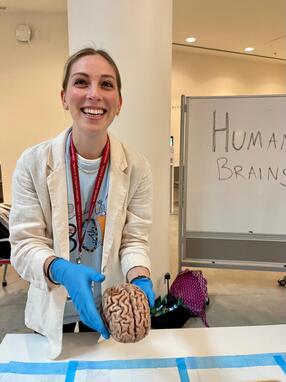
Challenged by the work in her Principles of Neuroscience class, Kranz reached out to the course leader, Eve Marder, Brandeis’s Victor and Gwendolyn Beinfield Professor of Biology. The connection was a turning point in her education and career. Marder offered Kranz a position in her lab and became a mentor, supervising the student’s honors thesis.
“Eve taught me how to think about science,” Kranz says. “We would dissect the nerves of crabs and use electrodes to measure what cells were doing, then perturb the system with things like temperature and neuromodulation and see what happened. I would watch action potentials in real time on the screen and just think, ‘How am I here? How am I allowed to do this?’ It felt like I was at some extraordinary place I had never imagined I could inhabit. That was how I started, and I thought, ‘I am never going to do anything other than this.’”
Work with Marder at Brandeis led to a position in the lab of Michael Long, Thomas and Suzanne Murphy Professor of Neuroscience and Physiology at New York University, where Kranz studied the motor pathways involved in the singing behavior of zebra finches. Like Marder, Long served as another critical mentor, teaching Kranz in vivo experimental techniques and rigorous scientific thinking. With his encouragement, she applied to PhD programs, eventually enrolling at Harvard Griffin GSAS.
“Long basically said, ‘You are obviously good at this. You are obviously going to do a PhD.’ And I was like, ‘A PhD?’ I never really imagined that,” Kranz says. “By that point, though, I realized I had found this extraordinary niche in the world where you could probe questions, generate new knowledge, ask things about the brain, and do experiments to find answers. And people would fund this. There were labs that did this. It was amazing to me.”
Mystery and Wonder
Building on her early work probing how neural circuits give rise to behavior, Kranz wanted to move into human studies, bringing together different advisers across basic and translational neuroscience. Working with multiple mentors as a PhD student at Harvard and Boston Children’s Hospital—including HMS Assistant Professor of Neurology April Levin, as well as Fagiolini and Nelson—had its challenges. But Kranz says it also stimulated her thinking and afforded insight into discrete aspects of her project, enriching both her academic work and her overall experience at Harvard Griffin GSAS. “My PhD advisers were incredibly willing to teach more about another new world—human-subjects research,” she said. “They were amazing mentors and teachers.”
The tradition I grew up in is mystical. There’s a lot of thinking about big systems, a lot of wrestling with ideas and trying to make sense of how things fit together. I came to see that I may actually be bringing something unusual to the table—a certain creativity, a way of seeing systems, a kind of big-picture thinking that not everyone necessarily has in the same way.
—Devorah Kranz
Although her upbringing and schooling may have created a steeper learning curve for Kranz than other aspiring scientists, over time, she realized that the perspective she brought to the lab could also be an asset. “The tradition I grew up in is mystical,” she says. “There’s a lot of thinking about big systems, a lot of wrestling with ideas, and trying to make sense of how things fit together. I came to see that I may actually be bringing something unusual to the table—a certain creativity, a way of seeing systems, a kind of big-picture thinking that not everyone necessarily has in the same way.”
Today, Kranz is focused on postdoctoral projects, publishing research, and enjoying the joys of parenthood—perhaps the greatest of which is seeing the look of pure wonder in her daughter’s eyes. It’s how Kranz, who remains involved in her religious tradition and close to her family of origin, feels about science.
“When I was a teaching fellow, I used to tell my students, ‘I don’t know if you all realize this, but this is quite incredible!’” she says, referring to a concept in the Harvard undergraduate Neuroscience of Behavior MCB80 course, which she taught for several years. “Watching my daughter develop, I feel as if I’m learning about neuroscience all over again. I’m watching her brain observe the world, make connections, and develop skills in real time. And I can imagine one day talking about it all with her and feeling that wonder bubbling up again.”