How to Discover a New Species
Arianna Lord, PhD ’25

Originally from New Zealand, Arianna Lord graduated from the Harvard Kenneth C. Griffin Graduate School of Arts and Sciences in November 2025 with a PhD in organismic and evolutionary biology. She discusses her journey from New Zealand to Cambridge, the strangeness of velvet worms, and why you shouldn’t bring up species with an evolutionary biologist.
From New Zealand to North America
I'm from New Zealand—that's where I was born, and where I grew up. I think people generally care about the environment and live much closer to nature there. The elementary school I went to was literally on the beach, so we would go snorkeling and go look in the rock pools as part of class. I think that creates curiosity and encourages an interest in the natural world.
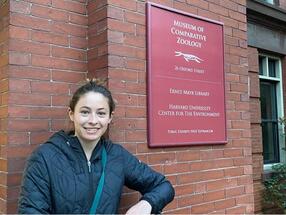
I came to the United States when I was 19 for my undergraduate degree at Yale University, where I studied geobiology and paleontology. I was always interested in pursuing science beyond an undergraduate degree, but I wasn't sure in what capacity, so I tried to get as many different opportunities as possible to experience different types of research and science. I worked in a geochemistry lab, a developmental biology lab, and the collections at the Yale Peabody Museum of Natural History in vertebrate paleontology and then invertebrate zoology, just trying to see what everything was like.
In my junior year, I took two great courses in invertebrate zoology and comparative genomics, both taught by Professor Casey Dunn. These classes opened my eyes to the diversity of life on Earth and the different ways in which researchers use genomics to better understand organisms and evolution. That's what got me hooked. When it came time to decide what I was going to do for my PhD, I knew the Department of Organismic and Evolutionary Biology (OEB) at Harvard was a good fit after my first visit. I also wanted to be able to keep working closely with a natural history museum, and Harvard has the amazing Museum of Comparative Zoology.
The elementary school I went to was literally on the beach, so we would go snorkeling and go look in the rock pools as part of class.
Weird Worms
During my PhD, I was focused on developing genomic resources and tools to better understand little-studied invertebrate animals. There's a lot of fantastic research that's been done on humans and other vertebrates like mammals and birds, but there's this huge other part of the tree of life that is not studied quite so much. Having genomic-level data to analyze the genetic code of these invertebrates can provide a lot of insights to the evolution of diversity.
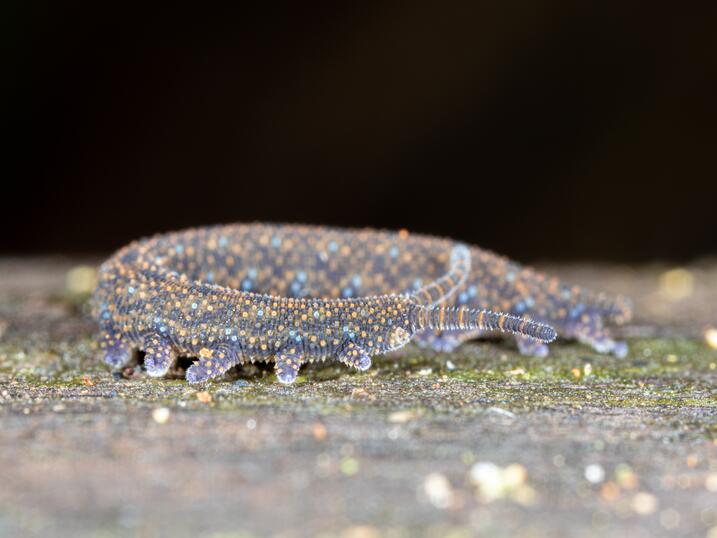
For my dissertation, I wanted to explore species relationships and boundaries in the context of geography. What are the drivers of biodiversity? I focused on velvet worms, an incredible group of animals that look like worms with legs, but they are neither worm nor insect; they are entirely their own unique group. They have an interesting global distribution and large, complex genomes. Historically, this has made working on them quite challenging, but now we have new technology for genomic sequencing. I was mainly focused on species in Australia and New Zealand and how the distributions of different species align with different kinds of geographic features in the landscape. Through that, we also discovered and described new species from Australia.
I focused on velvet worms, an incredible group of animals that look like worms with legs, but they are neither worm nor insect; they are entirely their own unique group.
I was interested in these broader questions of biogeography, but also in the organismal group themselves, because they're so weird, and we have so much to learn about them. They have these stumpy little legs with retractable claws, like a cat. They also have these organs, kind of like glue guns that shoot sticky, gluey slime from their faces, which they use for defense, but also to capture prey. Some species lay eggs, others give birth to live young. We are still trying to understand from both ecological and genomic perspectives why and how these different characteristics have evolved.
What Is a Species?
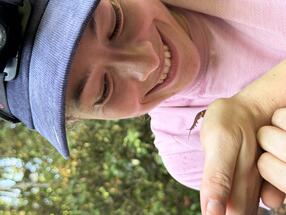
Species are the units we use to understand biodiversity, so you can't protect or conserve biodiversity, or you can't protect or conserve a species, without it having a name or being properly described. That's probably the outcome that's most exciting: we're able to contribute to our understanding of these animals, for who they are, and for conservation purposes as well. Since these animals are somewhat rare, names and descriptions give them important recognition.
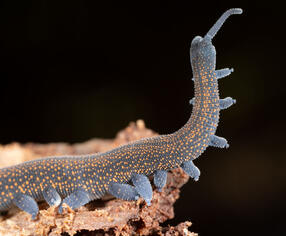
We're discovering and describing a lot of species today thanks to having genomic data that allows us to better understand who's who. With “cryptic species,” animals look very similar, but when you check their DNA you can see that genetically they’re quite distinct. In other cases, as with some of these worms, they're both genetically and morphologically distinct, but the genetic data can help guide us and reveal groupings that would take a long time to identify with morphology alone. To describe a new species, you should compare it to all other closely related ones in its genus. This involves dedicating time to finding animals in their natural habitat to use as representatives and tracking down older museum specimens. In my work, we’re finding new species across Tasmania. It is exciting since we don’t know how many there truly are; you feel a bit like a detective piecing together different lines of evidence.
My understanding of what a species is has become a lot more nuanced throughout my PhD. I had the opportunity to reflect on how, as humans, we try to categorize and classify and organize nature in our attempts to understand it, yet often nature and life don't squarely fit into categories. It is a joke in our department to never bring up the concept of a species, because as evolutionary biologists, you could debate and discuss for hours, since what defines the boundary between one species and another varies so much based on data and what organism or group you work on. I think it's a great example of how malleable concepts in science can be, and also how important it is to discuss them and how small, incremental steps are often necessary to develop our understanding of something.
With “cryptic species,” animals look very similar, but when you check their DNA you can see that genetically they’re quite distinct.
The Importance of Hands-On Learning
My advisor is Gonzalo Giribet, who is a professor in OEB and the director of the Museum of Comparative Zoology. I feel fortunate to have had him as a supervisor over the course of my PhD. He encourages not just me, but all the students in his lab to see their research from an organismal perspective and develop experience across sub-disciplines that are important for our field. This involves fieldwork, working with museum specimens, spending time at the microscope and in the lab with DNA and molecular research, and also conducting bioinformatic analyses with all the genomic data. I think being encouraged to explore these areas and methods of research has given me a good foundation as a scientist.
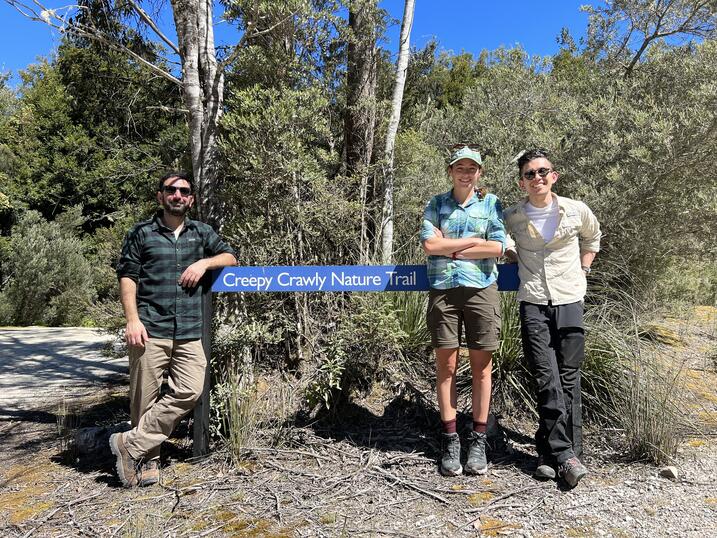
A highlight has been doing fieldwork with my supervisor and lab mates in many far-flung places all around the world, including Australia, New Zealand, Singapore, Panama, and Belize. There's no better way to understand biodiversity than being able to see these organisms in their natural habitats. I'm very grateful for the opportunity to conduct all this fieldwork as part of my PhD. I think a huge advantage of the OEB program is that you have the space to develop your own project, within the bounds of your lab. I was interested in exploring the biodiversity of Australia, and New Zealand in particular, so when I was starting to plan my project, that was always on my mind. It means a lot to me to be able to contribute to our understanding of animals in our little area of the world.
In addition to doing my own research, I’ve enjoyed being a teaching assistant for different courses while at Harvard, including OEB 51: Biology and Evolution of Invertebrate Animals, which was right up my alley. Every week, we had a lab section where we brought in live animals and museum specimens from different animal groups that we discussed in lecture that the students then got to observe. In addition to that, the course had a week-long field trip where we went to the Smithsonian Tropical Research Institute and went snorkeling all week to give the students an opportunity to see and study animals in the field.
There's no better way to understand biodiversity than being able to see these organisms in their natural habitats.
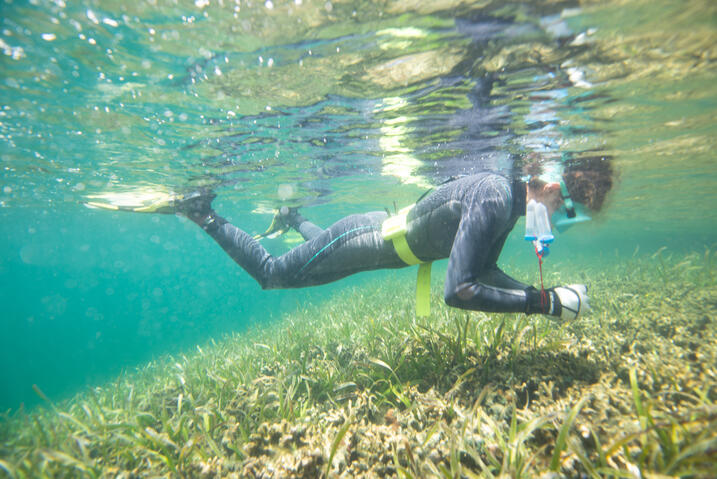
I think these experiences—taking learning outside the classroom and being able to observe students interact with course content in such a hands-on way, seeing the moment where they connect what they heard in lecture to what they're seeing in person—are very rewarding from a teaching perspective. It's a reminder that cultivating opportunities for curiosity and exploration is a big part of learning and understanding, and a starting point for a lot of great questions in invertebrate zoology and other fields as well.