Tackling Drug Resistant Tuberculosis
Three-Minute Thesis winner identifies genetic mutations to improve personalized TB treatment

Tuberculosis (TB) is the deadliest infectious disease in human history, claiming more than a billion lives since its scientific discovery in 1882. Though TB is both preventable and treatable, it has remained a persistent health threat: around 1.23 million people died of TB in 2024 according to the World Health Organization; 80 percent of those deaths were concentrated in low- and middle-income countries.
One reason TB continues to proliferate is the bacterium’s ability to mutate and become resistant to antibiotics. “About 1 in 25 cases of TB will be drug resistant, meaning the standard treatment regimen will not work,” said Abigail Frey, a PhD student in biological sciences and public health. “The good news is, many forms of drug-resistant TB can still be treated if properly diagnosed. The best way to perform this diagnosis is by screening the DNA of the bacteria for drug resistance mutations. But the bad news is that we don’t know all of the mutations to look for.”
Frey’s words were delivered recently to a rapt audience in Sever Hall 113 during Harvard’s second annual Three-Minute Thesis (3MT) competition. While the 180-second talk made her the contest’s winner, Frey says the real prize she’s seeking is the identification of mutations that characterize drug-resistant TB, leading to more effective treatment and fewer deaths.
Death Benefit
In addition to being the world’s most deadly infectious disease, TB may be its most costly. A 2021 study in The Lancet Global Health estimated that, without new interventions, the world would see “31.8 million tuberculosis-related deaths between 2020 and 2050, resulting in economic losses of $17.5 trillion.”
Each year, millions of newborns and children receive the Bacille Calmette-Guérin vaccine, which protects them against severe forms of TB, including TB meningitis, but does not prevent adults from contracting pulmonary TB, the primary cause of death. And while those infected with a drug-resistant strain make up only 1 in 25 cases of TB, they account for 1 in every 8 deaths from the disease.
Frey, who works in the lab of Harvard T.H. Chan School of Public Health Professor Sarah Fortune, says Mycobacterium tuberculosis (M. tuberculosis) has been evolving in humans for thousands of years. Researchers can identify exactly how the TB bacteria are changing by looking at the DNA of the bacteria from patients with the disease. “Previous work in the Fortune Lab has identified certain genes that have mutated over and over again in different people,” she says. “That is really a signal that these mutations are benefiting the bacteria.”
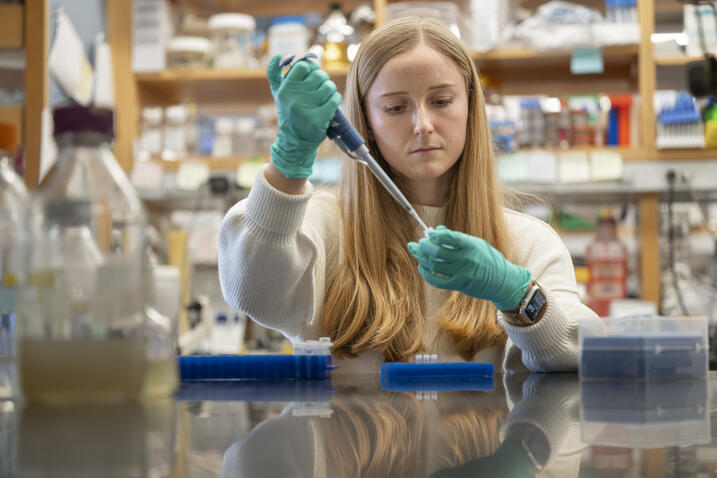
In her PhD research, Frey studies how these mutations allow some TB bacteria to survive while others are killed off by antibiotics. “We don't yet understand all of the ways that M. tuberculosis evades treatment. I'm working to close that gap.”
Using a mix of computational and lab-based techniques, Frey analyzed massive datasets of tuberculosis DNA sequences from patients around the world. “With this approach, I identified a new gene that, when mutated, is associated with an increased rate of treatment failure.”
A Cure, without Delay
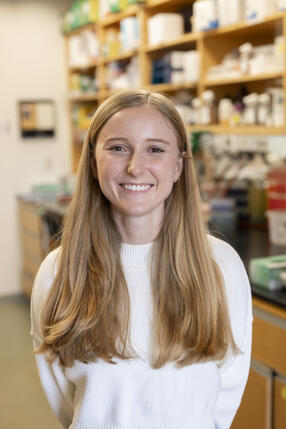
To test her findings, Frey introduced a clinically relevant mutation—that is, one that occurs naturally in patients—into a sample of TB bacteria. “I found that these mutations do cause resistance to multiple drugs in the standard TB treatment regimen,” she said in her 3MT talk. “And, by further studying M. tuberculosis in the lab, I’ve also identified the ways in which the mutation weakens the bacteria.”
Frey’s advisor, John LaPorte Given Professor of Immunology and Infectious Diseases Sarah Fortune, says her student’s work has the potential to make existing medicines more effective by matching them with the particular strain of TB present in a patient.
“The conventional way of testing M. tuberculosis or any bacterium for drug resistance is to see if it will grow in the presence of drug,” she explains. “The problem is that TB grows so slowly, this testing can take one or two months or even longer, which is a clinical nightmare. People can accumulate new drug resistances or even die before they are put on the right drugs. Abigail’s research is trying to define the novel antibiotic escape mechanisms by combining population genomics and bacterial genetics, which then helps build the roadmap for genetic diagnostics for patient use.”
Frey says the move toward more comprehensive genetic testing for drug resistance could make TB diagnosis and treatment far more efficient—and effective. “The ultimate goal is personalizing TB treatment, ensuring the highest chance of cure on the first attempt.”
Abigail’s research is trying to define the novel antibiotic escape mechanisms by combining population genomics and bacterial genetics—which then helps build the roadmap for genetic diagnostics for patient use.
Professor Sarah Fortune
The Challenge of 3MT
Frey was one of 10 finalists who presented condensed versions of their research at 3MT, a competition for master's and PhD students to develop and showcase their research communication skills in a language appropriate to a non-specialist audience. Participants had three minutes to communicate their research with the visual aid of one static slide. Prize-winners received a cash award or lunch with Harvard Griffin GSAS Dean Emma Dench.
This year, materials science student Sofia Edgar took second place for her talk on designing better batteries for a renewable energy future. Third place went to Near Eastern languages and civilizations student Masoud Ariankhoo, whose research explores how notions of Satan developed in medieval Islam. Kai Krautter, an organizational behavior student, claimed the Audience Choice Award for describing how great passion for one’s work does not always equate to better performance.
Christopher Brown, PhD ’15, associate director of Harvard Griffin GSAS’s Fellowships & Writing Center, the staff of which coached the 3MT finalists, says he and his colleagues were captivated by the participants’ insightful and impactful research.
“We were impressed by the depth and breadth of their talks, as well as by the enthusiasm of the audience, which was especially evident during the Q&A session,” he says. “These students, representing a wide range of disciplines and areas of expertise, represent the brilliance and dedication of the Harvard Griffin GSAS community. Congratulations to all of the finalists!"
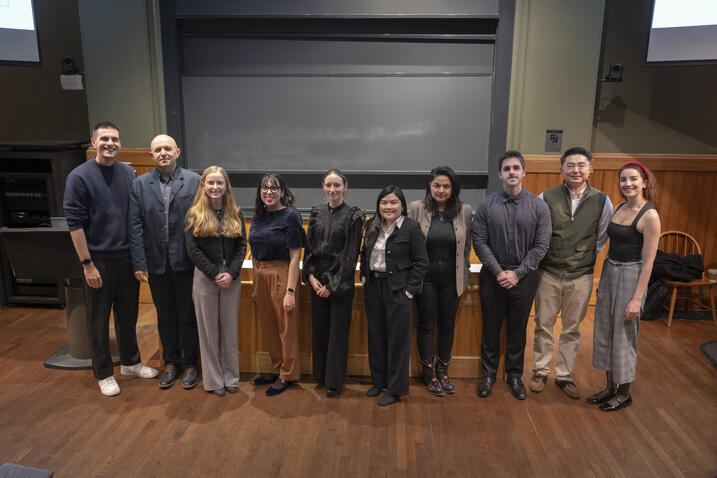
Frey was delighted, if a bit stunned, to win this year’s competition. Describing herself as “not the most confident public speaker,” she says she applied to 3MT to get better at presenting her work concisely to audiences outside her field. “Although I was nervous, I really thought it would be a great opportunity to put myself out there and gain some confidence in public speaking.”
We were impressed by the depth and breadth of [the Three-Minute Thesis] talks, as well as by the enthusiasm of the audience, which was especially evident during the Q&A session.
Fellowships & Writing Center Associate Director Christopher Brown
What made it possible for Frey to meet the challenge of 3MT, she says, was the support and training she got from the FWC. “We received one-on-one mentoring,” she says. “I was really lucky to work with [Fellowships & Writing Center Director Dr. Jeannette] Miller. The FWC helped all of us with our slides and also with editing our talks to make sure that they were clear and appropriate for the audience. They even provided a workshop on speaking with [American Repertory Theater lecturer and dialect coach] Erika Bailey, who taught us about handling nerves and speaking eloquently.”
In addition to a cash prize of $1,000 and the opportunity to advance to the Northeastern Association of Graduate Schools competition in late April, Frey says her 3MT experience gave her a better appreciation of what’s involved in high-quality science communication. “What my field cares about is a lot different than what a broader audience cares about,” she says. “A great deal of feedback and critical thinking went into revising my talk. I know I will look back on what I learned from this process when preparing for future presentations.”
To Eradicate TB
In the fifth year of her program, Frey says she plans to continue her PhD work at Harvard for at least another year. She hopes soon to publish her research in a scientific paper. In the meantime, she is studying some other TB genes and the benefit their mutations confer on the bacteria. “I’m really excited about this work,” she says. "I hope to stay in academia and keep doing important and interesting science.”
Ultimately, Frey hopes her research can spare some of the more than 125,000 people each year who die from drug-resistant TB.
“Of course, the dream is to eradicate TB, if that is possible,” she says. “Identifying drug resistance is not the only thing that would be required to get us there. Significant public health measures would be necessary. But if we were able to more efficiently and effectively treat drug-resistant TB, it would certainly help.”