What Really Influences American Public Opinion on Ukraine?
Pereverten explores what inspires US citizens to support Ukraine in order to aid in her country’s resistance

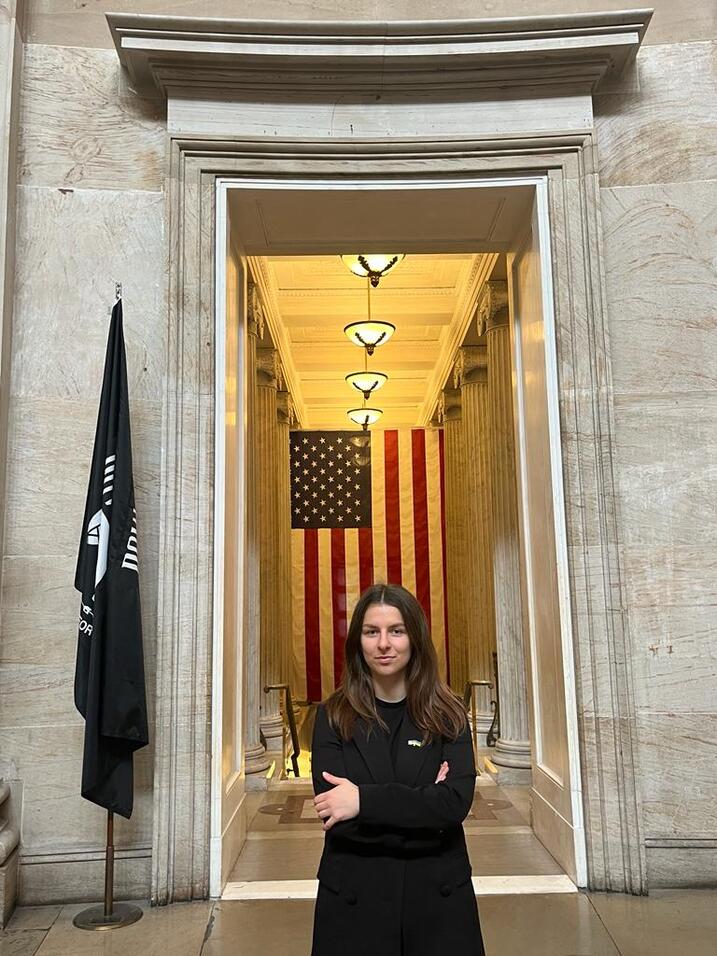
A native of the Ukrainian capital of Kyiv, Anastasiia Pereverten’s education and professional journey have been shaped by the war that began in 2014, when she was 12 years old. A student in the US since 2022, just before the launch of Russia’s full-scale invasion, Pereverten says she understands the position of privilege that she occupies.
“I’ve been home for months at a time, and I’m in everyday contact with my family,” she says. “But I didn't live through everyday blackouts. My life wasn't threatened by nightly airstrikes. . . . So, when you ask me, ‘How are you holding up?’ I think, ‘If my mom and my brother and my dad and my grandparents are going through that, being there, I surely can do it being here.’”
After she graduates from the Harvard Kenneth C. Griffin Graduate School of Arts and Sciences in May 2026 with a master’s degree from the Regional Studies: Russia, Eastern Europe, and Central Asia (REECA) Program, Pereverten will return to Kyiv. When she does, she will take with her new knowledge of how public opinion is formed and what motivates those in the US to support her country’s resistance—and act on that conviction. With Russia’s full-scale invasion of Ukraine now in its fifth year and aid from the US flagging, Pereverten’s efforts couldn’t come at a more critical time.
Incredible Support
Pereverten first came to the US in January 2022 as an exchange student at the University of Wyoming (UW) in Laramie. In February, Russia launched its full-scale invasion of Ukraine. As the only Ukrainian student at UW, Pereverten rallied support in the local community, explaining the conflict in her home country. “That’s when my activism work began,” she says. “My interest in international relations spiked. Prior to that, I was working for cultural galleries and art museums in Ukraine.”
Pereverten says there was “incredible support” for Ukraine in Laramie during the first weeks of the invasion. Journalists working for Wyoming Public Radio, the Cowboy State Daily, and other local news outlets reached out. “A couple of days before the invasion, I had some corrections to the university’s statements about the war,” she says. “I reached out to the office of the president and the provost, asking them to discuss the war in different terms, as one that had been going on since 2014. So, when the invasion began, some people already knew that there was this Ukrainian student on campus.”
Professors wrote supportive letters. Pereverten connected with others on campus who had been to Ukraine. “There were two students who went with the Peace Corps,” she says. “Together, we started organizing rallies and lectures about Ukraine, with rooms full of people expressing support and shock about the Russian aggression, and the atrocities that were taking place at that time.”
[At Razom for Ukraine], I had opportunities to meet with members of Congress and senators from Wyoming and talk about different bills and their positions. Some were very supportive, others not so much. But gaining that perspective taught me a lot about the opinions that public and political elites hold about US aid to Ukraine.
—Anastasiia Pereverten
While at UW, Pereverten participated in two internships. The first, after her sophomore year, was with the New Lines Institute, a Washington, DC-based think tank that generated reports about international law and mass atrocities in Ukraine. The following summer, Pereverten worked with the advocacy group Razom for Ukraine, interacting with Washington policymakers as part of Razom’s government affairs team. “I had opportunities to meet with members of Congress and senators from Wyoming and talk about different bills and their positions,” she says. “Some were very supportive, others not so much. But gaining that perspective taught me a lot about the opinions that public and political elites hold about US aid to Ukraine.”
Framing Aid
Pereverten’s work at Razom inspired her to study more deeply how opinion about her country formed in the US. So, in 2024, she enrolled in Harvard’s REECA program and came to Cambridge. “I wanted to analyze what frames of the war, or frames of aid, move the American public to be more supportive or less supportive of Ukraine. Is it talking about humanitarian concerns? The war crimes? The civilian loss of life? Or is it talking about the benefits to American national security of supporting Ukraine, the deterrence effect it might have on other potential aggressors? Would any of those framings of the war have an effect on public opinion about aid or on the proclivity to take action?”
To find out, Pereverten fielded a survey through Harvard’s Digital Lab for the Social Sciences. She cautions that her sample was not representative. Its participants were disproportionately well-educated and informed about the conflict, and were highly attentive to world affairs. “Based on that sample, I found that the strongest predictors of support for Ukraine aid were partisanship and whether people were internationalist or isolationist in their beliefs of what the role of the US was,” Pereverten says.
The survey also included an experiment. Pereverten presented participants with three different ways of framing aid to Ukraine. One discussed aid as a humanitarian issue, emphasizing Russia’s war crimes and human rights abuses; another as a way to deter potential aggressors from attacks that could threaten American national security; the third talked specifically about the economic benefits of military aid. Pereverten found that none of them had much effect. “Based on that sample—again, people who were very attentive to the war and generally very supportive of Ukraine compared to the control group—the frames didn't have any significant effects on support for aid.”
[Pereverten’s] research suggested that organizations supporting Ukraine would be better advised to spend their time getting those who already know about and care about the conflict to be more philanthropically and politically active.
—Harvard Lecturer on Government George Soroka, PhD ’14
The last part of Pereverten’s survey focused on the mobilization work of Ukrainian organizations. She asked participants who were supportive of aid if they wanted to contact their congressional representative immediately. Again, she found that different frames had little effect. “What contributed to the likelihood of people taking action was a sense of political efficacy, attention, and preexisting support,” she says. “People who thought their action could have an impact, who paid a lot of attention to world affairs, and who were more supportive of military aid to Ukraine to begin with, were more likely to call their representative.”
Lecturer on Government George Soroka, PhD ’14, says Pereverten’s research has important implications for those trying to garner support for Ukraine. “Anastasiia found that persuasion was of limited utility when people did not already care about the conflict—though there were some themes, like religious freedom and protecting children, that resonated more than others,” he observes. “Rather, her research suggested that organizations supporting Ukraine would be better advised to spend their time getting those who already know about and care about the conflict to be more philanthropically and politically active.”
To Benefit the People of Ukraine
Pereverten says the results of her research and the fact that the Russian invasion continues unabated enable her to be more clear-eyed about her work for Ukraine. “When the escalation started in 2022, I thought that, if we all just work hard enough, talk to enough journalists, raise enough money, and convince enough people, the war will be over,” she says. “But the last four years showed me that there is a limit to how much one person, or even a group of people, can do. That's very sad, but, in a good way, I have more realistic expectations about what I can do.”
Soroka calls Pereverten "an amazing student and scholar" who will go on to do great things for her field and for her country. "Anastasiia has a deep and abiding concern for her native land," he says. "Her studies at Harvard Griffin GSAS will put her in a position to help Ukraine once the Russian-waged war is over."
I'm just trying to do the best I can and direct my attention and time in a way that is beneficial to people in Ukraine.
–Anastasiia Pereverten
In June, Pereverten plans to return to Ukraine, where she will take part in the World Bank Group Pioneer Program, reporting to donors on the projects that governments have financed through the Ukraine Recovery Trust Fund—specifically, projects that target electrical grid and transportation network reconstruction, and pay salaries to public sector employees. Afterward, her focus will be on making life better for her fellow Ukrainians, putting to use the knowledge, skills, and experience she acquired at Harvard and in the US
“I think what I've been doing—working in government affairs and doing a lot of outreach with the media, think tanks, and different embassies—taught me to communicate with stakeholders well,” she says. “No matter what sector I end up in after the World Bank program, I want to deploy those communication skills and understanding of how public opinion is formed to improve Ukraine's relationships with its international partners. I'm just trying to do the best I can and direct my attention and time in a way that is beneficial to people in Ukraine.”