Stopping Cervical Cancer Before It Starts
Alton Gayton, PhD ’26

A researcher focused on developing therapeutic vaccines for the human papillomavirus (HPV), Alton Gayton will graduate from the Harvard Kenneth C. Griffin Graduate School of Arts and Sciences in May 2026 with a PhD in virology. He discusses his pioneering work using circular RNA and artificial intelligence to treat and prevent cervical cancer, his upbringing in North Carolina, and his path from there to Harvard, via the University of North Carolina.
Turbo-Charging T Cells
Most people know there is already an HPV vaccine, Gardasil, and it is highly effective at preventing infection. But once an individual is already infected, Gardasil has no therapeutic effect. Currently, the standard of care for a woman who tests positive for HPV is "watchful waiting." You monitor with Pap smears, and if abnormal cells develop, one option is to perform invasive surgical procedures like biopsies to remove the infected area. Even then, those procedures aren't 100 percent effective; between 10 and 50 percent of women see the disease return.
There have been about 20 different attempts to design a therapeutic vaccine for cervical cancer, but none have been successful yet. We realized that targeting the cancer itself might not be the best way to go. We decided to move "upstream"—to target the virus while it is still in the early infection stage, before it develops into a cancerous phenotype.
My dissertation work involved designing a vaccine that trains the immune system’s T cells to recognize and eliminate these infected cells. T cells are the part of the immune system that can tell when a cell is infected by a virus or starting to look like cancer. Our vaccine includes fragments of the proteins that HPV uses to replicate early on. By teaching the T cells to identify these viral fragments, we can stop the progression to cancer before it starts.
To do this, we used two really exciting innovations. First, our lab developed an AI-based tool called MUNIS. It predicts exactly what fragments—or epitopes—the T cells will recognize. MUNIS actually outperforms existing models in the field, and I used it to identify the best parts of the virus to include in the vaccine.
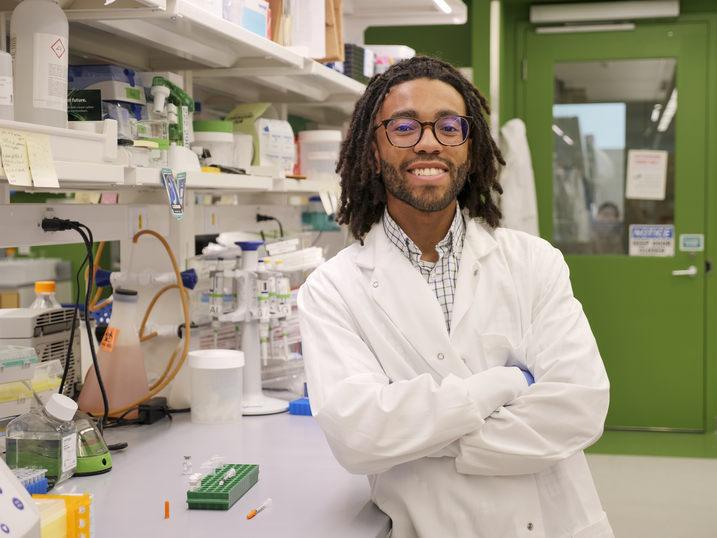
There have been about 20 different attempts to design a therapeutic vaccine for cervical cancer, but none have been successful yet. . . . We decided to move "upstream"—to target the virus while it is still in the early infection stage, before it develops into a cancerous phenotype.
Second, we experimented with a newer technology called circular RNA. Most people are now familiar with mRNA vaccines because of COVID-19, but these use linear pieces of RNA. Circular RNA, as the name suggests, is that same piece of RNA but circularized. At my defense, I made a joke that by effectively "tying up the loose ends," you get a molecule that lasts much longer in cells. This prolonged expression drives a much stronger T-cell response.
When we tested this in mouse models, the results were incredible. In a cervical cancer model, the circular RNA vaccines had a massive, robust ability to completely eradicate tumors. We also showed they were highly effective at preventing tumor growth in the first place. It’s a very different approach from what has been tried before, and seeing it work so effectively in the lab was one of the highlights of my PhD.
Small Genes, Big Impact
I initially went to college to study nuclear chemistry. I was really into the idea of renewable energy and wanted to work on a nuclear sub or at a power plant. But as part of my chemistry major, I had to take a basic biology class, Bio 101. When we got to the genetics section, it completely changed how I approached science.
The class looked at genetics through the lens of pathogens. I was fascinated by the idea that a virus could contain just a handful of genes—something so incredibly small—and yet, once it gets inside a person, it can completely change the immune landscape and make them sick. That’s what shifted my interest toward biochemistry, so I could study pathogens and viruses.
At UNC, I spent over two years researching how mutations in patient tumors shaped their cancer, but I wanted to move toward researching pathogens long-term. I chose the virology program at Harvard because it’s one of the few dedicated programs of its kind in the US. When I joined [Harvard Medical School Professor] Gaurav Gaiha’s lab, he pitched the idea of a therapeutic vaccine to treat cervical cancer, specifically for those who test positive for the human papillomavirus (HPV). HPV stuck out to me because it was the perfect marriage of my interests: a tiny virus that causes a massive problem like cancer.
In a cervical cancer model, the circular RNA vaccines had a massive, robust ability to completely eradicate tumors. We also showed they were highly effective at preventing tumor growth in the first place.
A Love of Lifelong Learning
I was born in Rochester, New York—that’s where most of my family is from—but when I was about four, my immediate family moved down to Raleigh, North Carolina. That is where I call home. My mom is a third-grade teacher, and she has been since I was in middle school. I think I get my love of learning and teaching directly from her. She put herself through college, earned an associate’s and a bachelor’s, and then both she and my dad went back to get their MBAs when my brother and I were pretty young. They were really trying to show us that we could go after higher degrees. Even when I was in college, my mom went back for another master’s in education. She instilled the idea of being a lifelong student in me.
My dad has worked in primarily in insurance of different varieties, but his real interest has been working as a private investigator on the side. I think from him, I picked up the power of observation and a real attention to detail. I’m the first person in my extended family to get a PhD, which is a big deal to them. My grandmother came up to Boston for my defense, and she told everyone that when I was in first or second grade, I was already saying I wanted to go to Harvard and get a PhD. When it actually happened, she said, "I cannot believe this dream of yours came true." Honestly, I can’t really believe it either.
The funny thing is, I almost didn’t go to the University of North Carolina at Chapel Hill for undergrad. It was a big public university right down the street, and I wanted to go to a small school in New York. But my dad kept pushing me to apply to UNC anyway. I joked with him later that he’d been secretly brainwashing me my entire childhood—I had a UNC rug in my room, and my house key was UNC color-coded. I had that subliminal messaging for years. One morning, right before the deadline to decide, something just flipped inside me, and I knew Carolina was where home was going to be.
Tying Up Loose Ends
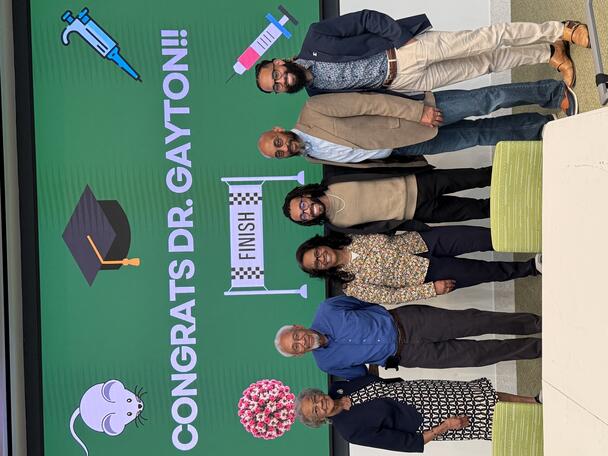
I defended my dissertation just last week, and it was actually a lot of fun. I really enjoyed the process, and I got great feedback on the presentation. After years of being in the "grind" of the lab, it was a really good day to see it all come together and celebrate with friends and family.
Looking back, the path from Raleigh to Harvard feels like a series of small, significant shifts. It was one biology class, one conversation with my dad, and one persistent dream my grandmother remembered. Science is often about those tiny details—the handful of genes or the "loose ends" of an RNA strand—that end up making the biggest difference. Being able to work on something that could potentially prevent cancer for millions of women is exactly why I wanted to become a scientist. And doing it here at Harvard? Like I told my grandmother, I still can’t believe it.