Quantum Ethics
Rodrigo Araiza Bravo, PhD ’24

Rodrigo Araiza Bravo graduated from Harvard Griffin GSAS with a degree in physics in November 2024. He studies quantum computing, but with a twist: He is determined to temper “pure research” with an understanding of its potential ethical, moral, and societal effects of science.
Optical Tweezers
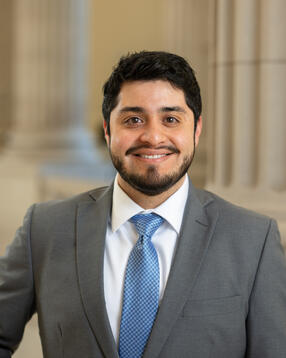
I started working with Professor Susanne Yelin in Harvard’s Department of Physics. She is an expert in atomic physics, studying the interactions between atoms. There was a lot of interest in quantum computing, since atoms trapped with a focused beam of light—what we call “optical tweezers”—can be used to make quantum computers where the interactions between atoms carry our computation. The way the atoms interact with light is very specific, so you can use light to kind of probe the system, learn about it, and get some really interesting data on how the atoms are behaving with each other.
This relates to quantum computing because, once you arrange the atoms, and let them interact with each other, both the state of the atoms—spin, charge, position, etc.—and the interactions themselves carry information. Atoms not only “compute” in this way, they interact incredibly fast. So, we were researching ways to optimize the atoms for computation.
With this technology, we were also simulating very complicated molecules that could be used for research on practical problems, like organic photovoltaics, or molecules that could zap carbon dioxide out of the atmosphere and ease global warming. The planet is warming far too rapidly now, so we need every single tool we can create to capture carbon and reduce its presence in the atmosphere.
Science and Society
In pure science research, you are trained to think about the challenge in the basic science sense. You’re not always trained to think about how it’s going to be used. I started thinking about this a lot, how the basic science is going to have impacts downstream. I also started thinking about how society shapes science through funding or wanting science to solve certain problems. I was really interested in relationship between science and society, so I started having a lot of conversations with people in the Kennedy School.
At HKS, I took this intensive course run by Professor Sam Weiss Evans called Beyond ‘Don't Be Evil.’ It’s part of the Harvard Science, Technology & Society Program (Harvard STS), which asks questions like: “What social, economic, and ethical assumptions are already reflected in the framing of your research? How do you think about the ethical, political, and organizational issues of your research?” It gets you thinking about the moral questions, the ethical questions, the societal questions, the legal questions, of the research you’re doing.
I really became really interested in this, so I started engaging more with the Harvard STS program. At the same time, I was teaching a quantum computing course for undergraduates, so I snuck in a few things about these broader ethical questions here and there in my lectures. And the undergraduates loved it! They were really grateful that I wanted them to be not just good scientists, but good people.
I also did a fellowship to study policy around quantum computing technologies in the United States. I was mentored by Professor Sheila Jasanoff who is a world expert on the ways our futures are often framed through science and technology. Then I put together a series of discussions on the broader, societal aspects of quantum computing. It was very interdisciplinary—we had panelists from the “hard” sciences, the social sciences, legal experts, historians of science, and from Harvard STS—just to stimulate a conversation that was different. People really enjoyed that.
When Sam left Harvard to join the National Security Commission on Biotechnology, there was no one to teach Beyond ‘Don’t Be Evil.’ And I thought, “You know what, this is the way that I got started thinking about science and ethics, and I want other people to get started on it too.” So, with these two other physics colleagues, I taught it as a January@HarvardGirffinGSAS mini-course. We pulled the lectures that we had from Sam, updated them, put in our own little material based on our research and the things that we thought were interesting, and taught it as a four-day course to other grad students. So that was really rewarding.
Union Booster
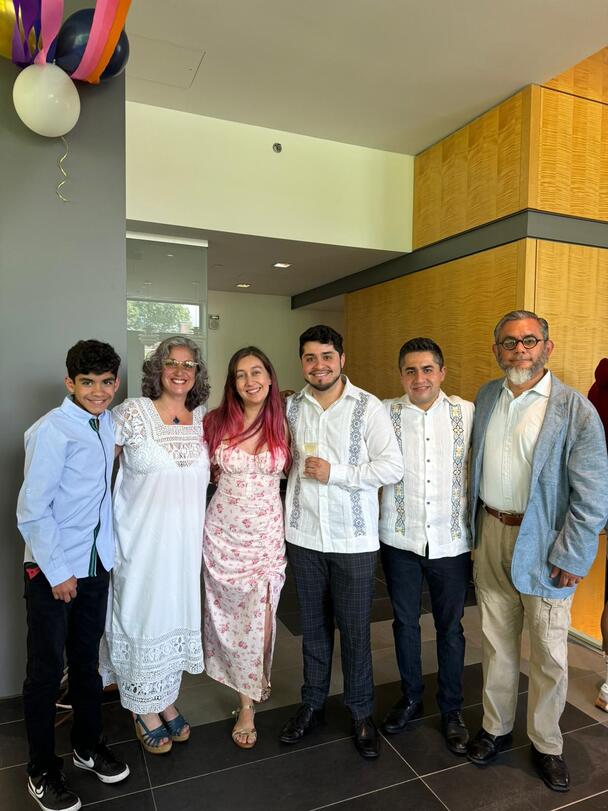
I was a member, then a steward in the Harvard Graduate Student Union. The work was fantastic. My family had been in the union movement for many, many years and many generations, so it was very familiar to me.
I worked on a few different projects: contract enforcement, getting things like offer letters done on time, making sure there's a process for handling complaints or separations. I was interested in the structure of the union, too: how problems get listened to, how we debate contract terms, how issues rise to the top. What I wanted to do is make it more possible for different folks to engage. So instead of just having union stewards, we also created an informal role we called organizers, listening to union members more fully, understanding their concerns directly.
It was a lot of fun. It brought me into more awareness of what it means to be a scientist. As scientists, we should have solidarity for those around us in the lab and outside of it.