Identity in the Age of Technology
Jaylon Sherrell, PhD Student

Jaylon Sherrell is a PhD student in organizational behavior at Harvard Griffin GSAS. Her research examines how people craft and manage their identities in digital work environments—across social media, Zoom calls, and even avatars. A native of Gary, Indiana, Sherrell reflects on her path from the technology industry to Harvard, the impact of early mentorship, and the evolving stakes of identity in a technologically mediated world.
Finding the Language of Leadership
I grew up in Gary, Indiana, a city just outside of Chicago. From a young age, I was fascinated by communication technologies—tools that helped me connect with family, meet new people, and interact with others around the world. That interest stuck, too.
I earned undergraduate degrees in communication and marketing at Indiana State University (ISU). When I graduated, I was offered the opportunity to take MBA courses while finishing my bachelor's degree, as well as an assistantship. It was an opportunity to continue what I enjoyed—learning—while saving on education costs.
After my MBA, I went to work in project management in the technology industry, working for a company that provided workforce management-oriented technology solutions. I led teams that worked on tech implementation for clients in industries ranging from retail to the public sector. Eventually, I moved into a marketing role focused on healthcare customers. Whether managing teams or working as an individual contributor, I was always interested in the same question: How can technology improve people’s experiences at work?
An Academic Itch
Even though I liked my career, I had what I call an “academic itch.” I kept coming back to the question: How does technology shape the way people show up at work—not just in how they perform, but in how they are perceived?
I reached out to my alma mater and connected with a professor at ISU, who took me under her wing. She gave me a clear picture of what a PhD would look like and invited me to join her research projects. I even had space to explore my own ideas. Her mentorship made all the difference when helping me to learn and grow as a scholar.
After a couple of years, I started applying to doctoral programs. Harvard stood out to me. The faculty here are doing incredible work on topics related to technology and identity—exactly the intersection I care about. I applied, and now I’m here.
The Stakes of Being Seen
My research focuses on how people manage their identities in digital environments. We’re surrounded by technology—for instance, phones, tablets, video conferencing, social media—and all of it shapes how we present ourselves and how others perceive us. In some cases, our digital presence can even influence hiring decisions, networking opportunities, promotions, and job security.
We know that how you present yourself online can influence whether you get a job or a promotion, whether you’re chosen for a special project, and whether you feel accepted at work. There’s also the question of authenticity: How much of ourselves do we share, and how does that affect how we’re seen?
In my current work, I explore how people create and sustain coherent identities across platforms—especially when those platforms allow us to tailor how we present ourselves in ways such as avatars. I also study how our use of technology affects how others evaluate us as professionals.
My dissertation currently focuses on how job seekers who’ve grown up online—both older and younger—manage their digital pasts in the workplace. How do people contend with information about themselves that’s already out there, especially when they’ve changed over time? What does it mean to be judged by a version of yourself you no longer recognize?
How We Show Up
Sometimes people may have to deal with a tension between online visibility and privacy when managing their careers. Some people limit access to information about themselves online to protect their privacy. Others may do it to better manage boundaries between their work and non-work lives. On the other hand, others might increase their digital footprint, hoping to increase their visibility for future opportunities. The reasons vary, but the reactions to these choices matter, especially in a professional context.
I’m especially interested in how these dynamics play out when considering the role of algorithms in our lives. In nascent research, I have been examining how algorithms shape our identities and self-presentation choices, as well as the interpersonal (and intrapersonal) consequences that may arise as a result.
Share, Engage, Contribute
I also use my research expertise to give back to my community. One way is through mentorship. For the past two summers, I served as a mentor in Harvard Business School’s undergraduate research program: PRIMO. Within PRIMO, I worked one-on-one with undergraduate student researchers as they learned about a career in academia and worked on projects with faculty.
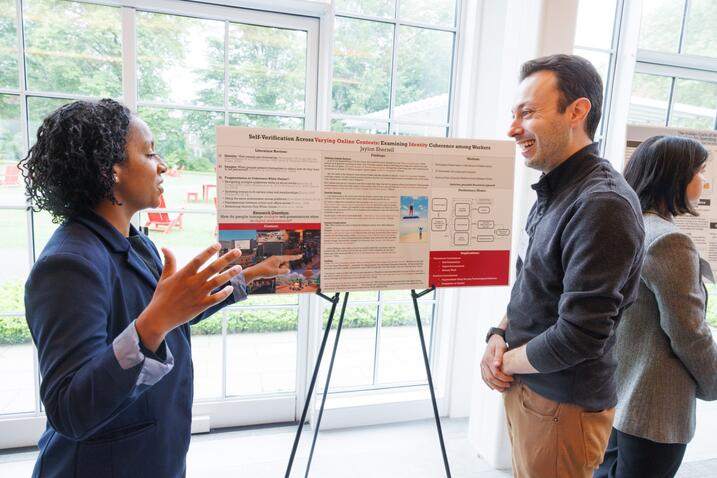
I also enjoy sharing research. I have presented my research within venues such as the Academy of Management, but also the European Group for Organizational Studies. Presenting in different settings has allowed me to engage with others who are researching similar topics – helping me to move my projects forward and grow as a scholar. My research was also recently selected as a finalist for the Future of Work Global Research Prize sponsored by the University of Zurich and The Adecco Group. These opportunities have allowed me to engage with others within academia and beyond.
To continue engaging with the larger community, I have recently launched a newsletter: Work Mode. My goal is to share research in my field with people who want to be able to put words to their everyday working experiences. Being able to contribute to my community has shaped the way I think about research—and about the kind of scholar I want to become.