Finding Cancer’s Weakness
Can starving leukemia cells of copper make treatment less damaging to children?

Advances in treatment have transformed pediatric leukemia from a largely fatal diagnosis into one of the most curable childhood cancers—survival rates in Acute Lymphoblastic Leukemia now exceed 90 percent. But when cancer spreads to the brain, a potentially deadly condition known as central nervous system involvement (CNSI), this progress comes with a cost: the same treatments that save a child’s life can also affect how that child learns and remembers.
To prevent CNSI, most newly diagnosed children receive drugs delivered directly to the cerebrospinal fluid to protect their brain and central nervous system. While these treatments effectively prevent the spread of the cancer, they also damage the brain. As a result, survivors of pediatric leukemia experience lasting cognitive challenges that affect how they learn, process information, and navigate daily life.
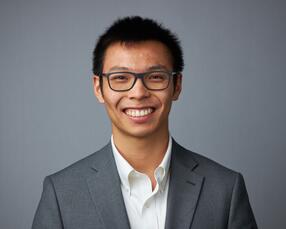
Addressing this challenge requires a deeper understanding of how leukemia cells survive and the nutrients on which they depend. In the Kanarek Laboratory at Boston Children’s Hospital, Alan Wong, who will receive his PhD in biological and biomedical sciences this May from the Harvard Kenneth C. Griffin Graduate School of Arts and Sciences, focuses on developing new approaches to treat pediatric leukemia while reducing harm to the brain.
By depriving mice, who have leukemia, of copper, you can actually slow the growth rate of the cancer. You can boost the effect of existing chemotherapies.
—Alan Wong
Starving Cancer of Specific Nutrients
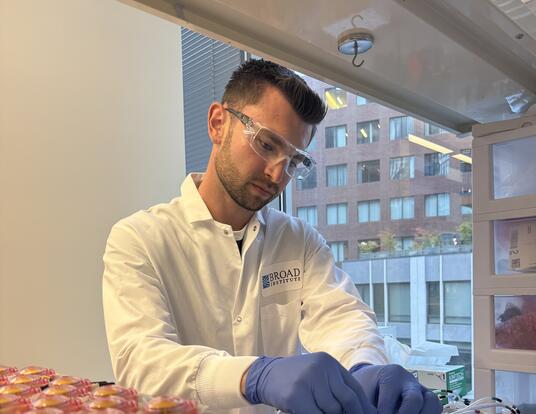
Using metabolomic techniques–the means of identifying small molecules (metabolites) found in biological samples–and mouse models, Wong identified a key vulnerability: leukemia cells depend on copper to grow, both in the body and in the brain.
“By depriving mice, who have leukemia, of copper, you can actually slow the growth rate of the cancer,” Wong says. “You can boost the effect of existing chemotherapies.”
Wong’s findings, published in the journal Nature Cancer, point to a broader shift in how scientists approach cancer treatment. Rather than focusing only on killing cancer cells directly, researchers are increasingly asking what those cells depend on to survive. Furthermore, scientists are asking what vulnerabilities are unique to cancer cells and not the healthy cells around them, and how we can target them. By identifying copper as one such requirement, Wong’s work shows how subtle changes in a cell’s nutrient availability can reveal opportunities for more precise and less harmful therapies, placing the research at the intersection of understanding how cancer cells use nutrients and how those dependencies can be targeted for treatment.
“I've always been really curious how cells know what's going on around them,” Wong says. “It doesn't really make sense to think of cells as humans, but some of the behaviors of cells mirror what we might expect of living, thinking beings. Their whole purpose is self-interested. They want to survive, they want to grow, they want to carry out their own functions. So, how do they respond to different stresses?”
Wong pursued this idea further, questioning how leukemia cells spread from the periphery—from bone marrow, for instance—to the brain. These two locations create very different environments and stressors for the spreading leukemia cells. Specifically, he examined how differences in the brain’s nutrient environment could create vulnerabilities that new therapies could target, landing on his understanding of the role copper plays.
Naama Kanarek, assistant professor of pathology at Harvard Medical School and Wong’s PhD advisor, highlights the impact of his work, emphasizing that the findings deepen our understanding of how leukemia cells survive in the brain and can help accelerate the development of more targeted therapies.
“The work is important in cancer research in general because it brings forward the immediate and impactful application of the fundamental understanding of metabolic vulnerability of cancer cells,” Kanarek says. “It shows how basic cancer metabolism research can lead to discoveries that can be implemented in clinical approaches.”
The immediate applications of Wong’s findings may be most relevant for a subset of patients, such as those with drug-resistant or central nervous system involved leukemia, but the implications could extend beyond leukemia. Wong and his colleagues are also considering whether similar approaches might be applied to other cancers, including brain tumors, where cells face similarly distinct metabolic environments.
“One of the most important aspects of this research is that it links careful mechanistic science to a question of immediate clinical relevance,” says Jessalyn Ubellacker, PhD ’18, assistant professor of molecular metabolism at the Harvard Chan School. “These research findings are highly significant because they reframe metabolic adaptation in the central nervous system not simply as a feature of leukemia biology, but as a potential therapeutic opportunity. That is a meaningful advance for the field and one that could have real clinical implications that could lead to safer and more specific treatments for children.”
[Wong’s research] shows how basic cancer metabolism research can lead to discoveries that can be implemented in clinical approaches.
—Professor Naama Kanarek
Reflecting on the Scientific Process
Growing up in Vancouver, Canada, Wong was always interested in science and biology.
“I remember doing the biology labs in school, extracting DNA from strawberries, or doing worm or animal dissections, and just thinking it was such an amazing process,” Wong says.
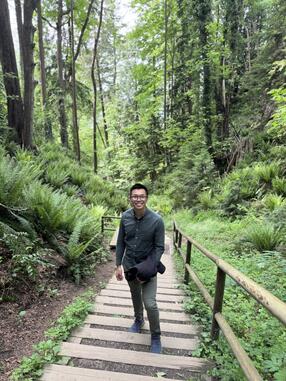
As a high school student, he shadowed a research lab at a local university, where he quickly took to the world of science and research. He appreciated the excitement of asking novel questions and the puzzle of trying to figure out how things work.
Then, as an undergraduate at Harvard College, Wong got involved in Professor Jessica Whited’s lab at the Harvard Stem Cell Institute, working with axolotls to study regenerative biology.
“Axolotls are these cute aquatic salamanders that have the incredible ability to regrow any organ in their body–their limbs, their hearts, their nervous system. They're really fascinating creatures,” Wong says. “At that time, we were trying to understand how they could regrow their limbs, to better understand how humans might one day be able to regrow and perhaps regain function of lost limbs.”
Wong credits his experience working with Whited for his love of research, explaining that, in addition to asking biological questions, it fueled his interest in trying to understand how work in the lab can improve human health and benefit the broader community. Today, he channels that dedication both in his research in Naama Kanarek’s lab and as an MD-PhD student at Harvard and MIT.
[Wong’s work] is a meaningful advance for the field and one that could have real clinical implications that could lead to safer and more specific treatments for children.
—Professor Jessalyn Ubellacker, PhD ’18
“Naama always thinks the best of her students. She always thinks everything's going to work the first time, and that the data's going to turn out in a really exciting way. I'm a bit more reserved,” Wong says, reflecting on his doctoral work and his relationship with his advisor. “But now, I appreciate the optimism, because I think when people are telling you that you shouldn't do your work, or you're getting another grant rejection, or your grants are getting canceled, you have to remain optimistic that the work that you do is important. Otherwise, why would we even bother?”
As he wraps up his remaining PhD projects, Wong prepares to start his third year of medical school as part of the Harvard and MIT MD-PhD program. He’ll spend the next year on medical clerkships at the Beth Israel Deaconess Medical Center. Long-term, Wong sees himself keeping a foot in the world of research while also staying firmly rooted in clinical practice, part of his broader goal to develop more precise and effective cancer treatments.
“I think the research problems I want to tackle are more translational and clinically oriented. I truly believe that seeing patients keeps you grounded in understanding what the problems are that people experience. You can read about clinical challenges in reviews and in the literature, but it's a very different experience seeing it with your own eyes,” Wong says. “I think I can be convinced to be excited about a lot of scientific problems, but at the end of the day, I want my research to be driven by the needs of my patients.”