A Conversation with Math’s Lauren K. Williams

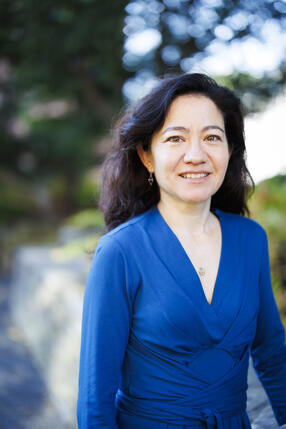
The Advising Project recently sat down with Lauren K. Williams, Dwight Parker Robinson Professor of Mathematics, to chat about all things advising. Williams discussed topics including industry jobs, getting stuck while doing research, and the rewards of being a graduate advisor.
What first comes to mind for you when someone says “let’s talk about graduate advising”?
I have been an advisor since 2010, when I was a new assistant professor at UC Berkeley. When I first started out, I was quite intimidated by the idea of advising graduate students, because I sensed that there was a lot of potential to screw up someone else’s life! But in the years since then, I have seen my students flourish, and have come to realize that they come in bright and capable, and my job is just to help orient them in the right direction and coach them as best I can.
What factors should a student consider when choosing an advisor?
One factor to consider, of course, is the area of research: a student should choose an advisor whose research they find interesting. Scientifically, there needs to be that connection. It’s also important to select an advisor that the student can have a good working relationship with.
Beyond their primary advisor, students can—and should—get advising and mentoring from other people, including other faculty members, peers, postdocs, and so on. I encourage students to look for other mentors because their own advisor may not be able to fill all their needs. For instance, some advisors might be amazing on the scientific side, but abysmal in terms of giving practical advice! On my website I have a link to a mentorship map from my friend and colleague in Physics, Jenny Hoffman; the map helps students visualize their support network.
Once a student and faculty member do start working together, what would you say makes for a strong advising relationship?
Clear communication is extremely important: it’s important for students to be able to express their concerns and worries. I try to make it clear what my expectations are of my students, and I hope they feel comfortable sharing what they expect of me. Since students are all quite different and have different working styles, I try to tailor the advising relationship (e.g. the frequency of our meetings) to the individual student based on what they need. I mostly meet my students individually, but it is nice to have group activities as well, so that students can build community and learn to learn from each other. It is important for students to be proactive – for instance, a student can check in with their advisor from time to time and say “I’m doing this, this, and this, is there anything else that I should be doing?”
One issue I’ve seen in math departments is that students who are thinking about taking an industry job after their PhD may be nervous about telling their advisor their plan. I think they are worried about whether they will be perceived as a “sellout” or someone who “abandoned the academic dream.” I try to reassure students that there are amazing jobs in industry, that I’m totally supportive of anyone who wants to pursue that route, and that they shouldn’t feel obligated to stay in academia! (By the way, to any former math grads out there who have made it big in industry, please consider donating to our department!)
One of the tricky aspects of the graduate advising relationship is that both parties need to contribute while working within a power imbalance. What suggestions do you have for navigating this dynamic?
It’s important to understand that the power imbalance exists, and it’s especially important for the advisor to recognize that and make sure they never abuse that power. Back when I was at Berkeley, one of my students offered to babysit my first child, which was incredibly kind and considerate of them -- but I felt I had to decline because it would have been an abuse of power on my part. I try to put myself in students’ shoes and make sure that requests I make of them are always in their best interest.
We hear a lot from students that they are hesitant to reach out to their advisors because they know Harvard faculty are very busy and often overcommitted. What would you say to these students and to their advisors?
Advising is one of the main components of our job, so I would tell students that they should not hesitate to reach out to their advisors. I have never felt that my students were asking too much of me. I would also say that advising is one of the most immediately rewarding parts of my job. In math research, it is possible to be stuck on a conjecture for a very long time, and even when I prove a theorem, I do not know to what extent it will have an impact. But at least with teaching and advising, I can see the impact right away, so it’s a part of my job that I find really fulfilling.
What would you say to a student experiencing impostor phenomenon [sometimes called imposter syndrome]?
I would tell the student that imposter syndrome is incredibly common -- I think almost every scientist I know has experienced it from time to time. We’re all struggling with problems no one has solved before, and it can be pretty demoralizing to bash your head against a problem and not know if you will be able to figure it out. (Early on in graduate school, I was stuck for nine months trying to prove a conjecture.) I would also tell the student that they would not have been accepted into our graduate program unless the faculty felt they really deserved to be here. So just know that imposter syndrome is normal, and there’s a light at the end of the tunnel. Don’t give up!
What do you enjoy most about being an advisor to graduate students?
It’s exciting for me when I see students make a breakthrough. Usually when I propose a research problem to a student, I don’t know what the answer should look like – so it’s thrilling to see them start to figure it out and get excited about their research. And when I see my students defend their dissertations, graduate, and go off to amazing jobs, I have an overwhelming sense of pride in their accomplishments. Four PhD students graduated from my group in May 2025; it was such a pleasure for me to celebrate their achievements, meet their families, and talk about their next steps. It has also been fun to watch my former graduate students become advisors themselves. I’m a grand-advisor now!
Banner image by Gunnar Klack