According to a July 2026 survey from the Pew Research Center, 71 percent of Americans are very concerned about the cost of healthcare, 66 percent about the cost of groceries and consumer goods, and 64 percent about housing costs. And politicians are responding—at least in their rhetoric. It’s hard to change the TV channel or queue up a YouTube video this election season without being inundated by ads touting a candidate’s pledge to fight for affordability.
The University of Michigan economist, Justin Wolfers, PhD ’01, says that purchasing power has actually increased in recent years. Aside from a short-lived spike in inflation during the COVID-19 pandemic, consumer goods in particular have gotten more affordable. So why are we still so angry about rising prices? Drawing on the work of the Harvard economist Stefanie Stantcheva, Wolfers says the reason our feelings don’t match the facts has to do with the terrifying “boss” model of inflation we all carry around in our heads.
This transcript has been edited for clarity and correctness.
Make the case against the inflation rage that’s taken hold of the country really since the pandemic. If prices are relatively stable, rising around 3–3.5 percent annually, why is affordability the number one issue on most people’s minds?
I don’t think I’m trying to convince anyone of anything. I’m trying to understand the world we find ourselves in. The word affordability is clearly on the table. It’s in the air, and it resonates with regular people. Politicians are winning elections by running on it, and the president’s approval is suffering because he’s seen as weak on it. Concerns about affordability are absolutely top of mind.
If you stopped an economist in the hallway and asked them to define affordability, they might say it is how much stuff you can afford. To measure that, you would look at how much income you receive relative to the price of things. In other words, you would measure real income—income adjusted for inflation. We could disagree about whether to use disposable income, pretax income, or gross domestic product, and whether to consider labor income or capital income, but they would all be versions of income relative to the cost of living.
Income relative to the cost of living is rising. That isn’t a particularly courageous statement; it is almost always true almost everywhere. Since the Industrial Revolution, the story of the world has been one of economic growth. You could choose a short period—say, the past six months—and point out that average wages adjusted for inflation have fallen. I would concede that point, but I would also say that the affordability discourse began before that.
So how do we make sense of a word that the general public uses to describe an affordability crisis when economists would point to data showing that the opposite is true? Economists might say they wish more things were affordable, or that better economic policies would have allowed real income to rise faster. Still, most economists would be puzzled by the term affordability crisis.
This is where I become a popularizer of Harvard economist Stephanie Stantcheva. She is one of Harvard’s superstar economists. Let me explain an economic truth and then a psychological process.
The economic truth is that over time, when prices rise, wages tend to rise to catch up. That may not sound intuitive, but centuries of research across dozens of countries show that it is the case. Another way of saying this is that inflation doesn’t determine your real income. History teaches us that when prices rise, wages catch up. If that’s true, we shouldn’t be very worried about inflation.
But people are worried about it. When inflation occurs, I go to the supermarket and discover that my paycheck doesn’t go as far. I’m annoyed, frustrated, and angry. A dark, impersonal force walked into the supermarket and raised every price tag on every aisle, reducing my ability to get by and provide for my family. That’s the first step of the process.
The second step is what happens at the end of the year, when my boss at the University of Michigan says, “Justin, here’s a pay raise.” Suppose it’s around 2 percent. I think, “I’ve been doing economics morning, noon, and night, and finally the university noticed. I’ve been working hard, and I deserve this.” I feel great about it.
The economic one-step is that prices rise and wages catch up, so you’re fine. The psychological two-step is that prices rise and it feels as though someone stole from me and took away my purchasing power. Then wages rise, and I internalize that as a result of my productivity, worth, or value in the workplace. Psychologically, I don’t connect the two. My genius was recognized, and some other force stole from me. I experience inflation as theft.
The last few years marked the first time since the early 1980s that the United States experienced substantial inflation. I think the psychological two-step is dominating, even though the economic reality is that people can afford more than they did before. That’s why people are so angry about inflation.
History teaches us that when prices rise, wages catch up. If that’s true, we shouldn’t be very worried about inflation.
Let’s go back to the early 1980s. Inflation was much higher in the late 1970s and early 1980s, but people weren’t as pessimistic about the economy. During the early years of the Reagan administration, there was a terrible double-dip recession, but inflation was falling. Maybe people were responding to that decline: if inflation fell from 10 percent to 6 percent, they might have thought, “This is great.” But we’ve seen something similar recently. Inflation spiked to 9 percent, never quite reached double digits, and is now around 3 to 3.5 percent, depending on how you measure it. People still feel terrible about the economy. What’s going on?
You’re contrasting the 1980s with the present: in the 1980s, we had high inflation and people were relatively okay; today, we have moderate inflation and people are miserable. But there was a puzzle in the 1980s, too. That puzzle led to the work of Robert Shiller, which preceded Stephanie Stantcheva’s work. The truth is that people still didn’t like inflation. They were still angry about it. The puzzle for economists was why they were so upset.
You can see that anger in the number of governments that lost power following periods of high inflation and in surveys of people’s happiness. Inflation is related to happiness: higher inflation is associated with less happiness. That’s where the set of ideas you called the boss model comes in.
The economic reality is that my wages are determined in a market. If prices rise, then even if my boss doesn’t want to give me a raise to catch up, someone else will, because the product I’m making now sells at a higher price. My employer can afford to pay me more, and my wages are ultimately shaped by the market.
The psychological two-step is that prices rise and it feels as though someone stole from me and took away my purchasing power. Then wages rise, and I internalize that as a result of my productivity, worth, or value in the workplace. Psychologically, I don’t connect the two. . . . I experience inflation as theft.
People perceive something different. They believe their boss controls their wage. I can tell you the name of my boss, and you can probably tell me the name of yours. That person sets my wage and doesn’t like giving pay raises. When prices go up, my boss can keep my wage where it is, so the price increases feel as though I’m losing purchasing power.
The boss still has to respond to market forces. If everyone else is offering me a higher wage, eventually my wage will catch up. Sometimes bosses really are difficult, so you may have to move to a different firm to get a raise. In fact, the people receiving the biggest pay increases right now are often those who are switching jobs.
That was the question in the 1980s: Why are people so angry about inflation? The economic one-step is that wages and prices tend to rise together, so there’s no need to worry. The psychological two-step is that inflation steals from me, followed by an offsetting gain that I don’t interpret as a cost-of-living adjustment. I never say, “Thank goodness market forces gave it back. I was wrong to be angry.”
You’re right that people today are upset to a degree that makes little sense given historical experience. Through the 1960s, 1970s, and 1980s, inflation was not only high but volatile. People understood that inflation was a reality and part of life. They also understood that they tended to receive cost-of-living adjustments, even if their bosses didn’t call them that.
After two or three decades of experience with high and volatile inflation, people understood the economic one-step. If prices rose 10 percent in a year, they had decades of experience telling them that wages would catch up. By the early 1980s, people had learned that this was the deal with inflation.
The problem today is that we’re 40 years removed from that experience. Anyone younger than I am has never experienced significant inflation in their lifetime. They haven’t learned that when purchasing power is taken away, it is eventually given back. They’re therefore more susceptible to the psychological two-step.
Does it matter whether wage increases are driving inflation or price increases? You’ve described a situation in which the price of eggs—or of something affected by a tariff—rises, and then at the end of the year my boss gives me a cost-of-living adjustment. But I go back to the store, and prices are rising again, so I feel as though I’m never catching up. If prices are rising because wages went up first and people have more money to spend, perhaps that feels more tolerable. Is there data behind that distinction?
I’m going to accuse you of overthinking it. Every year, prices move, and every year, wages move. My pay raise this year was a cost-of-living adjustment, but my mistake was to see it as a bonus for having worked hard. Was it an adjustment for last year’s inflation or for expected inflation next year? I don’t really know. I understood it as a reward for merit and hard work rather than as a response to inflation.
At some level, it doesn’t matter whether wages move first or prices move first. That’s true for most kinds of economic shocks. But there is one kind of shock that is different: what economists call a supply shock.
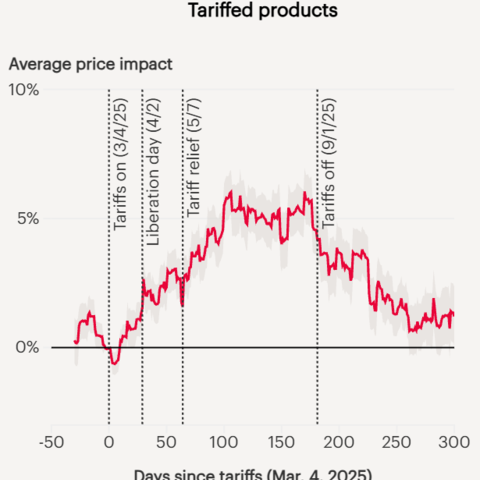
A supply shock is a shock to the cost of doing business. It might be tariffs, which are particularly relevant at the moment, or an oil shock, which also raises the cost of doing business. A supply shock raises firms’ costs, so they raise their prices. But the profitability of employing me hasn’t changed, and my employer has no extra money sitting around. If anything, margins have been compressed. There’s no reason for a supply shock or a price shock to lead to higher wages.
That’s why economists worry about tariffs. They affect your real earnings and your actual affordability. You won’t be made whole for price increases caused by supply shocks.
I want to ask about three aspects of the cost of living that are prominent if you live in an East Coast city—or, really, in most cities across the country. First is housing. The Boston Globe recently reported that a household now needs to earn about $260,000 a year to afford a median-priced single-family home, more than double what it needed five years ago. Employer-sponsored health care coverage rose 6 percent in 2025, overall health care spending rose 7.2 percent, and health care spending is now about 18 percent of GDP. Finally, child care prices rose about 30 percent between 2020 and 2024.
These are essential parts of the cost of living and have been rising for years. They also seem extremely intractable. Communities, states, and the federal government don’t seem able to make effective progress. Is that one reason people are so pessimistic?
We need to be careful about language because clear language leads to clear thinking. Inflation is a generalized rise in prices—a rise in the cost of living. Every time we receive a new inflation number, the headline tells us what happened to the cost of living. It is the best possible direct answer to that question.
People on the left may point to price increases that were especially damaging, while people on the right may point to falling egg prices. But both sides are cherry-picking. If you want to know what’s happening with inflation and the cost of living, look at inflation.
That doesn’t mean we don’t have serious problems. It means they have different names. Housing is too expensive. In Economics 101, you learn that when there are many people and not enough houses, the price of houses rises. One of my mentors at Harvard, Ed Glaeser, taught that to me very clearly. We have many people and too few houses because it is difficult to build them. If we made it easier to build houses, we would have more houses.
If you’re in Berkeley, Cambridge, Manhattan, or San Francisco, you know what happens when someone tries to build housing. NIMBYs march down to the local government and say, “We absolutely love affordable housing—but nowhere near us.” That’s the housing problem.
I’m not a health economist, but I’ll state something obvious: American health care doesn’t work. It is more expensive than health care in other countries and produces worse outcomes, with a few small exceptions. Cutting-edge techniques often reach the United States first, so if you have a very rare disease, this may be a good country in which to be treated.
The politics seem largely intractable. As an immigrant, I’ve noticed that whenever an American says nothing can be done, immigrants respond, “In my country, we figured it out.” In Australia, for example, we have high-quality, low-cost care. It involves a degree of government participation that would make many Americans uncomfortable, but it also provides a quality of service they would appreciate at much lower cost. If you want to find a better health care system, get on a plane and travel. You’ll see that these things are possible.
If we adopted a system like that, there would be changes. A very wealthy doctor with a very large house would probably not be as wealthy. But my job isn’t to make other people rich; it is to make sure we are healthy. That doctor and the American Medical Association would be deeply opposed to many forms of change. The US Chamber of Commerce would oppose many forms of change as well. There are many vested interests because many people make money from health care, and they like making money even when the system produces bad outcomes. I think that’s a lesson Hillary Clinton learned and Barack Obama nearly learned.
Child care is another deep and difficult problem. There are questions about regulation: We regulate the heck out of child care centers, so could we have lower-cost alternatives? There are also social policy questions. Should we think of child care as a right? As an investment in children? As an investment in maternal labor supply? Changing the frame would lead to a completely different set of answers. We need a serious, grown-up debate about what we want child care to do. Once we know that, we can design a different system.
Finally, what about the impact of AI? If we can use machine learning to produce some services in much greater volume and at much lower cost, could that have an important effect on affordability? For example, I’ve been writing about and speaking with people who work with medical AI. Some research suggests that it’s better than human doctors at frontline diagnoses, so perhaps it could intervene in an entire layer of the health care process. Could that technology make life more affordable?
Remember, affordability is simply how much stuff we can afford to buy. So, if we produce more, we can afford more. There’s no question that AI will enhance productivity. At a minimum, it won’t reduce it. The effect will be to create a larger economic pie. The only debate is whether the increase will be medium, large, or huge.
We also need to ask whether the effect is a one-time increase or a continuing process. If AI teaches us to come up with ideas faster—and ideas are the foundation of economic growth—it could be transformative. When you talk with economists and technologists, you hear optimism from both. Technologists say it could lead to GDP growth of 40 percent; economists say it could lead to GDP growth of 4 percent. Economists might respond that the technologists are bad at math and are wrong. But perhaps economists don’t know enough about technology, and it really could be transformative.
We should be tremendously uncertain about what AI will do to the underlying rate of economic growth. We know the effect is probably positive, but there may be growing pains, and the effect could be negative for a period of time. We’ve seen that in previous historical transformations. We should remain open to the possibility that the effect could be enormous.
So far, I’ve talked only about the size of the pie. The second question is who gets which slice. AI has the potential to divide the pie in intensely unequal ways. Let me offer a simple thought experiment.
For your birthday, I’m going to give you a robot called the Paul Bot 2000. We don’t have to tell Harvard that you received it, but the Paul Bot 2000 can do your entire job, particularly the annoying parts. What will you do with the time you save?
Study economics, of course!
I agree that could be a source of some joy, but what else might you do?
I’d spend more time writing and reading, more time with family and friends, and more time in church.
And Harvard would be just as happy because the work would still get done. Would you be better off as a result of the invention?
It sounds as though I would be.
Absolutely. You would live a better, richer, fuller, freer life. Now consider the same robot in a different scenario. Instead of giving the Paul Bot 2000 to you, I give it to Harvard University. It can do everything you do. What will Harvard’s response be? It will fire workers, and you’ll be poor and hungry.
Notice that it is the same technology in both cases. The Paul Bot 2000 is a metaphor for AI. If you own it, the result is utopian: you write poetry, spend time with family, and go to church. If Harvard owns it, the result is dystopian: older workers are fired, and you’re left penniless.
A very small change—who owns the technology—affects how the pie is divided. The larger pie could be paid out as fees to OpenAI or Anthropic, and that could produce intense inequality. The first observation is that the pie will get larger. The second is that there are many ways for it to be divided in very dystopian ways.