Of Animals and the Ancient City
Melina Seabrook, PhD ’25

Melina Seabrook, who earned her PhD in anthropology from the Harvard Kenneth C. Griffin Graduate School of Arts and Sciences in 2025, explores the deep history of human-animal relationships in the first urban centers of Mesopotamia and Iran. Now a postdoctoral researcher at the University of Cambridge, she discusses her path from a small town in Washington to the ziggurats of Iraq, the microscopic secrets hidden in ancient soil, and the enduring kindness of the people she meets in the field.
The Past Is Not Dead
I grew up in Monroe, Washington, a small town on the West Coast. We aren’t an academic family—my dad is a physician assistant, and my mom is a paraeducator—but they have always been incredibly supportive of my many interests and the paths I take.
Ultimately, I knew I wanted to explore the world beyond Washington. I had always been interested in history, but in tenth grade, I first learned about archaeology. I was drawn to how hands-on it is. I remember being fascinated by ancient civilizations like Egypt, Mesopotamia, and the Indus Valley. As a sixth grader, the fact that people were living in cities six thousand years ago—cities with neighborhoods and streets similar to ours—felt wild to me. It was intriguing that so much of the past is still with us, even if it’s covered by layers of earth.
That curiosity led me to Stony Brook University for my undergraduate studies. While there, I participated in a formative ten-week field school at the Turkana Basin Institute in Kenya. It was an intense desert environment where we slept on the veranda rather than in a cushy dorm. I loved it. It confirmed that I was on the right path.
Ancient Neighborhoods
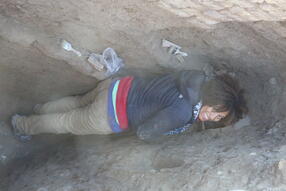
When I was only 20 years old, Professor Elizabeth Stone, a preeminent archaeologist of southern Iraq, offered to take me to the site of Ur. That first trip in 2015 was life-changing. You can see the Great Ziggurat on the drive up, and arriving at that fenced-in ancient city was an incredible moment.
Excavating at Ur is hard work, but finding even a tiny bone or a pottery shard is thrilling because it hasn't been touched for thousands of years. What struck me most was the familiarity of the landscape. Because of previous excavations, you can walk through the streets of ancient neighborhoods. You see the layouts of houses and realize these people lived in ways that mirror our own.
When we excavate a room, it’s like watching a long time-lapse in reverse. We start with nothing and slowly reach the floor. Standing in a room where someone lived thousands of years ago is an emotional experience. You see the kitchen installations, the drains, and the empty spaces, and you wonder about the stories that happened there. It makes you realize that our lives are just one small part of a much larger human story.
The Centrality of Animals
My research focuses on the changing relationship between humans and animals in and around urban centers in southern Mesopotamia. In the "pre-plastic" world, animals were central to every aspect of life. People didn't just eat sheep, goats, cattle, and fish; they used every part of the animal. They boiled bones for glue, used feathers for decorations, and relied on sinews to tie things together.
By not focusing on animals, I think we’ve done a disservice to how we conceptualize the past. In the Western world, we tend to keep animals separate from our "clean" urban centers. But the earliest cities likely had animals marching through the streets. To study this, I use faunal analysis (studying bones) and micromorphology.
Micromorphology involves taking chunks of soil, solidifying them with resin, and slicing them into thin sections to look at them under a microscope. This allows us to see "small-scale formation processes." For example, we can identify compressed layers in a road that indicate heavy animal traffic or the presence of dung, which was a vital fuel source. This helps us understand if certain areas of a city were kept free of animals or if they were integrated into the daily flow of life in cities.
Flexibility and Resilience
For my dissertation, I worked with a collection from Tepe Yahya, a site in southeastern Iran excavated by Harvard professors in the 1970s. I analyzed sheep and goat fragments spanning 5,000 years, from early Neolithic villages to more established urban centers.
I found that these ancient societies used a very flexible strategy. They relied more heavily on goats than sheep because goats are hardier in arid, hot environments. As urbanism grew, they developed "buffering strategies" to protect against poor agricultural seasons. Mobile pastoralists—people whose sole job was herding—likely played a large role in supplying the cities.
Interestingly, I found that about 20 percent of the animals had dental pathologies—teeth worn down to the nubs. In traditional economic models, you’d assume an animal is killed as soon as it's no longer productive. But these animals were being kept for very long periods. This suggests that the human-animal relationship wasn't just about productivity; humans were personally invested in these animals' lives.
The Harvard Experience and Beyond
My time at Harvard was shaped by supportive advisors like Tina Warner and Shayla Monroe. They were instrumental in showing me how to write grants, publish papers, and navigate the complexities of graduate school. It was good to know they had my back during difficult times in the department.
Now, I am continuing my work as a postdoc in Cambridge, UK. I’m still researching the Tepe Yahya collection, but now I’m continuing to use stable isotopes to track animal mobility and seasonal movement. I’ve also returned to southern Mesopotamia, working at the sites of Lagash and Fara.
People often ask about working in Iraq, given the history of conflict there. I’ve found that the people have always been wonderful, kind, and welcoming. They have every right to be frustrated by outsiders, but they welcome us with open arms. Getting to know them and the history of their land is a privilege I don't take for granted.