Alumni Named 2026 MacArthur Fellows

Harvard Griffin GSAS alumni Ellora Derenoncourt, PhD ’19; Song Lin, PhD ’13; and Vincenzo Vitelli, PhD ’06, have been named 2026 MacArthur Fellows by the John D. and Catherine T. MacArthur Foundation. The three scholars are among this year’s recipients of the foundation’s unrestricted “genius grants,” which recognize individuals who have demonstrated exceptional creativity in their work and show promise for continued achievement.
Derenoncourt, an associate professor in the Department of Economics at Princeton University, is a labor economist and economic historian who studies the historical roots and ongoing drivers of racial disparities in wealth and economic mobility in the United States. Lin, a professor in the Department of Chemistry at Stanford University, develops electrochemical methods for constructing complex organic molecules more efficiently and sustainably. Vitelli, a professor in the Department of Physics at the University of Chicago, builds theoretical frameworks for understanding metamaterials, soft materials, active matter, and biological systems.
Each Fellow will receive an $800,000 stipend, awarded without conditions and payable over five years.
Ellora Derenoncourt
Derenoncourt uses innovative datasets and real-world historical events to investigate labor market standards, wage inequality, and economic policy. Her research identifies policies and other forces contributing to persistent gaps in earnings and accumulated wealth between Black and white Americans.
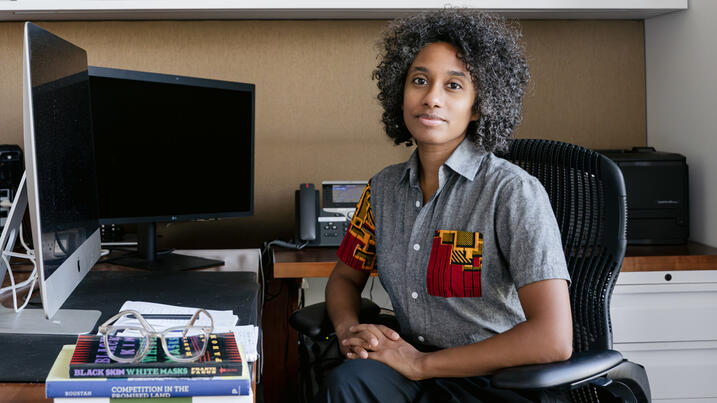
In her 2022 paper, “Can You Move to Opportunity? Evidence from the Great Migration,” Derenoncourt examined the economic consequences of the movement of Black Americans from the South to Northern cities. Although migrants achieved some economic gains, she found that economic prospects declined for subsequent generations. Using datasets on local government expenditures and neighborhood characteristics from 1920 to 2015, she identified backlash against new arrivals and subsequent disinvestment in urban neighborhoods as causes of the downward shift in economic mobility. Racial segregation in schooling increased as more white children attended private schools, while funding for policing and incarceration rates also increased. Derenoncourt’s findings suggest that policies designed to relocate low-income families to higher-opportunity neighborhoods can have unintended negative consequences when implemented at scale.
For her 2023 paper, “Wealth of Two Nations: The U.S. Racial Wealth Gap, 1860–2020,” Derenoncourt and her co-authors harmonized data from the census, early state tax records, and the Survey of Consumer Finances to create the first continuous record of the racial wealth gap from the Civil War to 2020. They determined that the gap has widened since the 1980s because earnings from investment assets have primarily benefited white households.
Derenoncourt received an AB from Harvard University in 2009, an MSc from the London School of Economics in 2011, and a PhD from Harvard University in 2019. She is also the founder and faculty director of Princeton’s Program for Research on Inequality.
Song Lin
Lin develops ways to use electricity to drive chemical reactions instead of relying on large amounts of chemical ingredients that can be expensive, resource-intensive, or toxic. His work offers new ways to build complex molecules used in medicines and materials such as plastics.
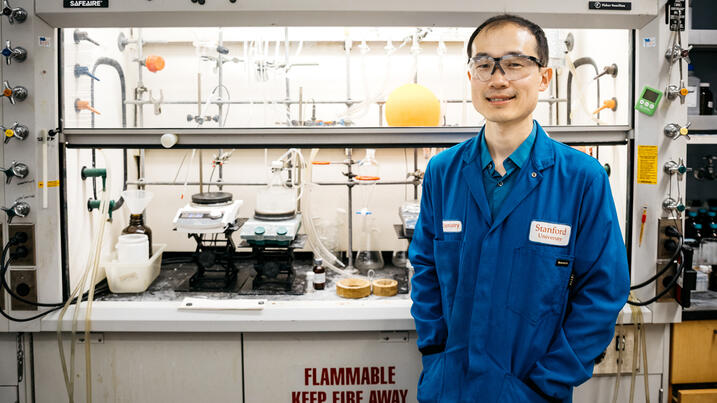
In early research, Lin developed an electrical method for transforming one type of molecule, known as an alkene, into another type that is found in many medicines and other biologically active substances. His process uses manganese, an abundant and relatively inexpensive element, along with the electrical current from two AA batteries. This approach avoids the rare and expensive heavy metals often used in similar reactions and produces less toxic waste.
More recently, Lin and his collaborators addressed a challenge that arises when a molecule contains several similar carbon-hydrogen bonds: how to change one specific bond without affecting the others. They developed pairs of highly reactive molecules that are designed to work together without reacting directly with one another. The molecules are kept far enough apart to prevent them from combining, but close enough to cooperate. Lin’s team can activate these pairs with electricity and direct them to make changes at specific locations on a molecule.
Lin has also developed tools that make these electrical reactions easier to use and study. His wireless devices use light to power chemical reactions and can support hundreds of reactions at the same time. This makes it possible to test many reactions efficiently. His work is opening new pathways to chemical processes that are safer, more environmentally friendly, and better able to produce a specific desired result.
Lin received a BS from Peking University in 2008 and a PhD from Harvard University in 2013. He was a postdoctoral fellow at the University of California, Berkeley, from 2013 to 2016 and was affiliated with the Department of Chemistry at Cornell University from 2016 to 2026. He joined Stanford’s faculty as a professor of chemistry in 2026.
Vincenzo Vitelli
Vitelli uses ideas from physics, engineering, and mathematics to understand materials with unusual properties, including artificial materials, soft materials, and systems made up of energy-using components. His work is helping researchers better understand biological and engineered systems and develop entirely new kinds of materials.
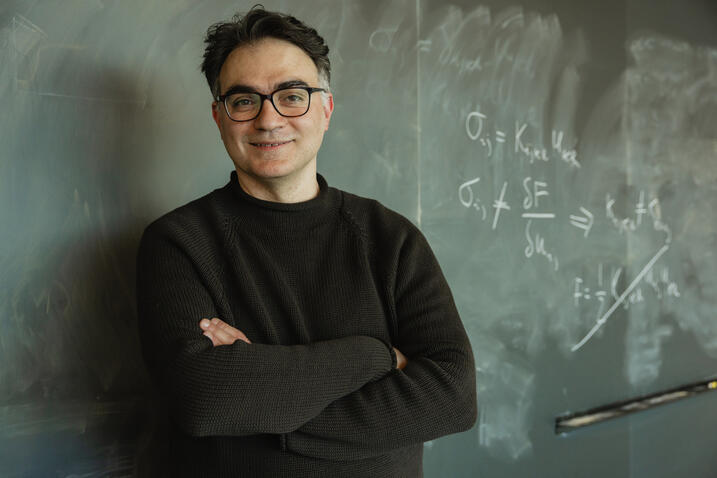
Vitelli was among the first researchers to apply ideas from topology—the study of properties that remain unchanged when an object is bent, stretched, or otherwise reshaped—to mechanical metamaterials: artificial materials designed to have mechanical properties that do not occur naturally. He showed that ideas originally used to describe the movement of electrons could also help researchers design materials with distinctive mechanical properties.
Vitelli has also advanced the study of active matter—systems made up of individual components that take in and use energy like living tissues, flocks of birds, and groups of robots. In many such systems, a component does not respond to a push or other disturbance with an equal force in the opposite direction. Instead, its response can be uneven or one-sided.
Vitelli introduced the concept of “odd elasticity” to describe how soft, active materials respond when they are squeezed, stretched, or otherwise reshaped. In ordinary soft materials, applying force in one direction generally produces a predictable response in another direction. Vitelli showed that active materials can behave differently: a force applied in one direction can cause movement or reshaping in several directions. He also showed that systems with these one-sided interactions can shift from a stationary state to a moving state because of their own internal activity, rather than because of an outside force. His research is inspiring new materials and technologies in mechanical engineering, robotics, and biophysics. It is also opening new directions for studying how these physical principles might apply to biology, human behavior, and artificial intelligence.
Vitelli received a BSc from Imperial College London in 2000 and a PhD from Harvard University in 2006. He is a professor in the Department of Physics and the James Franck Institute at the University of Chicago.
About the MacArthur Fellowship
The MacArthur Fellowship is a five-year $800,000 “no strings attached” grant to individuals who demonstrate exceptional creativity and the prospect for continued achievement. The fellowship gives recipients the flexibility to pursue their artistic, intellectual, and professional activities without specific obligations or reporting requirements. There are no limits on age or area of activity, and individuals cannot apply. Fellows are nominated anonymously by leaders in their fields and selected by an anonymous committee. In addition to recognizing and supporting exceptional creativity, the foundation hopes the Fellowship will inspire people to pursue their own creative interests.
The preceding article was generated by ChatGPT and engineered, edited, and laid out by Paul Massari from information provided by the John D. and Catherine T. MacArthur Foundation.