Building Community, Spreading Joy
RAs Ghezae and Kadoma help build relationships that make Harvard Griffin GSAS's residence halls feel like home

Atte Kadoma and Isaias Ghezae had a lot of options when planning a fall outing for their fellow students in the residence halls of Harvard’s Kenneth C. Griffin Graduate School of Arts and Sciences (Harvard Griffin GSAS). They could have gone leaf peeping, immersing themselves in the area’s gorgeous fall foliage. They could have taken folks to one of Greater Boston’s many museums of art and culture. They could have visited a site that explores Massachusetts’ millennia of indigenous history. In the end, though, the choice was not “which” place to go, but “witch.”
“I thought, ‘Well, Salem has so much to do,’” says Kadoma. “There’s food, museums, shops, the outdoors—really something for everybody. And it’s just really fun in the fall with all the history and Halloween vibes. It’s also fairly inexpensive to get to—only $10 for a weekend pass on the commuter rail. Overall, everyone really enjoyed the day!”
Spreading joy and creating community are central to Kadoma and Ghezae’s work as resident advisors (RAs) and outings liaisons in Perkins Hall. And while each is immersed in a demanding PhD program at Harvard—psychology for Ghezae, materials science & mechanical engineering for Kadoma—they say that being an RA brings balance to their lives and enriches both their student experience and their scholarly pursuits.
A Day in the (Residential) Life
Perkins Hall, where Ghezae and Kadoma both live, is one of four residence halls at Harvard Griffin GSAS. Built in the 1890s along with Conant Hall, Perkins was joined in 1950 by Richards and Child halls, both of which were designed by renowned architect Walter Gropius. The halls can house more than 400 residents, mostly Harvard Griffin GSAS students, although a small group from other graduate schools at the University live there as well.
As RAs, Ghezae and Kadoma get a room and up to 10 meals a week at the Commons at Lehman Hall. They also gain valuable leadership, administrative, and interpersonal skills. “As well as being community builders, RAs are also liaisons between residents and the Office of Residential Life,” says Ashley Skipwith, director of residential life at Harvard Griffin GSAS. “But they are also liaisons between residents and other Harvard Griffin GSAS offices, including Student Services and Facilities.
Each day as an RA is different, Ghezae and Kadoma say, but there are some similarities. “It usually starts like any other graduate student’s day—with classes, research, writing,” notes Ghezae. “But it’s punctuated by small moments of community. Day-to-day, I might check in with residents I recently spoke with, plan logistics for an upcoming event, or coordinate something with the Office of Residential Life.”
Evenings sometimes include visits to the Commons at Lehman Hall for dinner with fellow RAs to discuss the challenges of their work, provide support to one another, and exchange ideas. They also check into the hall’s common areas to connect with residents, during or after an intense day in the library, classroom, or lab.
“In the evenings, a lot of residents on the second floor of Perkins gather around the table in the kitchen there,” Kadoma says. “We like to study together. Recently, we’ve been doing daily crosswords. One resident is very passionate about them, so we save the New York Times crossword for 10:00 p.m. every night and do it together. Often, we stay up late into the night talking about our research—sharing challenges or ideas.”
From time to time, RAs also organize more formal events to bring residents together. Both Ghezae and Kadoma remember the fun students had at a residence hall outing organized by Kadoma to Wachusett Mountain in western Massachusetts last winter. “It was my first time downhill skiing, and it was a blast,” Kadoma says.
Added Depth and Purpose
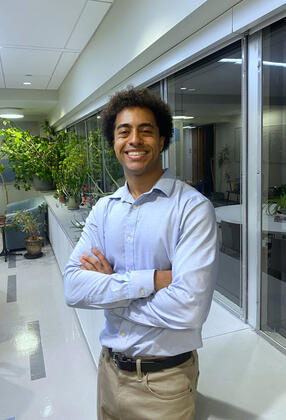
A PhD student in psychology, Ghezae was an RA in college where he experienced the rewards of connecting with residents, building community, and organizing events that bring people together. “In college, that role added a lot of depth and purpose to my college experience, and I wanted to recreate something similar in graduate school,” he says.
Although his PhD work is rigorous, Ghezae says that being an RA encourages him to think about life beyond academics. “It often pushes me to be more social, to care for others, and to engage with people in ways that make me more grounded and well-rounded,” he says. “Academics can sometimes make you focus narrowly on your own work, but the RA experience really reminds you of the value of empathy, community, and human connection. That’s why I decided to take on the RA role.”
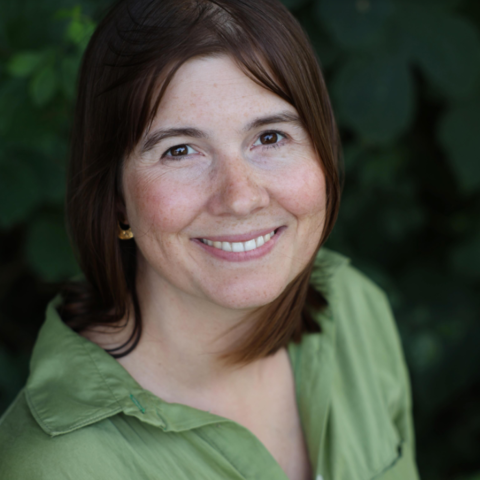
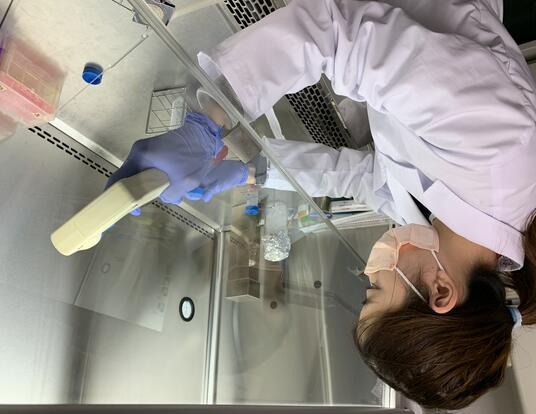
Kadoma, who studies materials science and mechanical engineering, says that being a source of joy and support for her fellow students outside of the lab elevates her work inside it. “When you connect with others, you learn things that benefit your own research,” she explains. “For example, in the halls, you get to meet people from lots of different programs. I’ve met people in the School of Design who’ve shared tips and tricks for how to make my figures in research papers visually appealing. I’ve gotten to learn those sorts of things from interacting with people as an RA.”
[Being an RA] often pushes me to be more social, to care for others, and to engage with people in ways that make me more grounded and well-rounded.
–Isaias Ghezae
The compensations of the work aside, Ghezae and Kadoma acknowledge that being an RA does take time and effort. The good news is that there are plenty of helping hands to pitch in. Kadoma observes that the Wachusett trip and Salem outing were both collaborative efforts. “Isaias was a big help in planning Salem, as was Elissa Day, the Student Center Outings Fellow,” she says. “It was a joint effort between both our offices to send out flyers and draft announcements. Elissa handled collecting payments and logistics. It was a big event—50 people signed up within three days of issuing tickets. It just wouldn’t have been possible without that collaboration.”
Residents as Well as Advisors
When Ghezae arrived in Cambridge from California, he dreaded navigating the notoriously difficult—and expensive—Boston rental market. But although he came to on campus housing for the convenience—Perkins Hall is only minutes away from his lab—he stayed because of the many intangible benefits.

“There is a built-in sense of community in the halls and an opportunity to meet people I otherwise wouldn’t have crossed paths with,” he says. “Living on campus makes it easier to stay engaged—attending events, collaborating with peers, having meaningful conversations. It’s been one of the most rewarding aspects of my graduate experience.”
After growing up in Minnesota and attending college in Iowa, Kadoma arrived at Harvard Griffin GSAS in 2020, the midst of the COVID pandemic. As if being at a new school in a new part of the country wasn’t isolating enough, courses and classes were almost entirely online only. She landed a spot in Conant Hall with only seven other residents. Thankfully, one of them was her RA.
“He made a difference,” she says. “We’d go on walks around campus, take Bluebikes into Boston, and he’d show me different parts of the city. He went the extra mile to cultivate a sense of community. He was in his dissertation year when I was just starting. It’s why the halls feel like home to me.”
Like Ghezae, Kadoma appreciates Perkins’ proximity to her lab, classrooms, and department buildings. (“When I need to do a late-night experiment, I can just walk down the street.”) But the sense of community and diversity of thought she encounters are the biggest rewards of living on campus. “In my program, you tend to go to the same seminars, work in similar research fields, and get one type of perspective,” she says. “In the halls, you meet people in design, exchange students from the UK, students in Russia, Eastern Europe, Central Asia studies, and many others. You get lots of different perspectives on topics, and that helps me think about my work in new ways.”
[My first RA] made a difference. We’d go on walks around campus, take Bluebikes into Boston, and he’d show me different parts of the city. He went the extra mile to cultivate a sense of community . . . It’s why the halls feel like home to me.
–Atte Kadoma
Moreover, Ghezae and Kadoma form bonds with fellow students not only from different disciplines, but also different backgrounds. “Most of my friends in the residence halls aren’t originally from the US,” Ghezae notes. “Some come from Pakistan, France, Germany, India. Each brings different traditions, ways of thinking, and experiences. Would I have had these friends otherwise? Maybe, but probably not as varied. The halls naturally facilitate cross-cultural connections in a way that doesn’t happen as easily off campus.”
Home Away from Home
Making the halls feel like home to other students is what continues to inspire Kadoma’s work as an RA. “You get excited to see people in the Perkins second floor kitchen,” she says. “It feels like coming home to friends. When someone isn’t there, it’s sad. We’ll say, ‘Where were you? You missed the crossword!’ It really is a small circle of people you look forward to seeing and doing life with.”
Ghezae says that circle of friends is one of the residence halls’ biggest selling points—and something he hopes students consider when thinking both of where they want to live and whether or not to become an RA themselves.
“People who don’t live in the halls miss out on the everyday sense of community here,” he says. “It’s the ability to meet and talk to people from different parts of the world and from different fields. There’s something special about running into friends in the hallway, sharing conversations in the kitchen, and attending events that bring people together. Those small, consistent moments build real relationships and make campus life feel more connected and supportive.”
Join the resident advisor team! Apply on Slideroom by January 31 to be a 2026–2027 RA.