From DNA to Disagreement
President’s Building Bridges Fund project opens dialogue about genetics across campus

We all know what a gene is: a unit of inheritance, the way we trace where we come from. No, wait. Isn’t it a DNA sequence that creates a protein—a fundamental component of a cell? Except that a lot of DNA doesn’t actually transcribe into a protein. In that case, should we still call it a gene?
Well, at least life scientists must know what it is, right?
“It’s actually not that clear what a gene is,” says Harvard life scientist Daniel Faccini. “Every biologist whom you ask probably has their own working definition of it.”
What are genes? And how much can you know about an organism by looking at it? These questions are the subject of immense debate both inside and outside of the sciences. Too often, experts and nonexperts alike form their own opinions, building walls and moats around them for defense as if they were medieval castles. With Whose Genes?, a new project funded by the President’s Building Bridges Fund (PBBF), Faccini and Julius Tabin, both PhD students in organismic and evolutionary biology at the Harvard Kenneth C. Griffin Graduate School of Arts and Sciences, hope to map the locations of these fortresses on the University’s intellectual landscape and bring the troops out to engage vigorously—but civilly—with one another.
Our Genes
As biologists, Faccini and Tabin are constantly bumping into different conceptions and misconceptions about genetics in the news and among the general public. “You know, people claiming that they found genes that explain educational attainment or government rhetoric about good genes or bad genes,” Tabin says.
It’s actually not that clear what a gene is.
—Daniel Faccini
In response, the duo conceived a project in 2025 to collect knowledge and questions about genetics from the Harvard community. “We wanted to foster dialogue between professors as a tool for helping people understand more about the science and its state. Where does our knowledge actually lie? What actually is settled and what isn’t?”
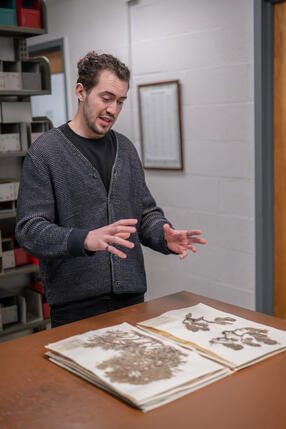
Faccini says the project’s name, Whose Genes?, refers to the place where genetics intersects with the concerns and experiences of people throughout the University.
“We all have genes, and we have tried to answer questions about our own identity—where we come from—by looking at our DNA, genes, and genome,” he explains. “So, Whose Genes? is a concept, a question, and, in a way, an answer: they’re your genes, my genes, and everybody’s genes.”
Late last year, Faccini and Tabin’s project received funding from the President’s Building Bridges Fund, an initiative of the Office of the President and administered by Community and Campus Life, that “seeks to foster a culture of pluralism at Harvard by building cross-cutting community among students outside the classroom.” Lakshmi Clark, dean of students at Harvard Griffin GSAS, says the PBBF is a chance for PhD students to continue to contribute to the life of the University, share interesting research and ideas, and foster learning across differences.
“Our School is composed of 57-plus degree programs spanning across the University,” she notes. “Each is unique. Students in those programs contribute new and exciting research to the University and the world. The PBBF provides them with an opportunity to further collaborate with others at Harvard in an effort to promote community-building.”
Clark says Whose Genes? is noteworthy because it demonstrates how research can contribute to discussion across differences. “Faccini and Tabin are scientists interested in furthering discussion about genes. Their project will undoubtedly promote new ideas and discussion about challenging topics while promoting inclusion and understanding between students and scholars with unique perspectives.”
Mapping Expertise and Inquiry
Along those lines, Faccini and Tabin envision Whose Genes? as both a dialogue and a tool that will be available to the community after the project has wrapped up in April 2026. To that end, the students plan to develop two “maps” that reflect the diversity of thinking and questions about genetics at Harvard.
For the first, the Map of Expertise, Faccini and Tabin plan to interview different professors across the University—experts who think about genes all the time for their research—on various questions of genetics: What is your working definition of a gene? What does it mean to say that a gene does something? What’s the best way to test what a gene does? What is the limit of the explanatory power of genes? And what’s the most important question that we should be thinking about asking about genes? The idea is to capture the range of opinion on the topic. “Some professors say that genes are the most important thing; they define nearly everything about you,” Tabin notes. “Other professors would even go as far as to say genes are not real.”
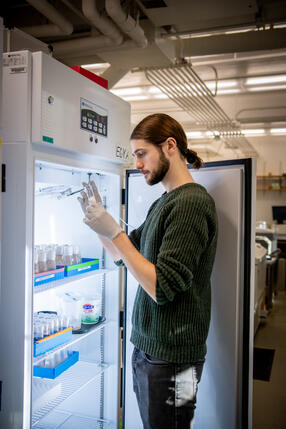
At the same time, Faccini and Tabin will solicit questions from the Harvard community at large about genes and genetics. “When we’ve gathered those, we’ll also create a Map of Inquiry and put the questions in a digital space so people can see whether folks at, say, Harvard Divinity School are thinking about the same type of genetic questions as people at Harvard Medical School. That’s another way the project will build bridges.”
Once the responses are gathered, the duo will make the maps available via a new digital platform and present them to the Harvard community in April at a panel discussion that brings together faculty with the most divergent opinions on genetics. The questions they address will flow from the Map of Inquiry.
Faccini says that the goal of the maps is not to catalog positions, but to understand the relationships between them. “We want to show how each researcher’s views are related to those of other researchers,” he explains. “It’s a space where you can interpret affinity between different practices or scientific schools.”
Some professors say that genes are the most important thing; they define nearly everything about you. Other professors would even go as far as to say genes are not real.
—Julius Tabin
Breaking through the Silo
Because the audience for Whose Genes? is not only experts in genetics but also the entire Harvard community and, ultimately, the general public, communication is central to the project’s success. For that reason, Faccini and Tabin are using their PBBF grant to contract with Buena Gráfica Social Studio, a Pawtucket, R.I.–based design firm led by faculty from the Massachusetts College of Art and Northeastern University.
“Visual communication is particularly important,” Faccini says. “We want to distribute posters across campus that will catch the eye of a Law School or Divinity School student walking by. So, we need something that will break through the scientific silo and appeal to the rest of the community.” Tabin says that the project’s online presence needs to be similarly accessible to the nonscientist. “We want a space that’s both intuitive and informative but not overwhelming,” he says. “Having a fine-tuned visual language is important if we’re going to include people who know nothing about genes but want to learn.”
Faccini and Tabin say that the ultimate stakes of their project are high. Both see a widening gap between the views of scientists and society at large. Faccini says history shows that the consequences of such a split can be dramatic. He cites as an example the Soviet Union during the 1930s and 1940s, when the agronomist Trofim Lysenko, who rejected Mendelian genetics, held power over the country’s agricultural system.
“Lysenko accumulated political power, but his theories were not supported by science,” Faccini says. “All of the country’s agricultural practices were shaped by his ideas, which, in addition to collectivization and other policies, contributed to the deaths of millions by famine in Russia and then in China in the mid-twentieth century.”
Today, Faccini and Tabin see some of those same dynamics playing out in skepticism about vaccines and other established public health measures. Whose Genes? is an attempt to rewrite the script by bringing science out of the ivory tower.
“I think that a lot of people find that when someone says, ‘I have a question about this,’ the response is, ‘Oh, well, that’s settled science. It’s how it is. You have to believe it,’” Tabin observes. “And often that may be true. It may be settled science. But it doesn’t do any good not to engage with people’s questions. Because then they start to do their own research—everyone has the tools now—and they may find papers that agree with an opinion they hold but have been debunked. If they don’t understand the scientific consensus, they won’t be able to navigate that information successfully.”
[Faccini and Tabin’s] project will undoubtedly promote new ideas and discussion about challenging topics while promoting inclusion and understanding between students and scholars with unique perspectives.
—Harvard Griffin GSAS Dean of Students Lakshmi Clark
To Ask Better Questions
Two words sum up Faccini and Tabin’s goals for Whose Genes?: diversity and understanding. They hope to capture a wide variety of perspectives on genetics, put them into context, and enable both experts and laypeople to see how scientists interact in real time around contentious issues. They say that it’s at least as important to enable members of the public to ask better questions as it is to provide them with answers.
“What we are making here is ultimately an experiment,” Faccini says. “We are setting up a way in which you can map a question and explore and study how people understand it. We hope this framework works for genetics, but also for other questions, in other disciplines as well. Ultimately, that’s what success would look like.”