Be Well: The Inner Voice You Haven’t Tried Yet
A psychologist’s case for self-compassion—and why it’s not what you think

Haley (not her real name) sat across from me, describing a week that had gone sideways: a bombed qualifying exam, a terse email from her advisor, and a long night of what she called “the spiral.” The graduate student picked herself apart into the wee hours of the night. She looked exhausted.
As her therapist, I asked her what she would say to a close friend in the same situation. She answered quietly: “I’d tell her she’s doing her best. That one bad week doesn’t define her. That she’s allowed to rest. She’ll get another chance.”
“So,” I said, “why not say that to yourself?”
She paused. “Because I don’t think I deserve it.”
That word—deserve—tells you everything. For high achievers like Harvard Griffin GSAS students, the idea of being kind toward yourself feels like something unreachable, not something you practice. But that’s exactly backward. And the research on self-compassion is unambiguous on this point.
What Self-Compassion Actually Is
Psychologist Kristin Neff, the researcher who put self-compassion on the scientific map, defines it through three interlocking elements: mindfulness, common humanity, and self-kindness. In my workshops—including Overcome Perfectionism Through Self-Compassion and the Befriend the Inner Critic summer series I run at Harvard University Health Services Counseling and Mental Health Services (CAMHS)—I return to these three components again and again, because they work together in a way that makes the whole practice more durable than any single habit.
Mindfulness in this context doesn’t mean sitting on a meditation cushion. It means noticing what you’re experiencing without immediately judging it or ruminating on it. The moment you can name a feeling—“I’m in a shame spiral,” “I’m exhausted and scared”—you’ve already created a little distance from it. I sometimes call this a practice of kindfulness: Being in the present moment with an open heart.
Common humanity is the recognition that suffering is not a personal failing—it’s part of the human condition. One of the most powerful moments in my workshops comes when students from different departments and different backgrounds realize they’ve all written nearly identical things on their inner critic worksheets. The isolation of “it’s just me” begins to break open.
Self-kindness is the piece most people fumble. Not because they’re cold, but because they’ve come to believe that warmth toward oneself is weakness, laziness, or self-indulgence. Most of the students I work with would never say out loud to a friend what they say to themselves inside their own heads.
The Evidence Is Hard to Ignore
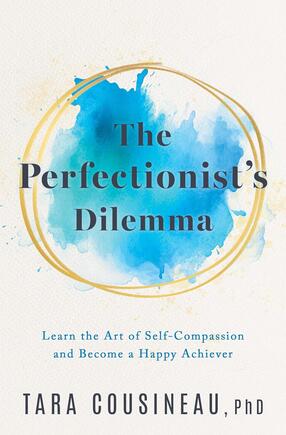
Over the past two decades, a robust body of research has documented what self-compassion practice does for people who are suffering. I address many of the findings in my book The Perfectionist’s Dilemma: Learn the Art of Self-Compassion and Become a Happy Achiever. Self-compassion is an antidote to the variety of “dis-ease” we often struggle with. It reduces symptoms of depression, anxiety, and PTSD. It lowers the intensity of the inner critic and decreases shame. It supports resilience after failure and increases intrinsic motivation—meaning people become more persistent and growth-oriented, not less. With graduate students and other high achievers, I find that self-compassion buffers against burnout and lessens the paralysis that often accompanies perfectionism, such as procrastination and imposter feelings.
Research findings I find particularly useful to share with skeptical students is that people who practiced self-compassion after a failure were more motivated to try again, not less (Breines and Chen, 2012), and have a sense of self-efficacy or competence to cope with challenges (Liao et al., 2021). Self-compassion doesn’t lower the bar. It makes the bar feel reachable.
Self-compassion doesn’t lower the bar. It makes the bar feel reachable.
The Resistance Is Real—and Normal
I never minimize the pushback. Many people—especially high achievers and perfectionists—experience genuine resistance to self-compassion. They fear it will make them complacent. They associate kindness toward themselves with letting themselves off the hook, or with the kind of empty affirmations that feel embarrassing to say out loud. Unrelenting standards and perfectionism got them this far, didn’t it?
Psychologist Christopher Germer, co-developer of the Mindful Self-Compassion method with Neff, offers an analogy I love: self-compassion is like oxygen added to a fire. The flames can roar at first, causing an emotional backdraft. When people start to soften toward themselves, old disappointments and traumas often surface—memories of being dismissed, hurt, or told they weren’t enough. This is not a sign that the practice is failing. It’s a sign it’s working. The protective inner critic, which has been doing its job all these years, needs time to stand down.
The key is going gently. Not swinging from harsh self-criticism to forced positivity, but finding the middle register: the voice you’d use with a person you actually care about.
Fierce Self-Compassion: The Part Nobody Talks About
There is also a misconception that comes up often, especially in academic and professional environments: the idea that self-compassion is soft and lightweight. Striving for excellence becomes equated with hard work, self-sacrifice, and suffering. Yet, self-compassion requires more emotional courage than self-criticism, not less. (Self-criticism requires very little effort!) And it tends to make people more accountable because they’re acting from values rather than from fear.
Neff describes self-compassion as having both yin and yang aspects. The yin is the receptive, nurturing quality — the soothing and comforting that most people imagine. But the yang is fierce and active. Fierce self-compassion means advocating for yourself. This may look like setting limits with people who make you feel less than. Or, speaking up when something isn’t right. It’s taking responsibility for your own needs and choices rather than spiraling into a shame storm.
This can be tricky because of the inherent power differentials in academic and work settings. I see fierce self-compassion in action when a student tells an advisor or colleague that a pattern of communication isn’t productive. Or when someone decides to drop their cover of invulnerability and asks for help or an extension—not as a failure, but as a reasonable request under the circumstances. Or when a student recognizes that the reason they can’t say no to anything isn’t that they’re a dedicated team player, but because a frightened part of them is trying to avoid rejection.
Fierce self-compassion means advocating for yourself . . . It’s taking responsibility for your own needs and choices rather than spiraling into a shame storm.
Micro-Doses: Where to Start When You Have Five Minutes
One of the most useful things I’ve learned from working with busy, overwhelmed students is that self-compassion does not require a meditation retreat or a long journaling practice. It can be practiced in ordinary moments, in small doses, throughout the day.
Compassionate touch is one of the most accessible entry points, and there is compelling research that shows it lowers cortisol levels. Simply placing a hand on your chest, or holding one hand in the other, activates the body’s care system—the same neurobiological pathway involved in soothing a distressed child. This sounds small because it is small. That’s the point. The nervous system responds to physical warmth even when the mind is still skeptical.
A practice I teach called the “self-compassion break”—adapted from Neff and Germer’s Mindful Self-Compassion program—takes under a minute. You acknowledge what you’re feeling (This is hard right now). You remind yourself that difficulty is part of the human experience (I’m not the only one who struggles like this). And then you offer yourself something kind (What do I need right now?). Three beats. The words are yours to choose.
I often suggest people start with the question students find least threatening: not “How can I be kinder to myself?” but “What would I say to a good friend going through exactly this?” Then say that. To yourself. Out loud if you can stand it. Quietly, if you can’t.
A Final Word on the “Deserve”
Haley came back a few weeks later. She’d had another hard week. But something had shifted. “I caught myself going into the spiral,” she said. “And I just . . . paused. I put my hand on my chest like you said. And I thought, okay, this is genuinely hard, and you’re doing your best. I didn’t fix anything. But I didn’t make it worse. If anything, I stopped overthinking and got a good night’s sleep.”
That’s not a small thing. That’s the beginning of a different relationship with yourself — one that doesn’t require perfection but the acknowledgment that you are worthy of care, rest, and dare I say it, play.
Self-compassion is not a reward for getting it right. It’s a resource you can access whenever you need it most, especially when you think you don’t deserve it.
Dr. Tara Cousineau is a staff psychologist at Harvard University Health Services Counseling and Mental Health Services. Learn more about her summer workshop series, Befriend Your Inner Critic for Graduate Students, on the CAMHS and Engage calendars.