Transforming Colonial Religion into Native Peoplehood
Trujillo unpacks the complicated relationship between Native nations and Christianity, showing how everyday people built community and power through religious practice.

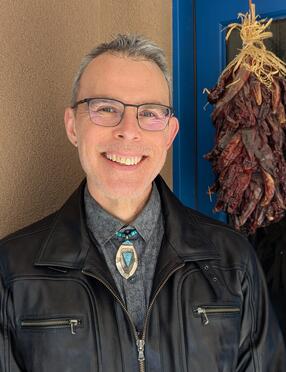
“You’re Indian, and you’re Catholic—and don’t you forget it,” Anthony Trujillo’s Grandma Gregorita used to tell his father when they were temporarily living away from Ohkay Owingeh, the Tewa-speaking Native pueblo in northern New Mexico that they called home. Growing up, Trujillo wondered how a religion brought to his community by Spanish colonizers could become so foundational to its life. Why had his ancestors embraced Catholicism? How did they forge such a strong collective identity from the fires of colonial rule?
“[B]eing in the cultural environment of northern New Mexico, with the Native history, Spanish history, and American history—a place of confluence—planted a lot of questions,” he says.
As a PhD student in American studies at Harvard Griffin GSAS, Trujillo investigates the complicated connections between colonial religions and Native life. His research explores how everyday people—often women—built power for their communities through Christian practice, transforming colonial religion into creative and artistic expressions of Native peoplehood.
Cultivating Community Power
For years, Trujillo engaged with these questions indirectly. He pursued an undergraduate degree in music, volunteered for the Peace Corps, and continued working there as a recruiter after his service ended. Eventually, his curiosity pulled him toward graduate school, and he enrolled at Yale Divinity School to pursue a master of divinity degree.
“[That’s] where I really started to dive into those questions that had been with me for a very long time about the connection between religion, my own family’s Native history, colonialism, and how Indigenous people make a life in these often fraught and very challenging circumstances,” he says.
Trujillo’s dissertation takes up this line of inquiry in the Northeast, centering on an unassuming data source: a 50-page booklet of Native spiritual autobiographies. The Experiences of Five Christian Indians of the Pequod Tribe was published in Boston in 1833 by Pequot minister William Apess. The short collection has been underappreciated by scholars interested in the history of Native tribes in the northeastern United States, but to Trujillo, it offers a window into the questions of religion and community life that have followed him for decades.


“It shows a genealogy of Indigenous, largely women’s, power from the 18th century into the 19th century—a really critical time when the Pequot tribe and many Native tribes in the Northeast were working to assert themselves as distinct political bodies in relation to the newly formed United States,” Trujillo explains.
His analysis began with one of the booklet’s five “conversion narratives”: the testimony of healer and preacher Sally George.
“[T]he climax of Sally George’s testimony happens when she is baptized in her ancestral river and goes on to become a powerful preacher and healer,” Trujillo explains. “Her Christian experience does not break her connection with the community or with her homelands—it deepens and intensifies it. And out of that experience flows her creativity and authority.”
For a very long time, scholars have struggled to understand how and why Native peoples in North America adopted Christianity. Was it pragmatic or sincere? By bringing new analytical tools to one of the earliest and most thorough accounts of a connected group of Pequot Christians, [Trujillo is] bringing a new and illuminating perspective to the still-mysterious question.
–Philip Deloria, Leverett Saltonstall Professor of History
Through George’s story and other testimonies, Trujillo argues that Christianity—despite having been brought into Pequot homelands by English colonizers bent on conquest—allowed this group of Pequot people to build and express their collective strength. Often for Indigenous women, the church provided a space to express power and authority, allowing Native people to maintain their communities and their cultures through trying times.
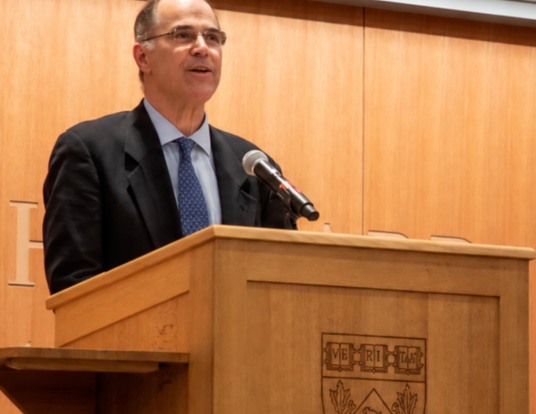
According to Philip Deloria, the Leverett Saltonstall Professor of History at Harvard University and Trujillo’s adviser, this unique approach offers new answers to longstanding questions in the field.
“For a very long time, scholars have struggled to understand how and why Native peoples in North America adopted Christianity. Was it pragmatic or sincere?” says Deloria. “By bringing new analytical tools to one of the earliest and most thorough accounts of a connected group of Pequot Christians, he’s bringing a new and illuminating perspective to the still-mysterious question.”
Connecting Politics, Aesthetics, and Place
In addition to offering a biographical account of these five Christian converts, Trujillo’s dissertation examines the cultural and artistic themes that run through their stories. For Indigenous Christians, traditional forms of music and art served as cultural “anchors” that kept them rooted in the Pequot community and their ancestral homelands.
“Things like sound and art can get categorized as aesthetic or set apart from the political in some cases,” Trujillo says. “But among many Native communities, there’s an integral understanding that those things make us who we are—whether it’s making pottery in the Southwest or basketry and other arts in the Northeast. These creative practices invoke a sense of communal belonging and are linked with the specificities of a place: clay, trees, rivers, animals.”


In the booklet of spiritual autobiographies, Trujillo noticed that each of the Pequot people turned to artistic expressions like music, basket weaving, and storytelling to strengthen their communities even as colonists pushed for assimilation or altogether disregarded their heritage. He has also seen this firsthand in Ohkay Owingeh, where public feast days featuring traditional song, dance, and food bring the whole community together and create space to build their future while honoring their past.
“I would say that it’s one of the reasons why my community—and Indigenous communities broadly—are so insistent on our ceremonial practices,” he says. “[O]ur songs convey stories of where we’ve come from and important things that have happened as well as where we are going together.”
Indigenous communities often have “a distinctive appreciation” for how the arts intersect with politics and place, Trujillo says, but this relationship is not unique to Native communities. “Music and the arts are central to how any society comes to understand what it is, who it is, and how it expresses and enacts power in the world.”
[T]he climax of Sally George’s testimony happens when she is baptized in her ancestral river and goes on to become a powerful preacher and healer. Her Christian experience does not break her connection with the community or with her homelands—it deepens and intensifies it. And out of that experience flows her creativity and authority.
–Anthony Trujillo
Challenging the Dominant Narrative
Through his dissertation research, Trujillo hopes to add nuance to the conversation about the relationship between Native communities and Christianity.
“It can be easy to categorize Christian practice as colonial. It’s uncomfortable,” he says. “But this perspective can overlook a cherished and central component of life for many Indigenous people.” In his research, Trujillo found that some of the artistic and musical traditions that sustain community cohesion—like hymn singing, preaching, and reading the Bible—are derived from Protestant Christianity.
At the same time, however, Native people pushed back against many Christian practices. The Pequot women featured in Apess’s booklet were strong critics of New England society and religion. “[They] fiercely condemned the racism, servitude, and dispossession that they and their Pequot community experienced at the hands of white Christians,” Trujillo says. “These women’s critiques and their faith are both important parts of the story of Native Northeastern history and life.”
According to Pamela Klassen, a professor of religion at the University of Toronto, exploring this nuanced relationship is a difficult but necessary intervention. “[Trujillo’s research] is characterized by both courage and creativity as he refocuses attention on what it meant for Indigenous people to engage with Christianity,” she says.
Trujillo’s experience at Harvard has modeled how a vibrant academic community can support the next generation of Native scholars. He credits the American Studies program, which has offered him a rich intellectual center for interdisciplinary study and conversations, and the Harvard University Native American Program, which connects Native scholars across the university through both academic and social programming, as two major sources of support throughout his academic journey. He’s also received outstanding guidance and encouragement from his advisor, Deloria.
Most of all, Trujillo draws motivation from the women in his own family who have worked tirelessly to keep their Pueblo connections and Tewa language alive. One powerful example is his Grandma Gregorita, who strove to maintain her family’s religious practice when financial strain in the 1960s pushed them to move temporarily from the Pueblo to Los Angeles.
I’m hoping to . . . draw attention to this larger community of people, not just the people who are labeled as radical or revolutionary, but the people who do radical and revolutionary work on a day-to-day basis by feeding their families and making sure they maintain a spiritual practice that energizes the community that holds them together.
–Anthony Trujillo
“That was basically like moving her family to another country, from village life to a metropolis. But she could do that because she knew who she was and where she was from,” Trujillo says. “[W]hile they were there, taking her family to Catholic Mass every Sunday was one of the principal ways of ensuring that her kids would have a connection with the church, and through the church, with their Native home.”
While history tends to memorialize heroic acts of greatness, Trujillo believes that everyday people like his grandmother also deserve recognition for their contributions to spiritual and communal life.
“I’m hoping to . . . draw attention to this larger community of people, not just the people who are labeled as radical or revolutionary, but the people who do radical and revolutionary work on a day-to-day basis by feeding their families and making sure they maintain a spiritual practice that energizes the community that holds them together,” he says. “[P]eople like my grandma, my aunts, who for more than 400 years have sustained our communities day in and day out.”