The Reader Over Your Shoulder
Notes from a Writer's Desk
“To write English well, it is generally agreed, is not to imitate, but to evolve a style peculiarly suited to one’s own temperament, environment and purposes.”
Though it may sound like it, in its context this is not meant as advice to aspiring writers. It is instead a reflection on the shaggy nature of the English language, “an immense, formless aggregate not merely of foreign assimilations and local dialects but of occupational and household dialects and personal eccentricities.” How on earth does one wrestle this into some set of broadly applicable standards that do not stifle all joy and voice in prose?
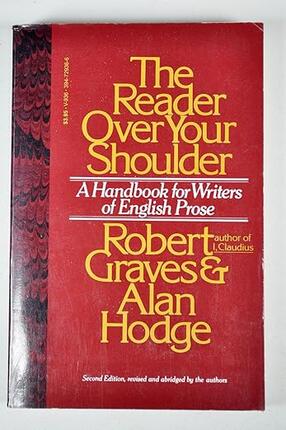
Enter The Reader Over Your Shoulder: A Handbook for Writers of English Prose by Robert Graves and Alan Hodge. In her introduction to the 2017 reprint, Patricia T. O’Conner calls it “the best book on writing ever published. It’s the sanest, most rigorous examination of English prose style to be found anywhere, and it may also be the most peculiar.” It is a relentless text, a funny one, and—if you are of a certain disposition—absolutely fascinating.
The Reader Over Your Shoulder was originally published in 1943, and it seems that its peculiarity was recognized at the time: the second edition removed, among other things, a lengthy history of English prose styles beginning with an Anglo-Saxon translation of Boëthius in the late 9th century. Perhaps some critics, not unreasonably, failed to see how such a history was germane to a writing handbook.
But in the work as in the title, the handbook element is less prominent than the imagined reader, who is intelligent, vaguely impatient, and always present at your shoulder. This reader must be given the right kind and amount of information, must be treated with respect for her time and wisdom, may not be subjected to undue demands by the writer and, most of all, deserves to know what you mean after having read your prose.
To this end the authors offer a set of rules and then examples of their application. They divide their guidance into 25 numbered Principles of Clear Statement and 16 lettered Graces of Prose (A–P), allowing them to tag sentences with notes like 23B to indicate something violating the 23rd principle and the 2nd Grace.
The Principles range from fundamental (“1. It should always be made clear who is addressing whom, and on the subject of whom.”) to more nuanced matters of style that betray the authors’ close attention to language (“11. No unintentional contrast between two ideas should be allowed to suggest itself.”). These rules are, the authors say, “concerned with the secure conveyance of information.”
Principle 10, for example (“Every word or phrase should be in its right place in the sentence”), calls to task sloppy newspaper writing in the following:
“Latest reports show that 28,306 children do not go to school in England. More than 4½ million are getting full-time instruction, 72,505 are receiving part-time schooling.”
Our authors note that “Far more than 28,306 children do not go to school in England; but in England 28,306 children do not go to school.”
The charmingly named Graces deal with style more than strict correctness, offering suggestions such as, “C. Metaphors should not be in such close association with unmetaphorical language as to produce absurdity or confusion.”
The example given on this topic is a fun one, taken from Graham Greene’s novel It’s a Battlefield: “Kay Rimmer sat with her head in her hands and her eyes on the floor.” The reader will, I hope, see why Graves and Hodge asked with good-natured (but unconcealed) glee whether her teeth were on the mantle.
This alphanumeric system of Principles and Graces is put to use in the second, longer part of the book. Part II examines, marks, and corrects the writing of numerous authors according to the style set out in Part I, and then rewrites the selected passages with these rules in mind. The authors take pains not to erase the voice of the original work, but only to demonstrate how it might be made clearer. In so doing, they display deep learning, a love of English, and a ruthless commitment against even titans of literature. Ernest Hemingway, Aldous Huxley, George Bernard Shaw, Ezra Pound, T.S. Eliot, and many more are subjected to scrutiny.
You might think that such a book ends up endorsing only the driest of prose or (perish the thought!) governmental or legalistic writing. It does not. Chapter 4, “The Use and Abuse of Official English,” rejects bureaucratic style thoroughly, and Graves, who wrote poetry, memoir (Goodbye to All That), novels (I, Claudius, later a popular BBC series), and more, cannot reasonably be accused of being dull. Alongside soberminded, grammatical maxims lie sentences like:
“The natural arrangement of ideas in historical writing is the one recommended in Alice in Wonderland by the King of Hearts to the White Rabbit: ‘Begin at the beginning, and go on till you come to the end: then stop.’”
The writing here is slyly fun—cheeky, in the appropriate vernacular[1]—but driven by a dark undercurrent, the genuine feeling that the English language of the 1940s had lost its way, slipping into a laxitude that required conscious correction. In this concern for the state of linguistic affairs, The Reader Over Your Shoulder joins another literary canon developing in 1940s Britain: that of George Orwell.
The two approaches do not overlap precisely. Orwell worried that sanitized language might cloak evil in abstraction, and that euphemism could be deployed to stretch the gap between word and meaning so far as to nearly break the two apart; in 1984, the Ministry of Peace concerns itself with war. Propaganda, totalitarianism, and the shocking violence of a world at war created an environment where to see what was in front of one’s nose required a constant struggle against deliberate obfuscation.
Graves and Hodge worry about precision and clarity too, though less as a deliberate, systemic matter and more as one of inattention. They claim that the writing of English is a “moral matter” which, because of a generous British national character inclined to ignore faults until the last moment, has been allowed to degrade. It will continue to do so until it reaches a level of acute crisis. Their unease about the state of the English language in 1940s Britain leads them to “regard the present crisis as acute enough to excuse this book.”
Graves and Hodge caution that there “is no natural safeguard in the English Language against the faults of haste, distraction, timidity, dividedness of mind, [or] modesty.” It is a wild language unbound by academies or fixed meaning, and so it falls to writers to resist dangerous imprecision. As with Orwell, the decoupling of sense from meaning was cause for distress, and when reading Graves and Hodge on the matter, to write carelessly feels almost like a moral failing.
The Reader Over Your Shoulder is, indeed, an extraordinary book on writing. Its enduring utility is not at odds with the sense that it came from a specific time and place—which, being true of all books ever written, can hardly be judged a fault. In fact this only adds to its interest, and I found myself wondering what it was about Britain in the 1940s that led to such concern about the (ab)use of language.
As a practical matter the 41 Principles and Graces are admirable, and I can say with confidence that their constant application will produce clearer prose. Implicit in the authors’ project is that one does not simply produce prose of masterful clarity; revision, as ever, is the key to successful writing. In the examinations of published prose that make up the bulk of the book, our authors are kind enough to do it publicly, for readers’ benefit.
I am never more conscious of the deficits of my writing than when describing a book on the craft. I will therefore give the final word to a contemporary reviewer of The Reader Over Your Shoulder, Evelyn Waugh, himself the author of works including Brideshead Revisited. He wrote: “I have taken about three times as long to write this review as is normal, and still dread committing it to print.”[2]
[1] In Chapter 1 of the book, the authors call English “a vernacular of vernaculars.”
[2] Review of The Reader Over Your Shoulder: A Handbook for Writers of English Prose, by Robert Graves and Alan Hodge. Tablet, 3 July 1943. Reproduced in The Essays, Articles, and Reviews of Evelyn Waugh, ed. Donat Gallagher, 1983.
Ready to book an appointment with FWC staff? Access the FWC intake form.