Living History
The scholar and father Thomas Blakeslee re-examines Black masculinity, countering decades of stereotypes with his research on "radical paternity."

Thousands filled the pews of one of Chicago’s largest Black churches on June 15, 2008, to hear then-Senator Barack Obama deliver a much-anticipated Father’s Day speech. Given the occasion and setting, few would have been surprised if the candidate for president had taken the opportunity to lift up the role of Black men in family life. And at first, he did, briefly praising the work and virtues of the congregation's leader, Bishop Arthur Brazier, and his son, Rev. Byron Brazier.
Then Obama pivoted sharply, delivering a withering indictment of absentee fathers in the Black community. “We need fathers to realize that responsibility does not end at conception,” he said. “We need them to realize that what makes you a man is not the ability to have a child—it’s the courage to raise one.”
Thomas Blakeslee knows something about Black fatherhood, and about the kind of courage Obama mentioned in his speech. He says he did "every sort of menial labor" imaginable—including driving a truck up and down the West Coast, where his family settled—partnering with his wife to support and raise their two children. Then, the couple returned to school, working full-time while earning top marks at top colleges. But Blakeslee, who graduated from Harvard Griffin GSAS in November 2025 with a PhD in history, says that instead of celebrating Black fathers like him, Obama's 2008 speech reinforced long-standing stereotypes of Black American men as a social problem.
“A line that came to define the speech, ‘They have abandoned their responsibilities, acting like boys instead of men,’ echoed a historical trope rooted in pro-slavery and later white supremacist depictions of Black men as inherently immature and irresponsible,” he says.
Now a postdoctoral fellow at the University of Notre Dame, Blakeslee's research traces this narrative back to racist stereotypes that emerged alongside emancipation after the Civil War. Building on decades of scholarship that chronicled the resilience of the Black family, Blakeslee’s research illustrates how fatherhood gave rise to “radical paternity”—acts of resistance and new versions of masculinity in the African American community that emphasized care and service while rejecting domination and violence.
Dysfunctional Narrative
Vincent Brown, Harvard's Charles Warren Professor of History, says the "so-called' crisis of Black fatherhood is among the most vexing tropes in the social and intellectual history of the United States. "A long tradition of scholarship by sociologists, anthropologists, and historians has analyzed and debated the nature of Black families in slavery and freedom," he notes. "Among the most hotly contested issues in the study of American society, Black fatherhood has also been salient to political debates, as criticism of Black family arrangements often underlies rhetorical attacks on attempts to advocate for a more equitable society."
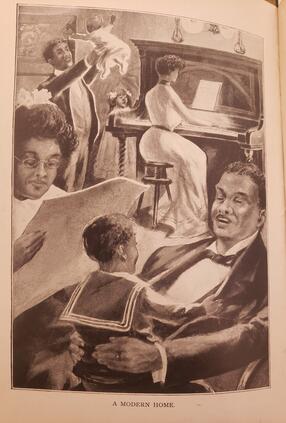
Part intellectual history, part social history, Blakeslee’s research examines how African American fathers were positioned within national debates on race, gender, and citizenship—and how those debates were shaped by and helped shape ideas of family from the mid-19th to the early 20th century. He finds that the idea of the lack of Black patriarchy goes back to the moment of emancipation.
“It was part of the excuse as to why Black men should not have the vote or political power,” he says. “They were portrayed as not being the heads of household, not leaders. You had the stereotype of the Sambo, and then the city dandy, and all kinds of characters that showed a lack of mature masculinity, the ability to be a leader of a family, a provider, or a protector of any kind. So, the trope went, they needed the ‘strong governing hand’ of a white slave master to even function in society.”
As with most stereotypes, the portrayals of the Black family were far removed from the reality of the time. Blakeslee cites the work of Princeton University historian Tera Hunter, author of Bound in Wedlock: Slave and Free Black Marriage in the Nineteenth Century, as evidence of how committed Black families were to adhering to the social norms of the time.
“They wanted to be ‘legitimate,’ as married couples, starting a nuclear family in the moment immediately following slavery,” he says. “But, as Black populations moved to northern cities during the Great Migration, they continued to encounter this narrative that they were dysfunctional because they didn’t adhere to middle-class bourgeois norms of social orientation.”
Among the most hotly contested issues in the study of American society, Black fatherhood has also been salient to political debates, as criticism of Black family arrangements often underlies rhetorical attacks on attempts to advocate for a more equitable society.
–Professor Vincent Brown
Even as the Civil Rights Movement gained momentum in the 1960s, the trope of the dysfunctional Black family garnered renewed attention with the release of The Negro Family: The Case for National Action, a 1965 report authored by Daniel Patrick Moynihan, then assistant secretary of labor under President Lyndon Johnson.
“Moynihan was a sociologist and later a US senator,” Blakeslee notes. “His report represented the consensus at the time that a lack of Black patriarchy was at the root of much of the social dysfunction, poverty, and unrest among Black populations, especially in the urban North. In response, scholars like Herbert Gutman in his 1977 book The Black Family in Slavery and Freedom, 1750-1925, showed that this narrative was simply false. As far back as they could find, nuclear families were the norm among Black folks in the US.”
Winthrop Professor of History Walter Johnson says Blakeslee excavates the history of the derogation of Black fathers—and the ways that played into the derogation of Black people in general—but doesn't stop there. "Alongside that history, he builds on the work of both social historians like Gutman, Hunter, and many, many others to provide an account of the persistence of Black fathers during the period of slavery and after,” notes Johnson, Blakeslee’s faculty advisor. “In so doing, he addresses a longstanding historical silence.”
Radical Paternity
If scholars like Gutman and Hunter challenged stereotypes of the absent Black father, Blakeslee hopes to establish a new narrative that describes the ways in which African American men resisted racist ideologies by embracing fatherhood as a site of dignity, responsibility, and political commitment—a phenomenon he calls “radical paternity.”
“It’s the way that the idea of fatherhood influenced or supported resistance in the US,” he explains. “That’s where the term radical paternity really has its most value. It’s how Black men combatted these beliefs in their social and intellectual lives.”
[African Americans] wanted to be ‘legitimate,’ as married couples, starting a nuclear family in the moment immediately following slavery. But, as Black populations moved to northern cities during the Great Migration, they continued to encounter this narrative that they were dysfunctional because they didn’t adhere to middle-class bourgeois norms of social orientation.
–Thomas Blakeslee
Looking at variables such as location, generation, economics, and class orientation, Blakeslee’s work uncovers how Black fathers pushed back on mainstream ideas of patriarchy, upholding the service and care aspects, but rejecting domination and violence. In so doing, he finds supporting evidence for his thesis in unexpected places.
“I look at certain studies, especially among the Black intellectuals who fought against eugenicists and debated with them,” he says. “In one study I came across, a eugenicist interviewed interracial couples and found that white wives who’d had white husbands and remarried to Black men reported their new spouses were more caring than their former ones. This is in the 1920s, so interracial marriage was still pretty rare, but the white wives reported their Black husbands to be more caring toward their children, and more gentle toward them and vulnerable family members.”
“The character and intimate lives of African Americans have been under attack from the very beginning of their time in North America,” Johnson says. “Blakeslee’s notion of ‘radical paternity’ highlights the ways that care—including paternal care—was a form of economic, cultural, and psychic resistance.”
From GED to PhD
Blakeslee’s route to a PhD was unexpected as well. From a large family in the Philadelphia area, he was a blue-collar worker with an intellectual interest in books, documentaries, and good music. With only a GED and a complicated high school experience, he had no plans to attend college, much less pursue a graduate degree. “I did basically every sort of menial labor that was available to a young man,” he says. “I did warehouse work, construction, masonry, I was a security guard, delivery guy, all those things.”
By his early 30s, Blakeslee had a wife and two children and had moved to California, where he drove trucks for a living up and down the West Coast and into Nevada. When his wife started taking classes at Solano Community College in the northern part of the state, he helped with her homework. Eventually, he decided to explore Solano himself. “We worked full-time, took night classes, and we raised two children,” he says. “We supported each other all the way.”
At community college, Blakeslee’s work caught the eye of an English professor who encouraged him to continue his education at a four-year institution. “He treated me like an equal, like we could actually have an intellectual discourse,” he says. “I had never experienced that before. He was the first person to tell me that my efforts were outsized for the class itself—that I was a big fish in a small pond and that I needed to apply to the University of California, Berkeley.”
With his wife transferring to the University of California’s Davis campus, Blakeslee applied and was admitted to Berkeley, the state’s flagship university. There he was glad to find a sizeable community of adult students in their 30s, 40s, and even 50s. As at Solano, he also found academic success and faculty who urged him to reach for something more.
“I had a professor there named Waldo Martin who treated me as a friend,” he remembers. “That was the first time I would grab lunch and just talk shop with a teacher. And there were other professors who encouraged me similarly. When I proposed an idea, they took it seriously and didn’t try to reshape me in their image. They pushed me to develop as a scholar and pursue a PhD in history, which is definitely not something I had in mind when I initially decided to take college courses.”
All along my educational journey, I wanted my efforts to inspire my children, as well as my siblings and peers. I wanted to show that you could go from GED to PhD—an aspect of my life that has evolved from a source of shame to a point of pride for me.
–Thomas Blakeslee
Blakeslee continued to work full-time while he finished his undergraduate degree. As one of Berkeley’s McNair Scholars, he got support to develop professionally—conducting original research and publishing for the first time. He also got advice and guidance on applying to top PhD programs, including Yale and Princeton, as well as Harvard. After visiting Cambridge and meeting with the faculty, he knew Harvard was his choice, as much for his family as for himself.
“All along my educational journey, I wanted my efforts to inspire my children, as well as my siblings and peers,” he says. “I wanted to show that you could go from GED to PhD—an aspect of my life that has evolved from a source of shame to a point of pride for me. Today, one of our adult children has a bachelor’s degree. Another is now in a PhD program. So, I think the decision that we made over 10 years ago has panned out in many good ways. You know, we’ve all changed our lives since then.”
Now the Provost’s Postdoctoral Fellow in History at the University of Notre Dame, Blakeslee is expanding his doctoral dissertation into a book. Combing the archives, the recent graduate is crafting a historical narrative he hopes will advance the now vast fields of African American history and gender studies.
“I hope that my work can help redefine the field of Black family and Black masculinities,” he says. “There really hasn’t been any work on Black fatherhood and how it aligns with resistance ideologies and activism, which is what radical paternity is all about. So, rather than contributing to ongoing conversations, I want to start a new one.”