

Inside the Quantum Tinkerer’s Workshop
Molecules of light? Diamonds? Flecks of gold? Mikhail Lukin and his students are opening the toolbox to explore new frontiers in physics.

Mikhail Lukin is not a super villain—honest. Sure, the professor of physics keeps a hoard of lasers on hand and casually says things like, “I am of the opinion that we should be able to control nature.” Yes, he dabbles in a strange brew of matter known as the “dark state” and has brought light, the ultimate speedy sprite, to a screeching halt. But—and on this point he is very clear—he is not a mad scientist trying to manipulate the weather or plot world domination. Instead, he is hoping to harness the bizarre properties of quantum physics—a branch of science that describes the microscopic world—to build devices that could actually help us.
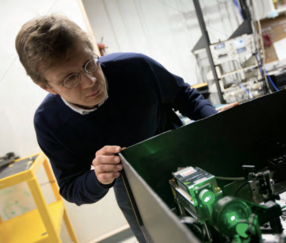
Among the potential applications: sensors that could probe the temperature of individual cells to help fight cancer, for example, or components of computers that could run calculations that are currently impossible or even unimaginable. “What we are trying to do is to create devices that make use of the fundamental laws of quantum theory,” Lukin says. Just as earlier studies of electromagnetism led to the development of light bulbs and laptops, research into quantum physics could pave the way for a whole new era of technological wizardry, he says, sounding more like Inspector Gadget than Lex Luthor.
Things which sound very weird are actually real. What we and others are trying to do now is not just to understand the laws of quantum mechanics but also use them.
Still, he does have an underground lair, where he and his minions—er, colleagues —construct these contraptions. “Now we will go all the way down to the minus fourth floor,” Lukin says cheerfully to a visitor as the elevator door in the LISE building shuts off any chance of escape. Down there, in a warren of rooms filled with lasers and monitors, researchers use atoms, subatomic particles, and photons of light like Legos, making them interact in different combinations to perform different functions.
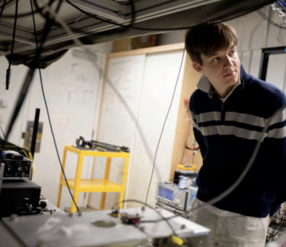
All of these building blocks follow the dicta of quantum physics, a branch of scientific inquiry that is notoriously weird. In the quantum realm, where the action happens at an atomic or subatomic scale, the certainties we take for granted every day — this table is here, this pen is there —are gone. Objects that display quantum properties can be everywhere at once and in multiple states at the same time —at least until they are observed. The theory chips away at the very notion of an objective reality, which led no less a light than Einstein to doubt that the universe really plays by quantum rules.
Yet experiments in the century or so since quantum theory was first formulated have shown time and again that it is rock solid, even if what it describes is anything but. “Things which sound very weird are actually real,” Lukin says. “What we and others are trying to do now is not just to understand the laws of quantum mechanics but also use them.”
The ultimate application would be a quantum computer, which could, in theory, solve problems that would stump the most powerful processors in the world today. Regular computers crunch data stored as strings of binary bits — 1s or 0s. But quantum computers would use quantum bits, or qubits, that could each be in a “superposition” of both 1 and 0 at the same time. That would allow them to run multiple calculations simultaneously. “You can, in principle, do all the calculations in parallel,” says Peter Maurer, one of Lukin’s graduate students. “That’s where the power of a quantum computer lies.” That could enable quantum computers to unscramble encryption codes too complex for ordinary computers and to run simulations of particle interactions that could potentially turn up phenomena entirely new to science.
The realization of a full-blown quantum computer is extremely challenging. No one knows at the moment how to do it.
Researchers around the world, including Lukin and his lab mates, are looking into various quantum objects that could act as qubits—including photons and cooled atoms. Each has its pros and cons, but none has yet been completely tamed. At this point, Lukin laments, “The realization of a full-blown quantum computer is extremely challenging. No one knows at the moment how to do it.”
One big problem is that the superposition states that would give quantum computers their oomph are very fragile. At the slightest nudge, say from a molecule of air, they are prone to collapsing into a single state—a 1 or a 0, ending the quantum calculation. So they must be isolated as much as possible from their surroundings, as if kept in a sensory deprivation tank.
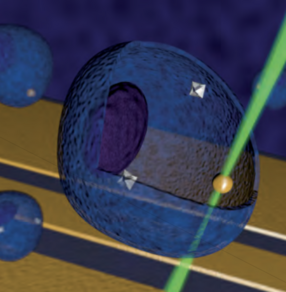
Diamond acts like such a tank. Its regularly spaced carbon atoms hardly interact with the occasional nitrogen atom that inevitably finds its way into their midst. The carbon atoms slot together like puzzle pieces, but the nitrogen is an imperfect fit, so when it lodges in, it leaves an empty hole by its side. Together, the nitrogen and the hole, considered a defect in the diamond, act like an atom with a pair of electrons. The pair’s spin can be used as a qubit—if it points up, it represents a 0, if down a 1, and any angle in between, a superposition of the two states. Their spin can then be used to control the spins of specific atomic nuclei nearby, which also act as qubits. The vast majority of carbon atoms interact very sparingly with the particles used as qubits, “as if you would have your particle hovering in a vacuum,” says PhD student Georg Kucsko.
Last year, Maurer, Kucsko, and their colleagues were able to keep such qubits in a superposition state for longer than a second at room temperature. Even though that sounds short, it was a record for controlling single spins in a solid and suggested that these diamond defects could be used to store and crunch data in future quantum computers.
Building such a computer is still a long way off. But in the meantime, the researchers have figured out another way to use the defects—to measure the temperature inside a living cell. They put diamond dust specks, each less than a millionth of a meter across, into a human cell, along with tiny flecks of gold.
They zapped the gold with a laser, heating it up. That heat caused the nearby diamonds to expand, which shifted the energy levels of their defects’ electrons. Another laser was used to measure that shift, which revealed how much the diamonds had heated up in the process. The researchers also measured the temperature needed to kill the cell.
They say that diamonds could one day be used to monitor the temperature of cells in the body and spot irregularities that might be caused by cancer. Any tumor cells found could then be singled out and heated until they were destroyed, without damaging surrounding tissue.
The diamonds have other potential uses [see sidebar], but they are not the only materials in the tinkerers’ toolbox. Ofer Firstenberg, a postdoctoral fellow in Lukin’s group, recently led a team that managed to get two photons—which in a vacuum would simply pass through each other without interacting—to stick together like a molecule, as if they had mass.
They did it by linking the photons with atoms of the element rubidium, creating one species in a whole menagerie of light-matter hybrids known as the “dark state.” When a photon hits an atom under just the right circumstances, “they become one entity,” says Firstenberg—like a “naked” hermit crab climbing into a shell. Encumbered by the shell, the new creature can no longer move as fast as it did as a freewheeling photon. (In fact, it can even be stopped completely—something teams led by Lukin and Lene Hau, Mallinckrodt Professor of Physics and Applied Physics at Harvard, first did in 2001.)
Still, even moving slowly, these beasts prefer to remain hermits. So to get them to interact, the researchers essentially put giant antennas on their backs. They did this by making sure that the photons they began with had just the right energy to push electrons orbiting the rubidium atoms to great distances, allowing these excited atoms to have an outsize electrical influence on their neighbors. “They can speak loudly with each other and interact strongly,” says Firstenberg.
This interaction might help lay the groundwork for the use of photons to process information in quantum computers. Light is inherently slippery—it does not like to stand still, and photons barely interact with each other. This makes it ideal for conveying information, and indeed, we can thank light traveling along optical fibers for our high-speed Internet. But getting photons to actually run calculations in a quantum computer would require them to be able to change each other’s quantum state. That is tricky “because photons normally do not see each other,” wrote Sougato Bose, of University College London, in Nature. “Firstenberg and colleagues’ work is a milestone in remedying that.”
While the photons in this experiment traveled through the cloud of atoms in pairs, as if they were attracted to each other, Firstenberg thinks the setup can be tweaked so that photons will repel each other. In that case, a group of photons might arrange themselves in an evenly spaced train, keeping the same distance apart from each neighbor. Such a train would provide a reliable source of single photons for sensitive experiments, says Firstenberg, since it is impossible to control exactly when a photon will emerge from a laser.
The fact that researchers in Lukin’s group are working on so many different materials and projects is unusual, says Sebastian Hofferberth, a former postdoc in the group who is now at the University of Stuttgart in Germany. “He is just extremely willing to take risks and just try things,” says Hofferberth. “[That] makes the Lukin group a very crazy but fun place to work.”
“What is actually very nice about physics is that at the end of the day it’s an experimental science,” agrees Lukin. He rattles off other projects his team is working on, including a plan to create a global network of atomic clocks that would pave the way for ultra-precise GPS devices that could help guide future driverless cars. In order to tap into this coveted network, he says, countries would have to refrain from war. “It’s a long time until it might become practical,” he says. “But things like this could potentially change the world.” Super villains looking for new partners in crime, keep moving—it seems there really is nothing to see here.