How Music Moves the Brain
Christine Junhui Liu, PhD ’25

Christine Junhui Liu graduated from the Harvard Kenneth C. Griffin Graduate School of Arts and Sciences in November 2025 with a PhD in speech and hearing bioscience and technology. She discusses her early passion for the viola, how curiosity about music led her to uncover the hidden roles of peptides in the brain, and what graduate school taught her about asking questions in the lab, at conferences, and in life.
The Power of Peptides
At Harvard, I joined Dr. Anne Takesian's lab at Mass Eye and Ear. We studied a population of inhibitory neurons in the outermost layers of the brain's cortex—cells that had been largely ignored. It turns out the neurons in this region play an important role in learning and plasticity, and we wanted to understand how.
I studied a subset of these cells that express vasoactive intestinal peptide, or VIP. Like other inhibitory neurons, VIP cells release a neurotransmitter called GABA that dampens neighboring cell activity. But they can also release peptides—signals that work more slowly and more broadly, and that typically kick in when a neuron is firing rapidly. We found that VIP cells receive direct sensory input and can be driven by sound, but they also receive signals tied to attention and reward—putting them in a position to integrate a lot of information at once.
During learning, when an animal is associating a sound with a reward, the brain is highly engaged. We found that VIP peptide is released in the auditory cortex during this state, and that applying VIP to cortical neurons made them more responsive to incoming signals. When the brain is integrating sound, reward, and attention all at once, these cells may be doing far more than we gave them credit for.
This challenges how we think about inhibitory neurons in the sensory cortex. Their peptidergic side has been largely overlooked here, even though peptide transmission has been studied elsewhere in the brain for a long time. What's exciting now is that new tools let us monitor peptide release in living animals in real time—something that simply wasn't possible before. We're just beginning to understand what these signals are doing, and I think that's a great place to be.
Now, as a postdoctoral scientist at Cedars-Sinai Medical Center in Los Angeles, I'm still asking the same questions about peptides, just in a different part of the brain. I study the hypothalamus, a region deep in the brain that coordinates the body's most fundamental drives: hunger, thirst, fear, and others. There’s a whole world of peptide signaling there that I’m really excited to explore. Finishing a PhD at a moment when the future of academic science felt genuinely uncertain, I was incredibly lucky to have found Dr. Celine Riera, who not only offered me the chance to keep doing science, but also introduced me to the wonderful world of hypothalamus research.
Growing Up on Campus
I grew up in Beijing, China. My dad was in business and real estate, and my mom taught economics and accounting at a university. I have very early memories of being in my mom’s office with coloring books while she gave lectures. I’ve always found college campuses fascinating; I grew up thinking they were places where people got to spend their days learning exciting things, asking interesting questions, and figuring things out. That sense of wonder stuck with me.
Music was where that wonder lived first for me. I started by learning to play piano and then violin. My elementary school orchestra needed more violas, so I learned to play that too when I joined. I've been part of an orchestra since I was nine years old.
As I got older, I wanted to keep pursuing music seriously while also having the room to follow all my other curiosities. I was at a wonderful public school in Beijing, but my parents and I felt that a different environment might give me more room to do both. I was really lucky that music led me to Choate Rosemary Hall in Connecticut, where I got to play chamber music alongside a rigorous academic curriculum, and where I met people from all around the world who shared a deep curiosity about something. Our teachers and mentors really encouraged us to dig deeper into whatever we were interested in, and I owe a lot of my growth to my time there.
The Emotions and Physics of Music
I entered Northwestern University as a viola performance major at the Bienen School of Music, and eventually switched to major in music theory. That's where I really fell in love with music beyond just playing it. Learning about Bach was transformational for me. For the first time, I started to understand the historical context of his compositions, his faith, and why his music has inspired so many genres that came after. What fascinated me most was how he codified the rules of counterpoint and harmony, and then broke them to write something so profound. When I play his music now, it feels almost meditative—like I'm reaching across time, connecting myself to Bach, to his world, and to every musician and tradition his work has ever touched.
Playing music makes me feel like part of something larger than myself. And being part of an orchestra takes that feeling even further. One of my favorite memories was performing Gustav Mahler’s Symphony no. 2 (the “Resurrection”) with the Northwestern University Symphony Orchestra at Millennium Park in Chicago. In the final movement, when the full orchestra was joined with the chorus, bells, and organ, the sound was so loud and so powerful that it moved me to tears. I think it moved many people in the audience, too.
Music also moves people in the most literal sense. The vibrations of instruments and vocal cords push air molecules forward, creating sound waves that eventually hit our eardrums. That mechanical movement translates through the hair cells in the inner ear into neural signals that travel toward the brain so we can process and feel these sounds.
I became obsessed with how sound is processed in the brain. That curiosity also inspired me to study neuroscience at Northwestern and led me to join Dr. Nina Kraus’ lab, where I got to study how musical experiences shape the brain. I found that active music training—where children actually engage in making music rather than just listening—trains the auditory system to respond to non-musical sounds more robustly. This really fascinated me. It showed me that the sound of our lives changes our brains. But I wanted to understand more mechanistically how this happens. So my mentors encouraged me to apply to the Program in Speech and Hearing Bioscience and Technology at Harvard Griffin GSAS.
Confidence as a Scientist
The most valuable thing I took out of graduate school was learning to respect science and respect myself as a scientist. A big part of that came from my advisor, Anne Takesian. Early in grad school, I told her I was terrified to ask questions at seminars. And at Harvard, there were always some world-famous scientists in the room; the idea of raising my hand in front of them was paralyzing. Anne told me she knew I had good questions, because I’d asked her my questions privately. Her advice was simple: just raise your hand. When you get called on, you'll ask. There's no wrong question, and that's how you learn.
So at my very first professional conference with her in early 2020, we made a rule—at some point during the week, I had to ask a question in a big public session. The days went by, and I kept putting it off. Then it was the last day, and Anne was chairing the final session. I told myself, this is my last chance now. All I have to do is walk up to that microphone after the speaker finishes, and just ask. And I did. Having that back-and-forth with a scientist after their talk made me feel that I belonged in that conversation. That experience really changed something in me. I've felt more comfortable at every seminar since. Asking questions is the foundation of science, and I'm really grateful to have had a mentor who taught me it was safe to ask them—in the lab, at conferences, and in life.
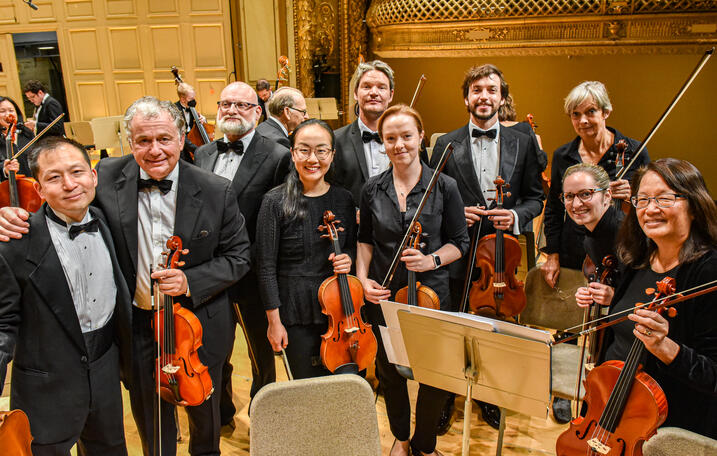
Graduate school also reminded me that science and music were never really separate for me—they both come down to curiosity, and to finding a community of people who take their questions seriously. I joined the Longwood Symphony and discovered that so many scientists and doctors play too; the same people asking pointed questions at seminars are also rehearsing Brahms on Thursday nights. For many years, I've been the violist in the string quartet that plays "Pomp and Circumstance" for the Division of Medical Sciences hooding ceremonies. Getting to be there for my friends as they crossed that stage, instrument in hand, felt like a perfect expression of everything graduate school gave me. I look forward to experiencing it myself—in regalia and not with viola—this May at Commencement.
Christine Liu’s work was supported by the Herchel Smith Graduate Fellowship, the Harvard University Center on the Developing Child Science and Innovation Fellowship, and the Amelia Peabody Graduate Fellowship. Her research was also supported by several of her principal investigator’s grants, including from the National Institute on Deafness and Other Communication Disorders (R01DC018353, R21DC016991), a Nancy Lurie Marks Research Grant, and a Bertarelli Foundation Collaborative Research Grant.