Fighting the Opioid Overdose Crisis in Boston, and Beyond
Harvard PhD student Swathi Srinivasan leverages her journey through Hodgkin’s lymphoma to advocate for Narcan access and health equity in the opioid crisis

Before you cross the street
Take my hand
Life is what happens to you
While you’re busy making other plans
—John Lennon
Harvard College junior Swathi Srinivasan had a lot of plans in 2019: plans to help address the opioid crisis through the work of Harvard College Overdose Prevention and Education Students (HCOPES), a group she co-founded and co-directed; plans for her academic research on drug overdose prevention, which had just taken her to Portugal; plans for an upcoming trip to Brazil to study why the country’s public health system had been so successful in containing the human immunodeficiency virus (HIV).
Then life happened.
“I got the call in the middle of an event for newly admitted undergraduates at the Harvard Club in my hometown of Cleveland, Ohio,” she remembers. “It was the nurse telling me that the results of my biopsy came back positive, and that I had Hodgkin’s lymphoma.”
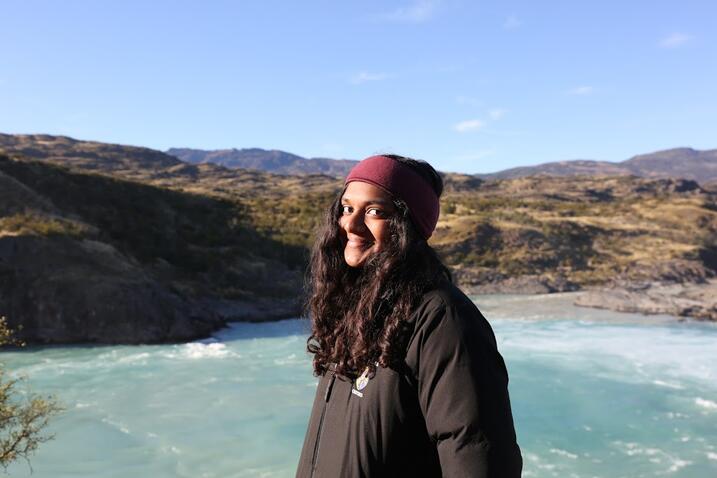
Now a PhD student in population health sciences at Harvard’s Kenneth C. Griffin Graduate School of Arts and Sciences, Srinivasan still has plans. She wants her research and hands-on work in the community to improve access to health care and, specifically, to help mitigate the ongoing overdose crisis in the Boston area and beyond. But her bout with serious illness infused both Srinivasan’s academics and action with a heightened commitment to ensuring that access to the kind of high-quality care she received is not restricted to those fortunate enough to attend Harvard.
The Crisis at the Front Door
Srinivasan’s cancer diagnosis came at a time when her public health work—both academically and in the community—was expanding. She was already working for RIZE Massachusetts—a foundation “dedicated to funding and collaborating on solutions to end the overdose crisis”—when a young person overdosed on the steps of the Blue Bottle Café between Adams and Quincy Houses during the summer of 2019. In response, she joined with friends and Harvard Professor Allan Brandt to get the emergency overdose medication Narcan into campus automated external defibrillator boxes. The effort was ultimately unsuccessful, but its scope and the administrative pressure she encountered, inspired her to co-found HCOPES.
I got the call in the middle of an event for newly admitted undergraduates at the Harvard Club in my hometown of Cleveland, Ohio. It was the nurse telling me that the results of my biopsy came back positive, and that I had Hodgkin’s lymphoma.
Swathi Srinivasan
Encompassing policy work, advocacy, and community-level efforts, Srinivasan’s vision for the group was big. So was the response from her fellow Harvard students. “We had maybe 30 members in our first year,” she says. In partnership with the City of Cambridge, HCOPES trained local businesses to use Narcan. Members volunteered at homeless shelters and participated in public health education on campus and in the community. HCOPES participated in activism as well, demonstrating against the Sackler family, owners of Purdue Pharma, the company that developed the popular opioid OxyContin. On the policy side, members worked on a proposal to make Narcan available in public transit stations, inspiring a pilot program on the MBTA’s Red Line launched by the Massachusetts Department of Transportation in the summer of 2024.
Overdose prevention was also central to Srinivasan’s studies, where she worked with Harvard sociology professor Theda Skocpol, PhD ’75, to study opioid-related policy in Ohio. Growing up in the state, Srinivasan encountered many of the same challenges facing other heartland towns: the youth mental health crisis, opioid addiction, and overdoses.
“When I was 11 or 12, one of my childhood friends overdosed,” she says. “It was close to where we lived. She was about 13. It happened again when I graduated from high school. A few students had passed away, some from suicide and some from overdose, but, you know, our town didn't really talk about it. Now, I sit on the Prevention and Education Subcommittee of the Northeast Ohio US Attorney’s Opioid Task Force, where I provide counsel at home on policies and initiatives from my research and experiences.”
Srinivasan won a grant to travel to Portugal during the fall of 2019, where she studied drug policy. “I went to overdose prevention centers where people could use substances and be monitored so that they don’t overdose,” she says. “I shadowed harm reduction centers, detox centers, and residential treatment centers.”
Srinivasan returned to learn of her acceptance to a January term course in Brazil led by Harvard T. H. Chan School of Public Health Professor Marcia Castro. “I had been an intern at the United Nations Joint Programme on HIV/AIDS in Geneva,” she says. “In Brazil, I was going to be part of a class researching HIV and the public health system. They have one of the largest public health systems in the world, and it’s the reason why Brazil’s HIV rate didn’t skyrocket like, say, South Africa’s did around the same time.”
Needing a yellow fever vaccine for the trip, Srinivasan stopped by Harvard University Health Services for an appointment with Nurse Practitioner Sharon McCarthy. She mentioned feeling more tired than usual. An exam revealed inflamed lymph nodes, which persisted, swelled, and hardened over the ensuing weeks. An X-ray led to a CT scan, a biopsy, then a cell phone call in Cleveland that put Srinivasan’s well-laid plans at risk.
Finding a Quarterback
The first people with whom Srinivasan shared her diagnosis were her parents. The next call she made was to Professor Anne Harrington, director of undergraduate studies in the Department of the History of Science at Harvard and the student’s closest academic adviser. “I was in New York City in a hotel room, having just finished giving an academic talk,” Harrington remembers. “The details of that emotional call don’t really matter. What matters is my memory of how honored I felt that she trusted me enough to reach out in a moment of such vulnerability and uncertainty.”
Harrington had just interviewed the president of Boston’s Dana-Farber Cancer Institute (DFCI) for a book she was writing. Shortly thereafter—on Christmas Eve, in fact—Srinivasan got an email from DFCI’s Dr. Ann LaCasce, a nationally recognized expert on lymphoma. “She basically said, ‘I’m going to be your doctor,’” Srinivasan says.
Harrington was there for Srinivasan as well on the morning of the student’s first meeting with her oncologist. Over popovers at Clover in the Science Center, the professor gave Srinivasan some simple advice: “She told me, ‘You need to find your quarterback, the person that’s going to be in your corner.’ So, I met Dr. LaCasce. She was brilliant and competent. She told me everything I needed to know and answered every question I had.”
With the consent of LaCasce and the support of the Chan School’s Castro, Srinivasan did go to Brazil—a trip that laid the foundation for her senior thesis. Upon her return, she took the GREs and simultaneously prepared for classes and chemotherapy. Then, in March 2020, the COVID-19 pandemic swept through campus.
“Through COVID, while so many students were safely holed up at homes scattered across the country, Swathi stayed on campus to pursue treatment,” Harrington recalls. “I’ll never forget how, without any fuss or drama, she biked across town for every treatment, to avoid the risk of infection during a particularly vulnerable time. The maturity, resilience, and steady determination that this young woman manifested in that time left me in awe.”
Like many cancer patients, Srinivasan was often exhausted. She lost most of her hair, dyeing the remainder pink. Her brain fogged. Her body changed. Through it all, her father, who had found a rental close by, cared for her, cycling with his daughter to chemotherapy appointments and preparing fruit smoothies when that was all she could keep down. Eliot House Resident Dean Andrea Wright, who had driven Srinivasan to her biopsy, checked in when she started radiation. And when the expense of treatment piled up, Harvard had Srinivasan covered. “I applied for emergency financial support, and the University paid my medical bills,” she says. “My mom suggested it and helped manage my finances. Thanks to all the support I got from my family, friends, mentors, and administrators, I was able to handle chemotherapy, classwork, running HCOPES, and other activities.”
The care and support Srinivasan received also yielded an important realization. “This was the moment it became clear to me how much of my success was luck,” she says. “So many people are not surrounded by the supportive people and resources I was. Everyone deserves that kind of care. It should not be a matter of chance.”
Throughout the trying time, Srinivasan continued to check in with Harrington. “It’s funny,” she says. “She told me, ‘Find your quarterback.’ Then I realized that she was my quarterback, this professor who cared so deeply and kept following up with me. Without Anne Harrington, I don’t even know where I would be.”
The Best Life
By early summer, Srinivasan had successfully completed treatment and was cancer-free. During her senior year, she wrote her thesis, studying racial inequality and health outcomes in Brazil during the COVID pandemic. She also won a Rhodes Scholarship and set her sights on a master’s degree in the history of science at Oxford. Amid all the success, though, something inside her had changed. “Almost a year after I finished treatment, I felt like I wasn’t as invested in some of the things I used to love,” she says. “I was more distant from my friends. I felt isolated in my experience. I wondered, ‘How do I resensitize myself to the world?’”
Harvard’s Counseling and Mental Health Services (CAMHS) was a place where Srinivasan could start to heal from cancer’s psychic wounds. (“Survivorship is a whole area of cancer care,” she notes.) Speaking with a therapist, she began to see that she wasn’t the sum of her many accolades. “The people I work with—the unhoused, those who are HIV positive, or who use substances—I value them for nothing other than the fact that they are here, just like everyone else,” she says. “Eventually, I learned to value myself on those terms too.” Srinivasan also found that the experience of having cancer gave her a new appreciation of life as both finite and fragile. “I felt like my time was short all of a sudden and that I should take advantage and do everything that I can.”
One thing she had wanted to do since childhood was marine biology. So, after graduating from Harvard College in May 2021—and with the support of a Priscilla Chan Summer Service Stipend—Srinivasan moved with two friends to the southwest coast of Maui, where she tracked critically endangered hawksbill sea turtles for the Hawaiian Wildlife Fund in the early mornings. In her off hours, she worked with low-income Pacific Islanders at a public health nonprofit and served as assistant coach for a girls’ soccer team. “It was the best life I had ever lived,” she says. “That time in Hawaii completely reinvigorated my sense of being.”
Toward the end of her time in Hawaii, Srinivasan’s supervisor at the public health nonprofit shared that she, too, had had lymphoma at a young age. Now in her 40s, the older woman had a rich life, with a home, a family, and meaningful work. “I saw the possibility of a future where cancer did not define me,” Srinivasan says. “Even if my memory never returned to what it used to be, even if my body was forever changed, I could still have a long, happy life. I would at least try.”
The people I work with—the unhoused, those who are HIV positive, or who use substances—I value them for nothing other than the fact that they are here, just like everyone else.
Swathi Srinivasan
Shortly after leaving Maui, Srinivasan arrived at Oxford, where, over the next two years, she earned her master of philosophy studying the history and ethics of the US President’s Emergency Plan for AIDS Relief (PEPFAR), work that brought her to South Africa. A scholarship from the Rhodes Trust extended her work, as Srinivasan traveled the world documenting overdose response in Norway, Brazil, the United States, and other nations. She returned to Massachusetts in 2024 to work as an AmeriCorps fellow at the Boston Health Care for the Homeless Program, where her harm-reduction work included a sedation monitoring clinic for substance users. In the fall of 2025, she enrolled at Harvard Griffin GSAS.
It Should Not Take Death
Now a first-year PhD student, Srinivasan brings an important ongoing project. “I am leading research on the pilot of Narcan on the MBTA with two fantastic Harvard alumni—Jay Garg and Sajeev Kohli—who were in HCOPES and the fantastic team of physician Scott Weiner at Mass General Brigham Integrated Health System,” she notes. She also brings a wide range of interests and ideas for PhD work: exploring the intersection of homelessness and the overdose crisis; identifying markers in childhood that make the development of substance use disorder more likely; the way that climate and geography combine to impact the rates of diseases like cancer; and the way that racism and classism shape drug criminalization. “I’m thrilled to go back to school,” she says. “There’s so much for me to learn.”
Amalie Moses Kass Professor of the History of Medicine Allan Brandt, who served as HCOPES faculty adviser, is also thrilled to see Srinivasan back on campus. “Swathi Srinivasan is a remarkable scholar and a remarkable human being,” he says. “It is rare to see someone so deeply committed to bringing their learning and research to make the world a better place. She has ranged widely across many disciplines to develop practical approaches to complex problems of health and disease. Her energy, motivation, and kindness appear to know no bounds.”
Reaching the five-year mark post-treatment is a big milestone for Srinivasan, both physically and mentally. Another bout with lymphoma is less likely now. She has also regained the attraction to long-term projects—ones where progress can often be painfully slow—that was the norm before illness compelled her to “seize the day.” What remains from her cancer journey is her longstanding appreciation for the inherent worth of every human being.
It is rare to see someone so deeply committed to bringing their learning and research to make the world a better place.
Allan Brandt, Amalie Moses Kass Professor of the History of Medicine
“The sanctity of life has always been important to me,” she says. “But being so close to my own mortality was a powerful reminder. We’re at a time when there is often a terrible disregard for human life. But if you go and you talk to someone at ‘Mass and Cass’ [an area near the intersection of Massachusetts Avenue and Melnea Cass Boulevard in Boston’s Roxbury neighborhood where many suffer from homelessness and substance use disorder], you will see their humanity, and you will also understand your own. It should not take death for us to value life.”