Cracking the Code of Immunity
New research sheds light on how the body recognizes pathogens

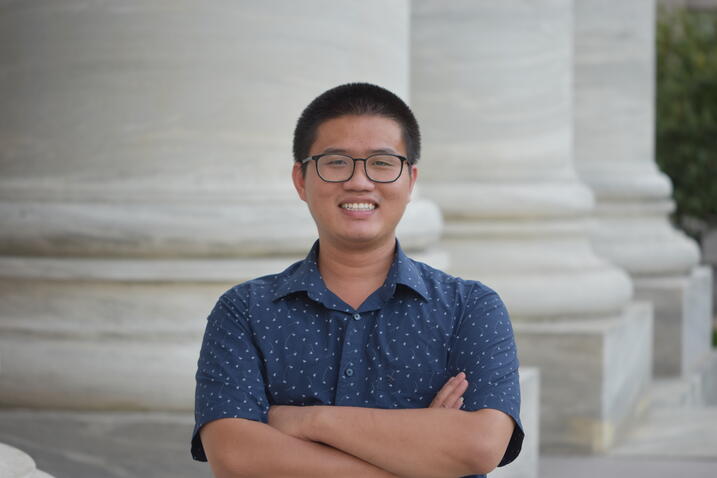
“Biology is the language of life,” says immunologist Anh Cao, PhD ’25. But how do you learn a language no one fully understands? That was the challenge Cao took on as a PhD student at Harvard’s Kenneth C. Griffin Graduate School of Arts and Sciences.
Immunologists have long studied how our body fights pathogens, but the precise patterns of molecules required to trigger an immune response weren’t fully understood. Cao took the research a step deeper to uncover the grammar of biology and our immune system.
During his PhD, the young scientist identified molecular patterns our immune system uses to “see” foreign pathogens that invade the body. “The deeper you dive into it, the more you understand one of the greatest languages we know,” he says. And the more scientists like Cao understand, the closer they get to new, more powerful treatments for infectious diseases.
Immunity in a Bind
To fight infection, our body must first detect that something is wrong. Immune cells search for signs of pathogens using specialized receptors on their surface. When these receptors encounter their target, the cells launch a response to kill the pathogen. In the lab of Marian R. Neutra, PhD Professor of Pediatrics Jonathan Kagan, Cao wanted to understand what these immune cell receptors “see.” What molecular patterns could immune cells recognize through their receptors? Answering this question could provide insight into what determines whether our immune system launches a response or not.
Cao studied the receptor caspase-11, which recognizes a molecule on the surface of bacteria called lipopolysaccharide (LPS). When our body detects bacterial LPS, it generates a strong immune response, including inflammation and fever. Cao sought to uncover the molecular patterns of LPS that allow the body to recognize and respond to bacterial infection. Interestingly, caspase-11 not only recognizes bacterial LPS, but also several lipid molecules normally found in our body, so-called “self-lipids.” Cao used these known molecules to identify the molecular properties required for recognition by caspase-11.
First, Cao tested what types of lipid molecules could bind caspase-11, giving the receptor lipids of different lengths and electric charges. Then he added an enzyme that chewed up the receptor at specific sites. If the lipid bound the receptor, it blocked some of the sites the enzyme normally cleaved. When Cao measured the results, he knew that longer fragments meant the molecule bound the receptor.
Cao found that the lipid molecules must be long and contain a negatively charged group of atoms to bind caspase-11. To identify the receptor parts required to recognize these molecules, he altered portions of the receptor and measured whether the molecule could still bind, identifying several amino acids required for the receptor to bind bacterial LPS and the self-lipids.
To test whether he had successfully uncovered the molecular patterns required for receptor-lipid molecule interactions, Cao took a natural receptor found in our body that could bind self-lipids but not bacterial LPS. By swapping out parts of the receptor, he engineered it to bind both types of molecules, providing further evidence of the molecular patterns governing recognition of bacterial- and self-lipids. His research was published earlier this year in Science Advances.
Scientists have studied how our immune system detects this bacterial molecule for over a hundred years, but until Cao’s research, they didn’t understand the molecular features detected by our immune cells’ receptors. Scientists can use these features to design new molecules that either mimic or prevent binding to the receptor—providing a way to modulate the immune system and its activation for therapeutic benefit. For example, scientists could design molecules to try to increase the immune response to vaccines, providing greater protection from disease.
“Now that we understand the essential features in endotoxin [(bacterial LPS)] that our immune system detects, we may be able to design novel molecules that prevent or mimic these activities for therapeutic benefit,” says Kagan.
A surprising finding from Cao’s research is that bacterial- and self-lipids are detected through the same mechanism. “The work has a very interesting evolutionary dimension,” says Shiv Pillai, professor of medicine and health sciences & technology at Harvard Medical School. The molecular patterns recognized by the receptor are conserved across animals, from humans and mice to polar bears, cheetahs, and manatees. Why is it evolutionarily beneficial for our immune system to detect self and pathogens through the exact same mechanism?
“Binding to self is not a bug. It’s a feature,” Cao says. Pathogens rapidly evolve to outwit our immune system. He hypothesizes that the ability of the receptor to bind self-molecules can serve as an “internal benchmark” to prevent the receptor from changing too dramatically. Otherwise, over time, the receptor could lose the ability to recognize the pattern it evolved to detect and no longer reliably elicit an immune response. Cao’s discoveries lay the foundation for future research testing this hypothesis to understand how the immune system responds to bacterial- versus self-lipids.
Now that we understand the essential features in endotoxin [(bacterial LPS)] that our immune system detects, we may be able to design novel molecules that prevent or mimic these activities for therapeutic benefit.
Jonathan Kagan, Marian R. Neutra, PhD
Professor of Pediatrics
The Path from Vietnam
Cao grew up in Ho Chi Minh City (Saigon), Vietnam, where he was raised in a family of four by his mom, a Russian teacher, and his dad, who worked in the army. Cao was drawn to science from an early age. He chose biology because the field was less crowded; in Vietnam, the subject was less popular because it lacked infrastructure and resources.
Throughout high school, Cao competed in the International Biology Olympiad, a team-based program involving theoretical and laboratory assessments of biology knowledge. At age 18, Cao competed in Korea together with the top four Vietnamese students, winning a silver medal in addition to Vietnam’s total of two silver medals and bronze medal. This was a huge achievement for a team that didn’t have the training facilities and experience that many others had.
Upon graduating from high school, Cao knew that if he wanted to pursue a career in biological research, he needed to seek opportunities in countries with more robust biology infrastructure. For him and other aspiring scientists of his generation, studying in North America was viewed as a privilege and a dream.
It was during his undergraduate studies at the University of Toronto that Cao took his first immunology class. In Vietnam, a mentor had remarked to him that immunology was going to be an important field for medicine. Now he had the opportunity to study it. “The dots connected,” Cao said. After remaining at the University of Toronto to complete his master’s degree in immunology, Cao applied to PhD programs and was admitted into Harvard Griffin GSAS’s PhD program in immunology.
Initially, Cao intended to join an immune bioengineering lab. That changed when he attended a course lecture by Professor Kagan on how our immune system recognizes pathogens. Kagan gave an elegant talk, asking deep, philosophical questions about biology. “It made me feel like I wanted to study something so fundamental,” Cao said.
Today, Cao is grateful for the intellectual freedom he was given by Kagan and by Harvard Griffin GSAS. “[He] always patiently allowed me to test all of my crazy ideas,” Cao says. Even when Kagan knew an idea might not go anywhere, he allowed his young researcher to discover it for himself, serving as a cheerleader throughout Cao’s PhD. In this way, the student was able to take ownership over the knowledge and find his scientific voice.
At Harvard, Cao had the resources to pursue basic questions rather than solely performing research with immediate profitable applications. At the same time, his findings do have important therapeutic implications, highlighting the importance of basic research for generating novel discoveries that may one day benefit society. By identifying molecular patterns recognized by the immune system, for instance, the Harvard Griffin GSAS alum’s work may enable scientists to design new molecules that positively alter the immune system’s function to promote health and fight disease.
The Joy of Teaching
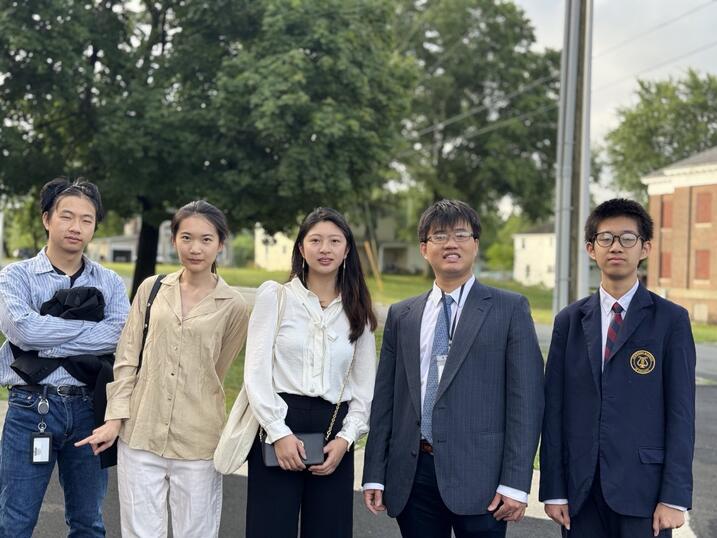
After defending his PhD earlier in 2025, Cao became an assistant professor of biomedical sciences at Fei Tian College Northern Campus in New York, a private, non-profit university. There, he strives to provide research experiences for students in the mid-Hudson valley, an underserved region of the state. The school is new, and Cao is helping build its biomedical sciences program—work that often draws on his creativity as well as his knowledge. Harvard labs, for instance, have spouts with purified water and rooms for sterilization. At Fei Tian, he buys distilled water from Walmart and uses a pressure cooker to sterilize equipment. “These limited resources really give me the joy of doing science and the feeling that my contribution means something to students,” he says. “For me, at this stage of my career, the local impact brings me so much joy.”
While Cao has made important contributions to our understanding of the immune system, he believes the PhD process, at heart, is about becoming a scientific thinker, rather than the scientific discoveries themselves. In having the freedom to pursue basic, fundamental questions of biology, he found his inner voice. He believes everyone has such a voice or personal philosophy inside of them. It’s simply a matter of finding and nurturing it. “PhD is a doctor of philosophy,” said Cao. “In the end of your journey, what is your philosophy?”