Writing Black Higher Education Back into History
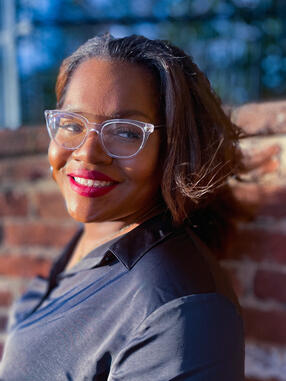
Cassondra Hanna, PhD Student

Cassondra Hanna is a third-year PhD student in African and African American studies at Harvard Griffin GSAS. She studies the history of Black education through a lens that’s often overlooked: the institutions that didn’t survive. Her dissertation focuses on Avery College, a school for African Americans in her hometown of Pittsburgh, Pennsylvania—one that has all but vanished from the historical record. In this profile, Hanna reflects on the layered journey that led her from a steel town to Harvard, and why the histories we preserve—and those we forget—say as much about power as they do about the past.
The Road from Steel City
I grew up in Pittsburgh, Pennsylvania, a city with a deep blue-collar heritage. Neither of my grandparents completed high school. I remember my shock at learning this as a child, for I found the idea inconceivable. My mom was the first in her family to earn a college degree. She did it in her mid-twenties, after my brother was born, and went on to work as an accountant. My dad worked in hospitality—whatever needed to be done, from management to cooking. I have a twin sister, two brothers, and an elder sister who has passed away.
We were raised in a part of the country that was rich in ethnic identity. Our neighbors traced their roots to Italy, Poland, or Ireland, among other countries. I went to the Jewish Community Center as a kid and often found myself surrounded by Catholic and Jewish communities. But there weren’t a whole lot of Black students in most of the schools I went to. By the time I graduated high school, I knew I wanted a different experience.
So I went on a national tour of historically Black colleges and universities and fell in love with Fisk University. I believe the thing that attracted me to Fisk the most was the rich historical legacy, its smaller size, and the more intimate campus community. It felt like a place where I could belong. I started there in 2017 with a vague sense that I might want to be a teacher or maybe a lawyer. I wasn’t sure. But then I learned about the Leadership Alliance.
A Summer That Changed Everything
The Leadership Alliance is a program that connects students with research opportunities at R1 institutions. I got into the program my freshman year and spent the summer of 2018 at the University of Virginia (UVA) doing research in 20th-century African American urban history with Professor Andrew Karhl. I decided to study my own city—specifically, the history of the Hill District, a historically Black neighborhood in Pittsburgh where both sides of my family had lived.
In the mid-20th century, the city destroyed a major section of the Hill—what’s now a parking lot and the PPG Paints Arena, where the [National Hockey League team, the Pittsburgh] Penguins play—and displaced 8,000 families. One of them was my grandmother’s. I grew up hearing stories about what used to be there. My dad would drive me around the neighborhoods and narrate their history like a tour guide. But in that summer at UVA, I realized this wasn’t just a local story. Urban renewal—what the writer James Baldwin once described as “Negro removal”—took place in cities across the country.
While at UVA in 2018, I learned about the Jefferson School, opened in 1926 as a high school for African Americans in Charlottesville. Before then, high school was virtually inaccessible to African Americans in Virginia unless they paid to attend the Hampton Institute. The story reframed how I understood the world my grandparents lived within, and drew me toward the history of Black education as a field of study. That was the first time I understood that becoming a historian was a viable career path. It was the path I wanted to take.
Teaching the Tour
Back at Fisk, I received the Mellon Mays Undergraduate Fellowship and began to develop a project on the history of HBCUs. I had been giving campus tours, and at Fisk, those tours weren’t about showing off amenities—they were about history. I talked about Reconstruction, the criminalization of Black literacy, the role of Fisk in African American history. I had seen similar tours on my Black college tour in high school, and those stories stuck with me.
My research grew into a thesis on the philosophies of Black education in America through the lens of Nashville’s educational landscape. I traced connections between K–12 education, Black colleges, and the public policies that shaped both. At the time, I figured that was the direction I’d continue in grad school.
The Mystery of Avery College
In my final year at Fisk, I had to write a term paper about Africa. I was writing a paper for a class that got disrupted by the pandemic, and so I needed to refresh the material, and started with the textbook. I wasn't unfamiliar with Africa (my advisor was an Africanist), but I was uncertain how to relate the subject of Africa to my research interests as an Americanist. So, I started flipping through old texts for inspiration.
I came across a name—Charles Avery—in an excerpt of a book by the nineteenth-century Black abolitionist Martin R. Delany. I had seen a Facebook post claiming Avery College as one of the “first state-chartered collegiate institutions for African Americans.” I learned about Charles Avery in my very first attempt to learn more about the school—an attempt that ultimately yielded little information. Once I saw the reference, I began trying to understand the connection between Avery and Delany and began to encounter tons of primary source material on Avery College in historic newspapers online. That confused me. I’d been researching the history of Black education for two years and had never seen it mentioned.
So I dug deeper. I found scattered references, but the historical record was full of inconsistencies. People seemed to confuse Avery with other institutions—like Avery Institute in South Carolina or the Cheney Institute for Colored Youth in Philadelphia. But the more I read, the more I realized Avery had been an important site of Black abolitionist activity, especially for those interested in emigration to Africa.
I turned that paper into a master’s thesis at UVA, then into a dissertation project, and now I’m working on that research here at Harvard.
What We Remember—and What We Don’t
My work focuses on Avery College and what it reveals about the history of Black education, especially the parts we tend to overlook. When we tell that history, we usually focus on the institutions that survived—places like Fisk, Cheney, and Wilberforce. And for good reason. These schools have fought to exist in the face of tremendous structural obstacles.
But there’s a risk in telling history only through what’s still here. The institutions that didn’t survive—like Avery—still have stories to tell. They reveal different models of education, different relationships to community, and different visions of Black freedom. Ignoring them limits our understanding not just of the past, but of what education can be.
I understand Avery’s demise as primarily an economic issue. Essentially, the institution was fiscally starved as punishment for its radical vision. It’s an issue of the outsized power of white philanthropy in Black education. It’s also an issue of social capital and legal power. The institutions that survived into the twenty-first century successfully negotiated this power structure, and their stories do not reflect the hundreds of Black educational institutions that failed between 1850 and 1960.
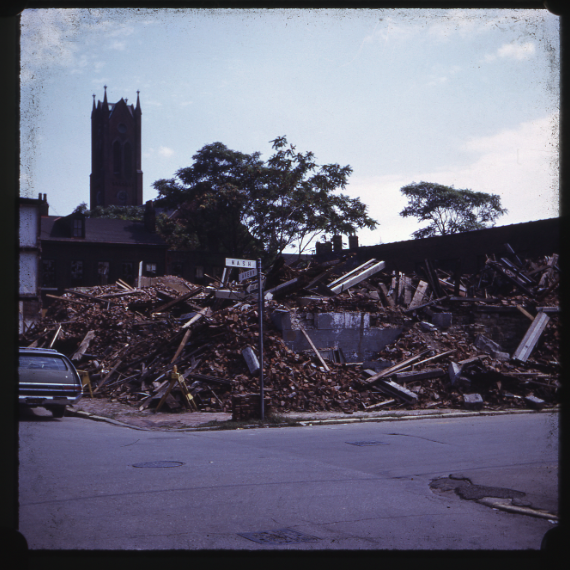
Avery has not been forgotten. Educators, historians, and archivists have worked to preserve the memory of Avery, and my work stands on their shoulders. More so, its existence and legacy have been ignored and erased from the built environment. I treat the closure of schools not just as institutional failure, but as evidence of power. I ask what it means to reconstruct the history of an institution that no longer exists.
From Fisk to Harvard
I never imagined I’d be at Harvard. I gave campus tours at Fisk and every week told the story of W. E. B. Du Bois—the most famous son of Fisk, the first Black person to earn a PhD from Harvard. I must’ve told that story a hundred times. But I never thought I’d be walking in his footsteps. Now I see his bust outside the African and African American Studies Department every time I walk in.
It’s been an adjustment. My parents are proud, though I’m not sure they always understand what a PhD entails. My grandmother—who’s almost ninety-eight—told me, “You’re going to the same school as Obama,” which wasn’t how I’d framed it, but I understood why it meant so much to her.
And Harvard has given me opportunities I didn’t have before. At Fisk, our library was under-resourced. I used Mellon funding to buy the books I couldn’t borrow. Now I have access to one of the most resourced library systems in the world. If a book isn’t available, I can request a scan and have it in two days.
I’m working with Professor Jarvis Givens, whose scholarship on the history of Black education has shaped the field. More importantly, he models what it means to live a commitment to Black studies and an ethic of collaboration. He’s built a community of scholars in the history of Black education that’s rare.
Studying the Past, Reimagining the Future
Being in a cohort of students who study different parts of the African diaspora has pushed me to think more broadly. One of my colleagues often reminds me that when I say “America,” I should clarify whether I mean the United States or the whole hemisphere. It’s a running joke, but it’s also a serious reminder of the assumptions we make when we write.
Last year, our department traveled to Bahia in Brazil. We spent most of our time in Salvador, the center of the transatlantic slave trade in Brazil, but also traveled to other communities in Bahia and asked what it means to be Black in the Americas—not just in the US, but in the world.
That’s what this work is about for me. Not just recovering the past, but also expanding the possibilities for how we understand it—and how we carry it forward.
The work described above received support from the Mellon Mays Undergraduate Fellowship and the University of Virginia Bridge to Doctorate Fellowship.