The Sounds of Healing
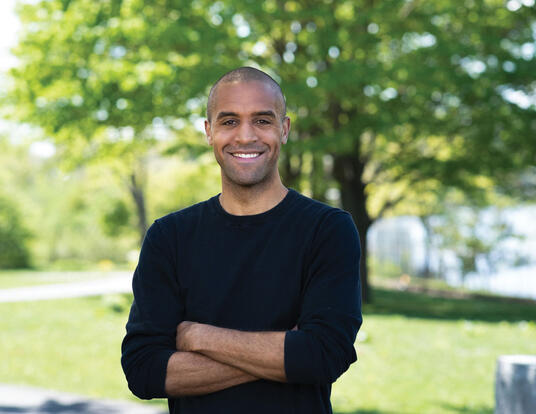
Samora Pinderhughes, PhD Student

Samora Pinderhughes is a PhD student who works with music and art to explore sociopolitical issues. Pinderhughes discusses growing up in the Bay Area with a love of music, his work on The Healing Project, and the joy of performance and art.
Beyond Genre or Discipline
I have been playing music since I was born and started percussion as a toddler. I began learning piano at seven, which sparked my lifelong love affair with the piano as an instrument, both in improvisation and composition. I was fortunate to be part of a program called the Young Musicians Choral Orchestra, which provided kids in the Bay Area with free lessons and academic training. This led me to believe that I could pursue music as a career, prompting me to attend Juilliard to study jazz piano.
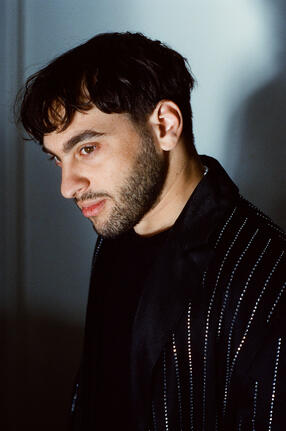
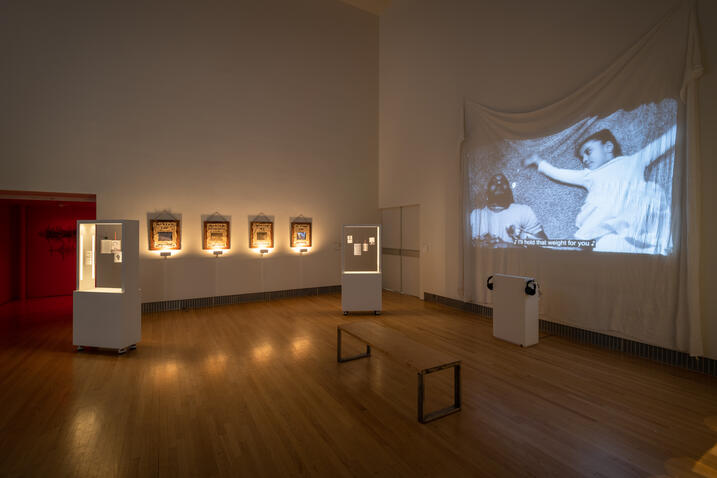
After Juilliard, I met the actor, playwright, teacher, and author Anna Deavere Smith, who became one of my primary mentors and helped me become an artist without being confined by genre or discipline. She inspired me to start The Healing Project, an organization that develops artwork with communities across the United States that have suffered from structural violence. The project particularly focuses on the realities of the prison-industrial complex and is an abolitionist initiative. We also work with youth who have encountered high levels of violence. Together, we create healing rooms, showcase the work of individuals healing from structural violence, and establish spaces where people can discuss and come to grips with that violence.
As a sound artist, I have conducted hundreds of interviews with individuals for The Healing Project. Anna Deavere Smith heavily influenced my interview process, which is conducted as audio-only. I wanted to remove the usual assumptions formed from looking at someone's face. In this context, the only story you have is the one told to you by the person. Weaving that work into music has been a lifelong pursuit, and I am continually inspired by the question of how we can delve deeper into a person's authentic way of living through the lens of the human voice.
The Healing Project
I came to Harvard Griffin GSAS to join the Creative Practice and Critical Inquiry program that Professor Vijay Iyer began. Before I ever stepped foot on campus, Professor Iyer had been one of my inspirations and guiding lights as a composer. His work has significantly influenced The Healing Project. When I learned about the program, I wanted to be a part of it because the work I do requires a great deal of research as well as structural and philosophical scholarship. It was a way to engage in a scholarly practice where the work of conducting research was always tied to the work of creating art. That’s what is truly special about the program—we are all making art as we conduct our scholarship.
As I work toward my dissertation on the sound of abolition, The Healing Project essentially serves as my thesis experiment. I have many questions that I research. Through The Healing Project, I test them in a real-time environment. Why are there no spaces where people can go to heal? How can they be built? Why do institutions that aim to critique the prison-industrial complex still engage in carceral logics? How is the carceral state rooted in the punishment of dissent, and how does this affect our conceptions of the legal system today? How can we address the fact that institutions choose punishment and the protection of capital over people’s well-being? These are the types of questions I explore.
People say that I am a political artist and attempt to marginalize that, but I believe that the personal is political and vice versa. We are all affected by everything occurring around us, and for me, music is the vehicle to not only tell the truth about things but engage with the emotional world of what it means to be alive.
The Power of Performance
Performance is the heart of my life. While I don’t define myself solely as an artist, a pianist, or a vocalist, performance is what brings me joy. I am fortunate to have a community of collaborators who support me in my life. Collaboration is extremely important to me, and it unfolds differently depending on the work. Sometimes I have the skeleton of a piece and flesh it out with my collaborators; other times it occurs in post-production. What’s so beautiful about songwriting is that there is always a song that speaks to whatever you’re dealing with. Songs I wrote years ago hold entirely new meaning because of my current experiences.
Art, in general, possesses that quality. Seven different people can look at the same painting or hear the same music, and it will mean different things to each of them. I do not want to dictate how people should react to my art because it depends on their perspective and how they encounter the work. If people can connect to my art with trust and an open mind, there is much they can gain from the information and emotions the work conveys.