Robot Teamwork
Ninad Jadhav, PhD '25

Ninad Jadhav explores how mobile and aerial robots can work together in teams. Below, he talks about developing alternative ways for computationally constrained robots to sense one another to improve coordination and collaboration, how his advisor helps him develop the skills to be a good researcher, and how he is learning how to teach at Harvard.
Independent Collaborators
My work explores how collaboration can be improved in dynamic multi-robot teams by equipping them with new sensing modalities. For example: a common sensor a robot would use is a camera to see where its teammate is. But what if the teammate is behind a wall, or obstructed so the camera can’t see it? There are limitations to such visual modalities. If the two robots can’t observe each other, they can’t collaborate as efficiently.
One way to get around this problem is to use wireless signals so robots can figure out where the signal comes from, similar to how humans play the game “Marco Polo.” An example of this that I look at is how robots can explore an environment efficiently in a distributed setting where, like a search-and-rescue scenario, communication is limited. In this scenario, robots use non-line-of-sight wireless signal-based sensing at very low bandwidths to estimate each others’ positions while moving. This allows the robots to make independent decisions to minimize the overlap of explored regions, thus speeding up overall exploration of the environment.
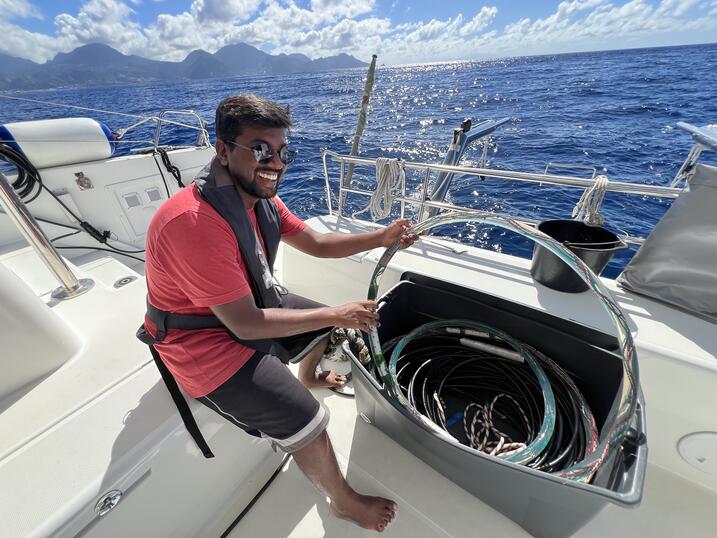
What makes this novel sensing difficult is enabling this when each robot can only use its own limited onboard resources. I address a similar constraint for marine wildlife monitoring where the signal source could be, for example, a sperm whale with a radio beacon tag that an autonomous drone needs to locate during the whale’s short surface duration of 10 minutes.
Ultimately, the goal is to make the robots more independent by equipping them with a new sensing modality that augments their current capabilities.
A Serendipitous Decision
My first exposure to robotics was at Arizona State University, where I started my master’s program after moving from India in 2017. My now-advisor, Professor Stephanie Gil, joined their faculty shortly after, and her class that focused on multi-robot systems inspired me to do research in her lab. This decision ended up being serendipitous, as I not only got the opportunity to join her lab as a PhD student soon after but also to stay on when she was offered a faculty position at Harvard in 2020.
Since then, I’ve learned a lot from Professor Gil about conducting research and presenting my work coherently to a wider audience. She also cultivated my focus and the patience needed for research, two of the most important skills that a student needs on their PhD journey.
The part of my research that took time to get used to was understanding how to perform research outside of a controlled lab environment. An example of this would be my most recent work which involves deploying robots for marine wildlife monitoring. The initial algorithms that we designed operated well in our indoor test environment but reacted very differently when scaled up. Getting my research from indoors to such an “in-the-wild” environment has been a huge learning experience. A major aspect of my research vision going forward is to push the boundaries of robotics research by continuing to develop robust algorithms and systems in such challenging settings.
Learning Through Teaching
A memorable milestone of my PhD journey was when I was the teaching assistant for my advisor’s robotics course in spring 2022. Having substantially worked with robots until then, I had begun to assume many fundamental concepts and pieces of information required for hands-on robotics. The teaching staff had designed multiple mini-workshops where students would spend a day learning the basics of mobile robots and deploying different algorithms that they were learning in the course. It was a lot of fun but also made me aware of students’ different capabilities and levels of knowledge, and the gap in my teaching style to accommodate it. Those workshops have been an important lesson for me to develop a flexible teaching style, especially for an interdisciplinary field such as robotics, which has a steep learning curve.