A One-Two Punch for Prostate Cancer
New therapy combines inhibition of dual biological pathways to shrink previously untreatable tumors

More men get prostate cancer in the US than any other form of the disease outside of melanoma. Around 3.5 million men live with prostate cancer, with 330,000 new diagnoses each year, according to the American Cancer Society. Over 36,000 men die from the disease annually.
The good news is that prostate cancer is treatable, especially when diagnosed early: the survival rate five years after diagnosis is a whopping 97.7 percent, according to the US Centers for Disease Control and Prevention. The bad news is that the rate falls to only 37.9 percent when the disease has spread. Moreover, treatment of the disease through hormone therapy can have deleterious side effects. For prostate cancer that does not respond, there is no effective treatment.
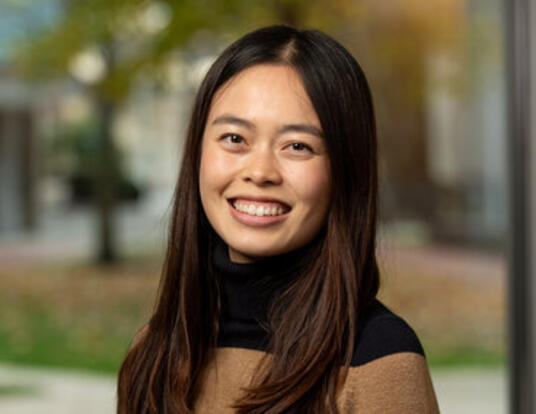
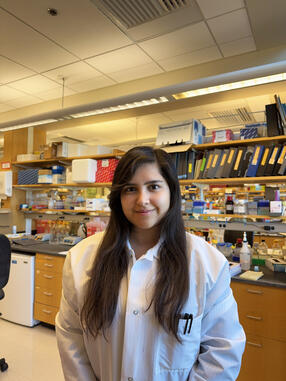
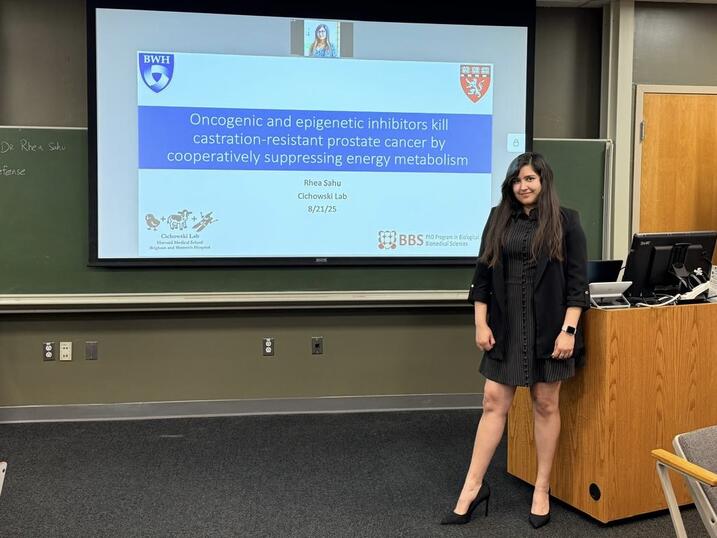
Now, help may be on the way. By targeting two particular biological pathways in cancer cells simultaneously, researchers for the first time were able not only to stop the growth of castration-resistant prostate cancer, but also to shrink existing tumors. The work, led by biologist Rhea Sahu, PhD ’25, a postdoctoral fellow at the San Francisco-based biotech firm, Genentech, was published recently in the Journal of Clinical Investigation.
Deadly Dynamism
Aggressive or recurrent prostate cancer is typically treated by blocking the hormone testosterone—so-called “medical castration”—and inhibiting the signaling of the androgen receptors (AR) where testosterone binds to cells. Unfortunately, patients often develop resistance to this therapy, and the disease progresses and becomes more aggressive. The reason? Metabolic plasticity.
“Metabolic pathways in our cells are very interconnected,” Sahu explains. “If you shut down one part of the metabolism or one key regulator, oftentimes something else can compensate, or the cells can change and adapt so they no longer rely on whatever you shut down. They start relying on another metabolic pathway to get energy or metabolites, or whatever they need to grow. That's what we call this plasticity.”
Metabolic plasticity is true of cancer cells in general, but it's especially true of prostate cancer. Most cells rely on the metabolic processes covered in high school biology class. Mitochondria are the powerhouse of the cell. Glycolysis breaks down sugar (glucose) into pyruvate and shuttles it into the mitochondria, where oxidative phosphorylation takes place. But prostate cells are different, cancer cells even moreso.
“Mitochondrial oxidative phosphorylation doesn’t take place in healthy prostate tissue. It stops at glycolysis,” Sahu says. “When you get primary prostate cancer, the cells then rely on oxidative phosphorylation. As the disease becomes more aggressive, they switch back to glycolysis. You can really see how dynamic this is. That's why plasticity is so important to target in prostate cancer specifically.”
When you get primary prostate cancer, the cells then rely on oxidative phosphorylation. As the disease becomes more aggressive, they switch back to glycolysis. You can really see how dynamic this is. That's why plasticity is so important to target in prostate cancer specifically.
—Rhea Sahu
Pathways to New Treatments
To address this deadly dynamism, Sahu’s research centered on two particular biological pathways—cascades of functions involved in cell regulation. The first, the PI3 kinase pathway, is the most frequently overactivated in cancer. In prostate cancer in particular, studies show that the pathway drives not only the formation, but also the progression of cancer. “We specifically focused on that because in 40 percent of castration-resistant prostate cancer tumors, you see alterations in the negative regulator PTEN, compared with only about 15 percent to 17 percent in primary prostate cancer. So as the cancer progresses, you get more and more activation of this pathway.”
The second pathway, EZH2 is also overactivated in prostate cancer, and is a driver of the disease. Technically, EZH2 is an epigenetic regulator rather than a pathway, changing how genes are expressed without changing the DNA itself.
“Cancer cells can adapt very quickly because they're very good at changing their transcriptional state,” Sahu says. “They can quickly shut off some genes and express others: ‘We can't rely on this pathway anymore? No problem. We'll just start expressing these other genes for this other pathway.’ So, we had this idea of targeting epigenetic regulators because cancer cells rely on them to change the transcriptional landscape. If we shut that off so the cell cannot quickly adapt, while at the same time shutting down the PI3 kinase signaling pathway that's important for proliferation, we thought those effects might converge.”
Sahu’s team tested their hypothesis on mice with prostate cancer. Some mice were given only a solution with no drugs. Some were administered a small-molecule inhibitor—a chemical that binds to part of a protein and stop it from functioning—that targeted either the PI3 kinase or the EZH2 pathway, but not both. A final group was given inhibitors for both pathways. As expected, tumors grew fast and aggressively in the mice that received the solution only. Similarly, the mice that received only one of the inhibitors saw little effect. The tumors continued growing. But when the inhibitors were combined, tumors actually shrank.
Harvard Medical School Professor Karen Cichowski, Sahu’s dissertation advisor, calls the results “extremely exciting.” “Regression of castration-resistant tumors is rarely, if ever, observed,” she says. “In addition, Rhea's discovery that these agents kill these cancers by reprogramming the metabolism of cancer cells was quite interesting and novel.”
Much of the impact of the new therapy took place quickly, within only a week, then began to plateau. Even so, that type of result in humans would be a massive breakthrough. “If we were able to shrink a tumor and keep it from growing at all, that's stable disease. That doesn't exist right now for advanced prostate cancer,” Sahu says.
Regression of castration-resistant tumors is rarely, if ever, observed.
—Professor Karen Cichowski
Hard on Tumors, Easier on Patients?
Sahu says that the new therapy is a kind of “one-two punch” for cancer. Blocking the PI3 kinase pathway shuts down cancer cells’ ability to make energy. Surprisingly, this "metabolic catastrophe" alone doesn't necessarily mean the cells will die off. In theory, they could remain in stasis with the tumor stable but not shrinking. By inhibiting EZH2, which controls how genes are expressed, Sahu’s treatment also allows activation of the gene BMF, which regulates cell death (apoptosis). “BMF acts as a sensor,” she explains. “It responds to the metabolic catastrophe by saying, ‘We can't make energy; we have to start killing the cell.’ That's what causes the shrinkage of the tumor.”
Sahu’s research also provides evidence for the effectiveness of cancer treatments that target the “managers” upstream in the oncogenic or cancer-causing pathway. “These oncogenic pathways are active at some baseline level in normal cells, but they're very highly activated in cancer cells,” she says. “So, when you give the mice this treatment, it inhibits the cancer cells much more potently than the healthy cells. The tumor gets the brunt of it.”
While Sahu’s team has not done a direct comparison, there is reason to believe the new therapy could be more tolerable for cancer patients. Chemotherapy, for instance, inhibits a fundamental process—the division of cells—with the idea that cancer cells divide much faster than healthy ones and will be more affected by the drugs. The problem is that many others divide quickly, too, including hair and some intestinal cells. “That's why chemotherapy causes hair loss and many other, more toxic side effects,” Sahu says. “With these oncogenic pathways, it really is more specific to the cancer cells. We didn’t look at healthy mouse cells, but we did look at immortalized prostate epithelial cells, which are the closest you can get without looking in a patient. There was no killing with these agents in that cell line.”
The new therapy is moving closer to human testing. The next step in the process is to test the treatment in primates, to see how it works over a longer period of time. The possible toxicity of the treatment also needs to be studied in greater depth. If the data from these trials are positive, human clinical trials can begin. “EZH2 inhibitors alone are in clinical trials for prostate cancer,” says Sahu’s colleague, Dr. Alycia Gardner, a postdoctoral researcher at Harvard Medical School and Brigham and Women’s Hospital. “We’d love to see this combination enter clinical trials as well, as our preclinical data suggests it could have greater efficacy than EZH2 inhibitors alone.”
With these oncogenic pathways, [the treatment] really is more specific to the cancer cells. We didn’t look at healthy mouse cells, but we did look at immortalized prostate epithelial cells, which are the closest you can get without looking in a patient. There was no killing with these agents in that cell line.
—Rhea Sahu
Sahu says only so much can be done in academia. One reason she’s at Genentech is to see how a biotech firm can take a new therapy over the finish line and into clinical use. “The issue sometimes becomes that we're using two drugs in a combination,” she says. “The company has to be developing both drugs, own both drugs, or collaborate with the company making the other drug. So there are factors outside of science that also determine this. Theoretically, if we could get somebody to do these experiments and go full steam ahead, I think we could do the first clinical trial in a year. But a lot of things have to fall into place.”