Imagination as a Tool of Survival
Miriam Udel, PhD ’08

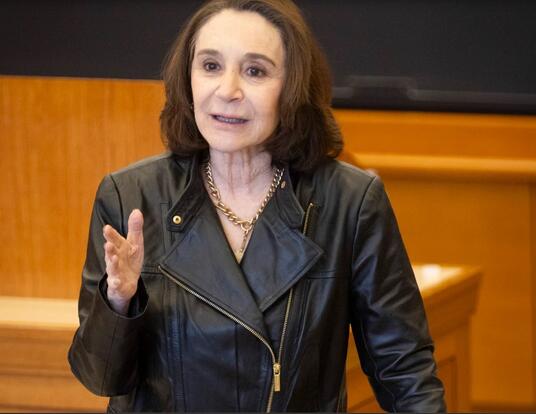
Miriam Udel graduated from the Harvard Kenneth C. Griffin Graduate School of Arts and Sciences in 2008 with a PhD in comparative literature. Now a professor of German studies and Jewish studies at Emory University, she works at the intersection of literary translation, cultural history, and democratic theory. Udel reflects on the power of children’s literature in the modern project of Jewish cultural survival, her passion for language, and a defining lecture delivered after the terrorist attacks of September 11, 2001.
A Passion for Language, A Life-Changing Conversation
I was born in the Berkshires to two teachers—my father taught high school English and my mother taught art. My parents divorced when I was young, and my mother relocated us to Miami. Our financial circumstances meant that my best shot at college was gaining admission to a need-blind institution like Harvard. Fortunately, I did.
Growing up in Miami, we fully embraced the city's international, Spanish-dominant landscape. In the fifth and sixth grades, my mother enrolled me in the Spanish track of a new foreign language magnet program. Immersed in Spanish for two and a half hours each day, we completed half of the social studies and science curricula in that language. To this day, I know the vocabulary pertaining to photosynthesis and Latin American geography better in Spanish than in English.
That experience taught me that I had both an aptitude for and a deep enjoyment of language study. My first year at Harvard College, I signed up for a five-day-a-week introductory modern Hebrew class, eventually concentrating in Near Eastern languages and civilizations. After graduating, I spent two years studying in Israel and freelancing for The Atlantic and The New Republic. I quickly learned that the freelance life is tough—you get kicked around a lot—and I realized that I wanted to conduct research on a longer time horizon than journalism allowed. I had unfinished business with literary studies.
When I returned to Boston to apply to graduate school, Professor Ruth Wisse, who became my PhD advisor told me, "You should think about Yiddish. You clearly like languages, and Yiddish is a Germanic tongue. You already speak English, so you have a head start." It was a conversation that changed my life. A few days later, she left a copy of College Yiddish, the then-preeminent Yiddish textbook, in her mailbox with a Post-it note that said in Yiddish, “For Miriam—a gift.” I kept that sticky note a long time.
A Repudiation of Terror
My very first class at Harvard Griffin GSAS—English 151—was the day after the terrorist attacks of September 11, 2001. I remember sitting in Sever Hall, completely unmoored, panicking, and wondering what on earth we were doing. How could we possibly discuss literature while the world was smoldering?
My first lecture was taught by Professor Philip Fisher. He stood before us, acknowledged the terror of the previous day, and said something that has stayed with me through every national shock and crisis over the course of my career.
When I returned to Boston to apply to graduate school, Professor Ruth Wisse, who became my PhD advisor, told me, "You should think about Yiddish. You clearly like languages, and Yiddish is a Germanic tongue. You already speak English, so you have a head start." It was a conversation that changed my life. A few days later, she left a copy of College Yiddish, the then-preeminent Yiddish textbook, in her mailbox with a Post-it note that said in Yiddish, “For Miriam—a gift.” I kept that sticky note a long time.
He told us that everything we had come to Harvard to do—our close reading, our collective attention to texts, our commitment to humanistic inquiry—was diametrically opposed to the spirit, the goals, and the destructive ideology of the authors of that attack. By showing up, sitting together in a room, and dedicating ourselves to reading a Victorian novel with deep, disciplined attention, we were directly repudiating and countering everything those forces of destruction stood for.
Embracing Scholarship—and Motherhood
Apprenticing myself to Ruth Wisse as a PhD student was a formative experience. I knew going in that she had a rich extramural life, and I didn’t expect to agree with her about everything. But I also knew she was a mother of three. As a young female scholar who hoped to have a family of her own, I desperately needed to see a model of how a woman navigates the seemingly impossible demands of elite academia alongside motherhood.
Somewhere during my coursework, I received the advice that if I wanted to have children, I should do so either immediately after completing my coursework while writing my dissertation, or wait until after securing tenure. Trying to learn how to parent during the probationary, pre-tenure years is notoriously difficult. I took that advice to heart.
It was a real litmus test, showing up in graduate school spaces with an obviously pregnant belly. But when I shared the news of my pregnancy with Ruth, she received it with unmitigated joy and celebration. There was never a hint that having my eldest son would hinder my progress; rather, she treated it as something that would motivate me. I will always cherish that human example.
Ruth shaped the trajectory of my scholarship in two profound ways. First, she placed the Yiddish language at the absolute center of our education, conducting all advanced seminars entirely in Yiddish. Second, she modeled a beautiful pedagogical ethos for navigating high-stakes, diverse classrooms. She would tell us: "When we are in this classroom, the only 'we' is we readers." In area studies, it is incredibly easy for the dialogue to slip into sectarian assumptions—for example, into "we Jews." By actively resisting that slippage, she preserved the classroom as a democratic, rigorous space of universal humanistic inquiry.
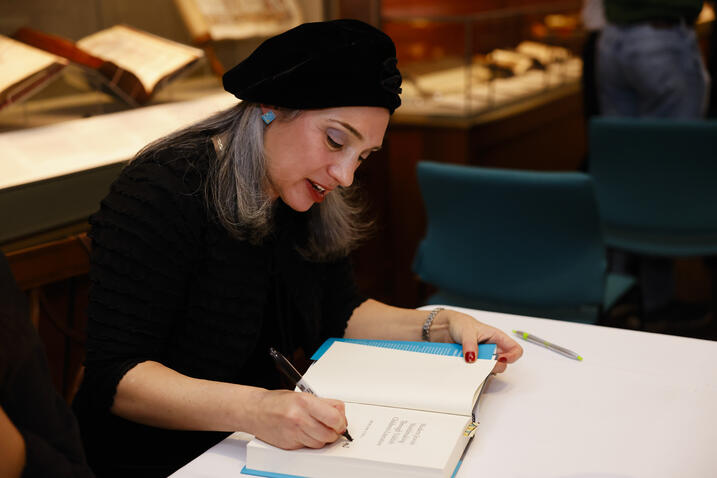
My very first class at Harvard Griffin GSAS—English 151—was the day after the terrorist attacks of September 11, 2001. My first lecture was taught by Professor Philip Fisher. . . . He told us that everything we had come to Harvard to do—our close reading, our collective attention to texts, our commitment to humanistic inquiry—was diametrically opposed to the spirit, the goals, and the destructive ideology of the authors of that attack.
The Nation without Borders
If you want to understand the modern Jewish project of cultural survival, you have to look closely at the stories written for its children. For most of my career, I have worked with Yiddish children’s literature as both a translator and a critical scholar. I see these two practices as deeply intertwined: the painstaking, intimate decisions required of literary translation heighten your consciousness as a critic, allowing you to go back into the primary texts with a kind of attunement that would otherwise be impossible.
Historically, this literature was not just entertainment; it was a highly organized nation-building project. Because Yiddish culture addressed a nation without traditional geographic borders, a sovereign state, or a military to defend them, language and literature became the primary coordinates of its collective identity. Passing this heritage to the next generation through storytelling was a vital, urgent political act.
To see this world-building in action, consider a poem called "Olke," written by Kadya Molodovsky and published in interwar Warsaw in 1935. Olke is a six-year-old girl growing up in a heavily Jewish slum neighborhood called the Okhote. Her parents are deeply impoverished and constantly out working, leaving Olke with a list of household chores that are completely out of sync with her age and abilities. She goes outside, opens her parasolke—her little blue parasol—and immediately disappears into a rich, recursive daydream.
The poem is beautifully iterative. With each new chore list, Olke retreats under her parasol to watch geese and airplanes—anything with the capacity to fly away and escape. In one sequence, she is supposed to sew buttons on a shirt, but she accidentally spills the canister. Instead of a disaster, the buttons organize themselves into wheeled conveyances: bicycles, wagons, and finally a train. In the poem’s final moments, the realistic fourth wall dissolves completely as Olke climbs aboard the button train and rides away from her reality.
Yiddish children’s literature took off after World War I alongside the rapid rise of modern child psychology. There was a conscious effort to protect children from graphic violence, to center girl heroines as full, active agents of their destinies, and to treat literacy as a powerful vehicle for a more just society.
For children growing up in the crushing poverty of interwar Poland, you could not tell them "the sky’s the limit." Opportunity was far too constrained. What Molodovsky’s poem does instead is brilliant: it inverts that promise. It tells the child that her tangible limit—the blue fabric of her parasol—is nothing short of a symbolic sky. It validates the sovereign, transportive power of the child’s own imagination as a tool of survival.
A Curriculum for Empathy
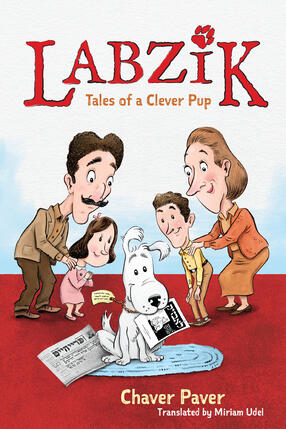
On the opposite end of the political spectrum is Labzik: Tales of a Clever Pup, a forthcoming book-length translation of mine. This text emerged from the Yiddishist, far-left communist community of New York in 1935. Labzik is a lovable mutt abandoned on an elevated train platform in the Bronx because his working-class family in Brooklyn can no longer afford to feed him during the Great Depression. As rush hour descends and the rain starts to fall, he sits shivering on the wet platform.
Along comes Berl, a local sewing machine operator. He sees this cold, shivering dog and, despite his own tight budget, decides he cannot leave him behind. Berl opens up his copy of the Morgen Freiheit—the Yiddish communist daily newspaper—wraps Labzik in it, and takes him home to a new, adoptive family.
From that moment on, Labzik and his humans go on a series of pro-democracy, anti-authoritarian adventures. Labzik joins Berl on the picket line when his sweatshop strikes against a lengthening workday, and he stands alongside his neighbors in resisting police brutality. It is a literature that deliberately embeds a curriculum for empathy, growing in complexity alongside the child’s development.
Unlike the classic fairy tales of the Brothers Grimm, which were first redacted in 1812 as a nationalistic, ethnographic enterprise and subsequently sanitized to remove sexuality while retaining extreme violence, Yiddish children’s literature took off in 1919 alongside the rapid rise of modern child psychology—a key insight of Harvard’s Professor Maria Tatar. There was a conscious effort to protect children from graphic violence, to center girl heroines as full, active agents of their destinies, and to treat literacy as a powerful vehicle for a more just society.
In this sense, 20th-century Yiddish children's literature shares a deep affinity with African American children's literature of the same era. Both traditions used the printed word as a democratic engine for social advancement, working to elevate marginalized communities out of systemic precarity and into an educated middle class.