Fighting Blindness with a Virus
Injecting the eye with a virus can treat age-related blindness—or kill the very cells that need healing. Virologist Apolonia Gardner, PhD ’26 investigates why this innovative treatment succeeds or fails.

Many students discover their passion for medical science in a laboratory or a hospital. But for Apolonia Gardner, who received her PhD in virology from Harvard Griffin GSAS and Harvard Medical School in May 2026, inspiration struck in an unusual setting: while competing at the National Spelling Bee.
“I didn't win, but the girl who did wanted to be a neuroscientist. I didn't know what that was until I looked it up in the dictionary, and I thought it was really cool,” she recalls. “I was trying to memorize thousands of terms and I thought, ‘How does the brain memorize all these words?’”
Gardner dove headfirst into the subject, participating in the “Brain Bee”—like a spelling bee, but for neuroscience facts—throughout high school and sampling four different labs as an undergraduate at the Massachusetts Institute of Technology (MIT). When it came time for graduate school, she leveraged her unusually broad skillset to investigate virus-based gene therapies for blindness. Today, as a postdoctoral fellow at Stanford University, she continues to explore how viruses can both help and harm the human body.
Virus for Good
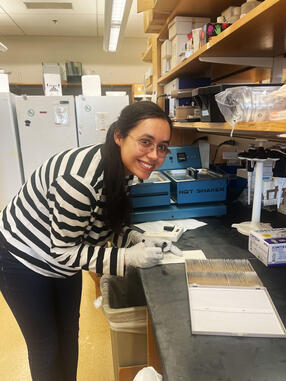
Gardner’s dissertation examined the promises and pitfalls of using adeno-associated virus (AAV) to deliver gene therapies to the eye. She describes her PhD as “two halves” which attack the problem from complementary angles.
“The first half is using AAV as a therapeutic to treat blinding diseases—so using it for good. And the second half is understanding why it can sometimes be bad,” Gardner explains.
In the therapeutic half of her work, Gardner tested whether using AAV as a delivery vehicle for a human gene called NRF2—which had already been shown to treat a different eye disease—could also fight dry age-related macular degeneration (dry AMD), the most frequent cause of blindness for people over the age of 50 in developed countries. Both diseases are driven by “oxidative stress,” antioxidant imbalances that damage eye cells.
The safety of [AAV-NRF2 for the treatment of blindness] was quite encouraging. We injected this viral vector into animals and waited a year to see if there were any issues, and there weren’t.
–Apolonia Gardner
“We thought we could use the same viral vector as a ‘gene agnostic’ therapy, which just means you're not too focused on the specific genetic mutation the person has, but rather the underlying disease mechanism,” Gardner says. “Across many blinding diseases, oxidative stress is an underlying trigger, and the NRF2 gene we're delivering counteracts oxidative stress in cells, so this AAV vector can potentially be applied to treat various forms of blindness.”
Using mouse and rat models, Gardner found that AAV-NRF2 was not only an effective treatment for dry AMD, but it was also quite safe, without many side effects.
“The safety of it was quite encouraging. We injected this viral vector into animals and waited a year to see if there were any issues, and there weren’t,” Gardner says. “[This shows] that over time, you may not get many side effects.”
Of Mice and Men
In addition to demonstrating the feasibility of this treatment in mice, Gardner had the rare opportunity to work with an industry partner looking to bring the treatment to humans.
“We were collaborating throughout my PhD and throughout this project with Spark Therapeutics, which is the company that developed the first FDA-approved AAV gene therapy for the eye,” she says. “Our PI [principal investigator] was interested in taking some of her gene therapies to clinical trials, and this was one of them.”
Gardner served as a bridge between her thesis laboratory and Spark, communicating records and results of experiments with the company as she and other members of the lab generated the data. It was challenging to balance these responsibilities with her own dissertation research (“almost like having two jobs,” she says). Despite this, she found the experience highly rewarding—both for patients and for her own career.
“Spark has all of our data stored. The plan is to use that data to move into a large animal model, collect more data, and then hopefully go into humans,” Gardner says. Working with Spark also allowed her to explore what happens to research once it leaves the laboratory. “It was fun to see the industry side of it.”
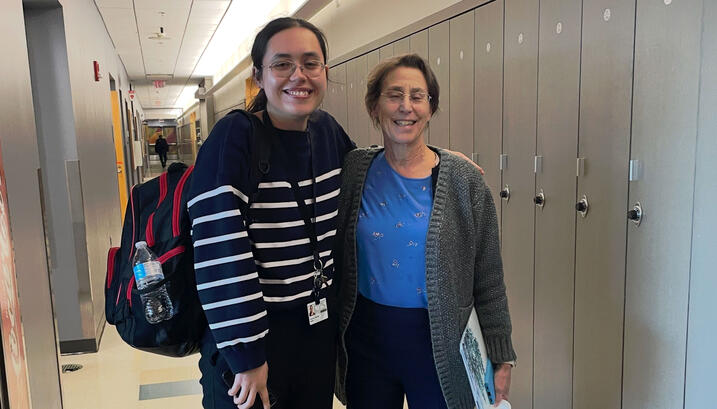
Since Apolonia was using mice to track down the effects of AAV gene therapy, she was able to use genetically altered mice to ask about cause and effect. This is hard to do in human clinical trials.
–Constance Cepko
Bullard Professor of Genetics and Neuroscience
Solving the Toxicity Puzzle
While it’s impressive on its own, Gardner’s research on the clinical applications of AAV for treating dry AMD is only the first half of her dissertation. The remainder investigates the flip side of the coin—why AAV can sometimes be toxic, killing eye cells rather than promoting healing.
“Clinically, we’ve seen that AAV, over long periods of time, can cause toxicity. Basically, cell death in the cell types that you’re trying to treat,” Gardner says. “That’s obviously not what we want, because we don’t want to kill the cell types that need to be treated!”
According to Constance Cepko, Gardner’s advisor and Bullard Professor of Genetics and Neuroscience at Harvard Medical School, many different mechanisms could explain this toxicity. Gardner’s task was to narrow down these possibilities.
“Since Apolonia was using mice to track down the effects of AAV gene therapy, she was able to use genetically altered mice to ask about cause and effect,” Cepko says. “This is hard to do in human clinical trials.”
Through a series of precise experiments, Gardner and her lab mate Christin Hong pinpointed two main factors that interact to produce AAV toxicity: the specific gene that the AAV delivers, and the type of cell that receives it. In contrast to AAV-NRF2, which her prior experiments demonstrated was safe and effective, using AAV to transport a different gene called green fluorescent protein (GFP) damaged the target cell types.
“Apolonia found that in addition to interferon [immune] responses, [which are] common in viral infections, cellular stress responses contribute to toxicity,” says David Knipe, Higgins Professor of Microbiology and Molecular Genetics at Harvard Medical School. Stress responses help cells adapt when they face environmental stressors, but they may eventually trigger cell death if normalcy is not restored.
These stress responses are likely responsible for the eye cell death associated with GFP. “This knowledge provides potential ways to treat toxic responses to AAV vectors during gene therapy,” says Knipe.
As scientists continue to develop AAV-based gene therapies, these results highlight the importance of rigorously testing their long-term safety, since genes and cells can interact in surprising—and unpleasant—ways. Gardner’s approach of investigating toxicity mechanisms in mice could help prevent any unpleasant surprises in human clinical trials.
“It is useful to learn early whether vectors with the potential to become clinically useful might be toxic over the long term, as this information could protect people from side effects,” Gardner says. “If you can model that toxicity in a mouse first, before going into humans, you can figure out which pathway is causing toxicity. Then, you can intervene and block that pathway.”
[Gardner’s research] provides potential ways to treat toxic responses to AAV vectors during gene therapy.
–David Knipe
Higgins Professor of Microbiology and Molecular Genetics
Same Questions, New Tools
Gardner has opted to leave the eye behind in her new role as a postdoctoral fellow in the microbiology and immunology department at Stanford University. “Actually, for the mouse project that I’m doing now, it involves every tissue except the eye,” she jokes.
While her day-to-day work has changed dramatically, the pivot was strategic. Gardner remains committed to investigating virus-host interactions and their potential applications for medicine, and she hopes the postdoc will push her to explore new approaches to these questions.
“I'm learning a lot of new techniques to apply to questions in virology, so that was part of why I picked [this job]—to expand the scope of the skillset I had learned as a PhD student,” she says.
Apolonia Gardner’s research was supported by a National Institutes of Health F31 grant (5F31EY035867-02) and a Harvard Herchel Smith PhD Fellowship.