This Far, By Faith
Ifeosa Anwulika Nkem-Onyekpe, PhD ’26

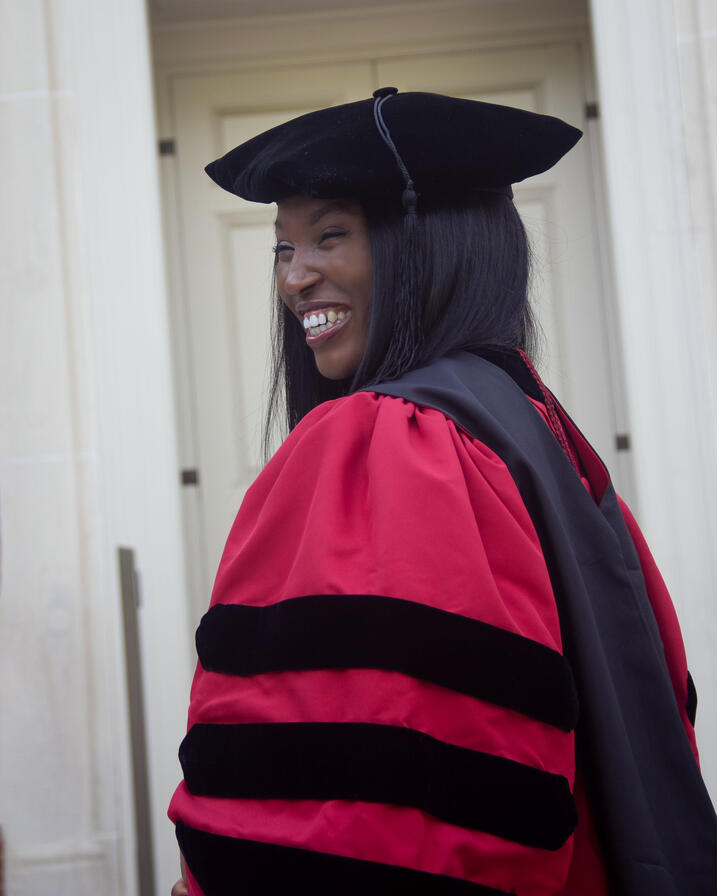
Ifeosa Anwulika Nkem-Onyekpe graduated from Harvard Griffin GSAS in 2026 with a PhD in history. She talks about her research on wealth, wellbeing, and poverty in Africa; the founding and expansion of her nonprofit Hope Library Project; growing up and completing her undergraduate studies in Nigeria; and how her religious devotion carried her to academic success and service.
Wealth, Poverty, and Wellbeing
When I entered Harvard Griffin GSAS, I knew I wanted to learn about rural people, especially because poverty in sub-Saharan Africa is concentrated more heavily in rural societies than in urban places. As my work developed, I wanted to understand the contradictions between wealth and poverty.
I studied the period from 1837 to 1979, primarily in West Niger Igbo Area, a sub-region of Southern Nigeria. I began in 1837 because that was the first time in recorded history that the outside world encountered this local community. British visitors wrote about the buildings and culture they saw and the trade opportunities they imagined. I describe that moment as the eve of integration: the beginning of exchanges and interactions that eventually drew local people into national and international worlds.
To understand the transformations that followed, I use the idea of “bilayered integration.” On one level, the West Niger Igbo people became part of a nation created through colonial rule called Nigeria. On another, local farmers, local people, and local consciousness became part of a global political economy and the development of capitalism. Poverty, wealth, wellbeing, and inequality can be understood within these two layers of integration.
The changes in the material world were unprecedented. Gradually, a person could no longer be considered well without clothing; a child could no longer be considered fine without education and literacy. Land became individual and private in a way it had never been before, so that some people could have it while others lost access. These changes came through the force of empire and, eventually, global capitalism.
The effects of globalization cut both ways. Greater integration expands opportunity. People like me can travel outside their home countries, gain education, find employment, and send money home. But the ways people experience lack also expand. Nigeria’s crude oil generates national wealth and creates employment, while the rural communities where the oil is extracted lose water, fishing grounds, and farmland. The monetization of land enables some people to build wealth through a speculative asset, while others lose the land on which they grow crops. Fate or fortune determine which side of the pendulum you happen to be on.
My work also shows how important it is to question the indices we use to measure wellbeing, wealth, and poverty. We talk about a poverty index, but then you say: To whom, and for what? We have more data and more global standards, but we also need ethnographic, real-life experiences and definitions. That will matter if we want to support poverty alleviation, encourage human flourishing, and recognize genuine kinds of wealth and wellbeing in Africa.
The effects of globalization cut both ways. . . . People like me can travel outside their home countries, gain education, find employment, and send money home. But the ways people experience lack also expand. . . . Fate or fortune determine which side of the pendulum you happen to be on.
A Library of Hope
In 2018, when I was an undergraduate at the University of Lagos, I founded a nonprofit called Stories of Home. The original idea was to write the stories of inspiring Africans because I am a product of hearing people’s stories and being inspired by them. As a student, I had seen people’s lives transformed around me. Those stories formed gems of inspiration in my heart, and I wanted to curate stories of faith, healing, and people overcoming difficult circumstances.
But I became restless because I realized it was not only about writing stories. It was also about recognizing how difficult life can be for people and asking what we could do. At the time, my family lived in the gated community of the University of Lagos. Just across the canal was a community where people lived in stark poverty. I felt in my heart that it was not enough to celebrate our stories; we also had to find ways of supporting people who did not have.
I started with three friends as volunteers. I was a youth corps member and had about 30,000 naira. My friends contributed more, so together we had 40,000 naira. We gathered used clothes and bought food—noodles, spaghetti, and other staples. We went into the community, held an event, and distributed the food and clothes. I remember how happy people were to be with us. But I knew the work had to be structured because it is not enough to give food. You ask yourself: What next?
The next time, we organized skills training to help people earn their own money. By the time I traveled to the United States for graduate school, we had about 10 core team members and 80 volunteers. I was learning on the job: how to put structure around a nonprofit, place people in charge, raise funds, and decide what exactly we were doing. During graduate school, I often devoted my weekends to church and the nonprofit, with a midpoint on Wednesday evenings when the team could tell me what was not working. Summers allowed me to return to Nigeria, do the larger work on the ground, hand it back to the local team, and then return to the United States to oversee it.
As our vision became clearer, the Hope Library Project emerged as an important arm of the organization. We are creating learning spaces for children in rural Africa, one community at a time. I am a product of libraries. They have always been places for me to dream, think, and learn. I came to the United States and saw public libraries in many towns and cities. In Nigeria, even many public schools do not have working libraries. I thought, let us do this for the children.
We are not simply bringing books. We are creating library spaces with mentors and programs, thinking about how the children are learning, what they are learning, and the excitement and inspiration they find. At one of our test runs, 118 children came on the first day—so many that we did not have enough space and had to create a rotation. Some of their parents, who were farmers and could not read, asked whether the parent-farmers could take the books home because it was so exciting.
We are now establishing our first permanent Hope Library. We ask governments, churches, or private individuals to give us a space that we can turn into what I call an oasis of hope and knowledge for children. It is more than a library of books; it is a library of hope and new dreams. Collaboration matters because we do not want to come into a community and simply give people something. We want them to own it and genuinely care about it.
I tell my team that one of my biggest dreams is that, someday, we will have 5,000 Hope Libraries in different parts of rural Africa. Then I can go to sleep. But it starts with one.
The Courage to Dream
I grew up mostly in Lagos, Nigeria. My family was middle class. I grew up in what might be called a suburban, but really low-income, community in Lagos for the first 16 years of my life. My dad is a professor of history at the University of Lagos, and my mom is a petroleum engineer.
One of the most important things that happened for me was attending the International School, University of Lagos, one of the best secondary schools in Nigeria. For the first few years, I struggled academically and with my self-esteem. Every time my dad dropped us off at the gate, my tummy would be so knotted. Many of my classmates came from wealthy families and great schools. When I heard them talk about holidays in Paris, I would think, “I don’t like this school. Take me back.”
But one day I asked myself, “What if I actually could become one of the best students here?” This was around 2010 or 2011, when I was also beginning to find my own faith. I had grown up Christian, but I wanted to know God for myself. I bought a Bible and decided to read it from start to finish. I began to think about what it meant to understand grace. I said, “God, I want to be one of the best students in this school. I’d like You to help me.”
I found my voice. I found how I learned. Eventually, I became one of the best students in the school and won prizes in many different subjects. During that period, I thought, “I’m going to go to Harvard someday.” I did not know how, but I had started learning the ability to dare to dream: to have the courage to dream, pray it forth, prepare my mind, prepare myself, and try.
After secondary school, I went to the University of Lagos. My teachers and my mom wanted me to study law, but I wanted to become a historian. At the time, my department had gone decades without a student graduating with first-class honors. I applied myself, asked God for help, and graduated first class, becoming one of the first people to do so, and having the highest cumulative grade point average in the department’s history by the time I graduated. My friends and professors told me it was possible to apply directly to PhD programs. That was when I decided to apply to Harvard.
We are creating learning spaces for children in rural Africa, one community at a time. I am a product of libraries. They have always been places for me to dream, think, and learn. I came to the United States and saw public libraries in many towns and cities. In Nigeria, even many public schools do not have working libraries. I thought, let us do this for the children.
Good News in the Dark
I will never forget the moment I learned that I had been admitted to Harvard. It was January 31, 2019. I was completing the National Youth Service Corps, a mandatory one-year program in which the Nigerian government sends graduates to another part of the country to serve. There was no electricity in my room that night. It was dark, and I had only my small phone.
At about 7:30 p.m., I received an email from Professor Dimiter Angelov. It said, “Ifeosa, good news, congratulations!” I opened it and read, “On behalf of the Department of History . . .” I thought, “No way. I know I was waiting for news, but is it really happening?” I went outside and called some friends in the compound. “Come and read this email and tell me what it is actually saying. I don’t think I’m seeing it correctly.” They said, “You are going to Harvard!”
I immediately called my family in Lagos. My dad had paid my application fees, even though they were expensive for us, and my mom had prayed nonstop. She was the first person who told me it would happen, and that I should have faith. The joy and the weight of the moment were enormous. My school, professors, community, pastors, and churches celebrated, too.
I had never left Nigeria before. Neither my siblings nor my dad had left the country, either. People gave me outfits and money as gifts because they all genuinely and collectively shared in the journey with me and my family. I traveled on August 22, 2019, just after my 23rd birthday. My dad wanted my mom to travel with me so I would not get lost, but we did not have enough money for two flights. When I finally got to Cambridge, I connected to the Harvard Wi-Fi and called my family. My dad said, “Oh God, you’ve arrived!”
Finding Community at Harvard
When I first arrived, it was overwhelming. In the first class I ever took, I did not have a computer, so I had to depend on my phone for the readings. It was a seminar, and I had never been trained to talk in class that way. My classmates discussed books and scholars who were completely new to me. Americans talked so fast that I could not always follow the conversation. After the first few classes, I called my brother crying and said, “I don’t think I can stay here. I don’t think I will do well. I want to go back home.”
Having great professors mattered. Professor Sven Beckert told me, “Of all the people who applied to our school, there is a reason we chose you. Don’t let any other person in that classroom make you feel intimidated.” My advisor, Professor Emmanuel Akyeampong, would walk with me around Harvard Yard, reassuring me and giving me tips.
Then COVID-19 happened. I could not go home, and I had trouble finding an apartment after students were asked to leave the residence halls. The Office of Residential Life was very kind and allowed me to remain, but I was the only person in the entire building that summer. Being alone was one of the toughest things I ever experienced in graduate school. Before, whenever I had a struggle, I would go to my mom and we would pray together. Now she was far away, and I did not have any family in America.
Gradually, things began to change. My church and the Christian fellowships at Harvard helped me find community. I had one foot in my primary church, the Redeemed Christian Church of God, and another in Harvard Christian groups. I became one of the coordinators of the Graduate Christian Fellowship for about three years. Some of my closest friends in America came from that group.
The fellowship was there when I needed help making sense of American culture and when I struggled with anxiety. It also became an accountability group. I would tell them, “In my next seminar, I want to be able to say two things.” Later I would report, “I was able to say one thing.” Next time, I would say two. There was no judgment. We were praying together, and everyone could be human. Gradually, I was able to create that kind of space for other international students.
I had grown up Christian, but I wanted to know God for myself. I bought a Bible and decided to read it from start to finish. I began to think about what it meant to understand grace. I said, “God, I want to be one of the best students in this school. I’d like You to help me.”
Mission-Oriented Scholarship
I am beginning my first year as a visiting assistant professor at Randolph-Macon College. For the future, I have settled on this: Academia will be the foundation of everything else I do. The research will feed the work we do with communities, while the nonprofit will give me the human grounding and real-life experience to reshape my scholarship. Both matter.
I want the Hope Library to inspire children across Africa and show people around the world what is possible when we put our hearts to dreaming and serving others. I also want my research to speak to the questions that matter to me and to the world: wellbeing in Africa, hope-inspired childhood, the ways people understand poverty, and how genuine collaboration can help communities thrive. I want to produce scholarship that actually matters—scholarship that speaks to the things that matter to my heart.