Of Star Stuff and Simulations
Gus Beane, PhD ’25

Gus Beane recently completed a PhD in astronomy at Harvard Griffin GSAS, where he used computational models to simulate the formation of the Milky Way. He reflects on his early fascination with physics, the challenge of modeling events from billions of years ago, and how his advisor’s support helped him navigate graduate school—and life—through moments of real difficulty.
Carl Sagan Was Right
I’ve seen the Milky Way form and evolve hundreds of times in order to simulate its past and understand where we come from.
When I say that, I don’t mean in some poetic, figurative way. I mean I’ve run over 400 simulations of our galaxy’s formation. The Milky Way, like all galaxies, is made up of stars—and every star contains a unique mixture of elements, like a chemical fingerprint. These elements can tell us the story of how that star formed and what kind of cosmic environment it came from.
Most of those elements are created through the deaths of other stars. Carl Sagan once said we’re all made of “star stuff,” and that’s true. The atoms that make up our bodies, our planet, even the sun itself, were forged in stellar explosions millions or billions of years ago. What I study is how that material ended up where it did—and what that can tell us about our galaxy’s history.
The Magnesium Gap
The central question of my research is how different stars in the Milky Way came to have the particular mix of elements we see today. The full story is complicated, but in general, you expect that younger stars will contain more heavy elements because those elements accumulate in the galaxy over time as stars die and recycle their material into new ones. Iron is a good indicator of this kind of enrichment.
But it gets more interesting when you look at the ratios of certain elements to each other. One in particular is magnesium, what we call an “alpha element.” When we measure the ratio of magnesium to iron in stars, we see something striking: a bi-modality. In other words, stars tend to fall into two distinct groups—those with high magnesium and those with low magnesium. There aren’t many in between.
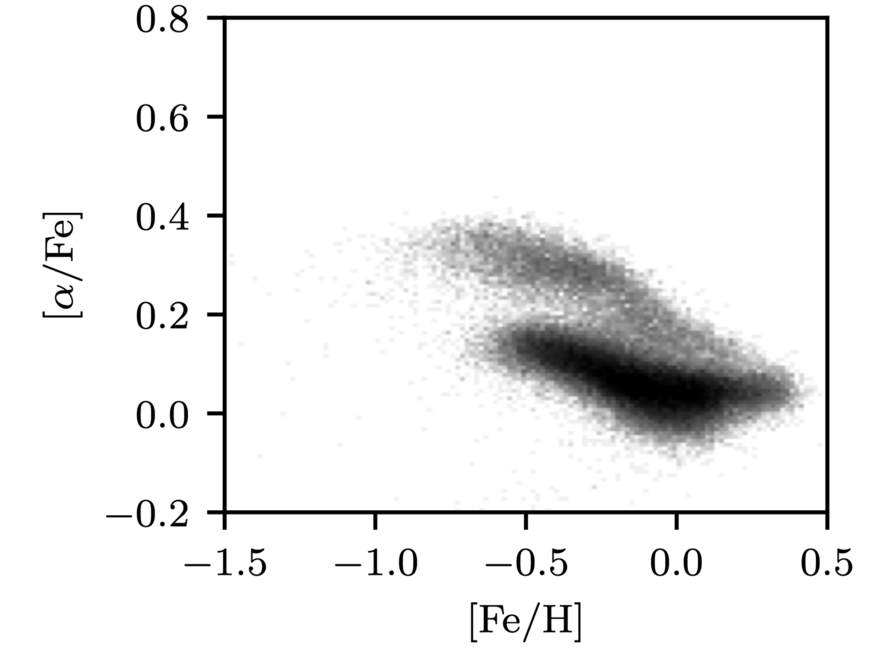
That gap, or dip, suggests that something significant disrupted the normal process of star formation—something that created two separate populations of stars. Many researchers believe a major merger with another galaxy caused this disruption. We know such a merger happened, so it’s a compelling theory.
But when I looked at simulations, I found something else. In every case where this magnesium gap appeared, there was a period—about 300 million years—where the galaxy temporarily stopped forming new stars. In galactic terms, that’s brief. But it’s long enough that the high-magnesium stars, which are born from short-lived, massive stars, stopped being produced. That pause left a chemical imprint.
So the new idea I’m exploring is this: it may not be the merger itself that caused the magnesium gap. It could be that any process which halts star formation for long enough will produce the same result—and several such avenues are already known. In other words, the merger may be a red herring.
Regular People. Amazing Science.
I grew up in Richmond, Virginia, in the suburbs near the University of Richmond. My parents weren’t scientists, and I’m the first in my family to earn a PhD. But they always supported me.
I got into physics in middle school after reading one of Brian Greene’s books. By high school, I was reading everything I could about particle physics. I even got to do research at the University of Richmond in a computational chemistry lab—an incredibly lucky break. Because they don’t have graduate students in the sciences, the lab was designed to support undergrads, and it was a great place to learn.
One moment that stands out: one of my teachers arranged a Skype call with a group of researchers in Italy who had just announced a major discovery in particle physics. We asked questions and talked to them about their work. I realized they were just regular people doing amazing science. That made research feel real to me—something I could actually do.
Up on the Roof
I’ve faced my share of challenges. The biggest, honestly, has been managing anxiety. It started in college but got worse as I transitioned to grad school—especially during the pandemic. I had to take time off to figure out how to handle it.
What made all the difference was the support I received at Harvard. My advisor, Lars Hernquist, was incredible. He’s a senior figure in the field, widely respected, and deeply selfless. When he was a student, he wasn’t treated well. He told me that when he arrived at Harvard, someone said he wouldn’t last a year. He did. And he decided he’d never treat students the way he had been treated.
There’s a moment I’ll never forget. During the height of the pandemic, when everything was still shut down, Lars and I met in person sometimes. One day, he brought a bottle of wine and said, “Want to go to the roof?”
So we climbed to the top of the Center for Astrophysics building and sat there for over an hour, talking. A little about science, a lot about life and the department and everything else. It was simple. But it meant a lot.
That’s the kind of person Lars is. That’s the kind of relationship we had. He never cared about how my productivity reflected on him. If I wasn’t getting results, he was only concerned about how I was doing personally. That kind of patience and care is rare. It’s something I’ll always be grateful for—and something I’ll carry forward if I ever advise students myself.
Even the Stars Have Secrets Left to Share
At its heart, astronomy is about curiosity. What surprised me most about this work is that we can even do it—that we can reconstruct the history of our galaxy, down to individual chemical traces in the stars.
What excites me is how much we still don’t know. We have competing theories about the same phenomenon, each plausible, each testable. My goal isn’t to pick a favorite, but to understand the mechanisms and let the simulations guide us.
That’s the beauty of this field. The sky is full of evidence, waiting to be decoded. And sometimes, even the stars have secrets left to share.