To Live Longer, and Better
New research reveals clues about length and quality of life

The human desire to live both longer and better has exploded into a cultural obsession. The global wellness economy—spanning fitness, nutrition, mindfulness, and biohacking—was valued at $5.6 trillion in 2022, with projections to reach $8.5 trillion by 2027. In the US and UK, 70 percent of consumers reported spending on healthy aging and longevity-related products or services, highlighting the widespread commitment to improving healthspan. Meanwhile, elite investors pour resources into anti-aging and life extension biotechnology, generating an unprecedented market expected to reach $64 billion by 2026. From fascination with centenarians to lifestyle trends to tech entrepreneurs aspiring to live forever, interest in aging reflects how deeply we value the quantity and quality of our days.
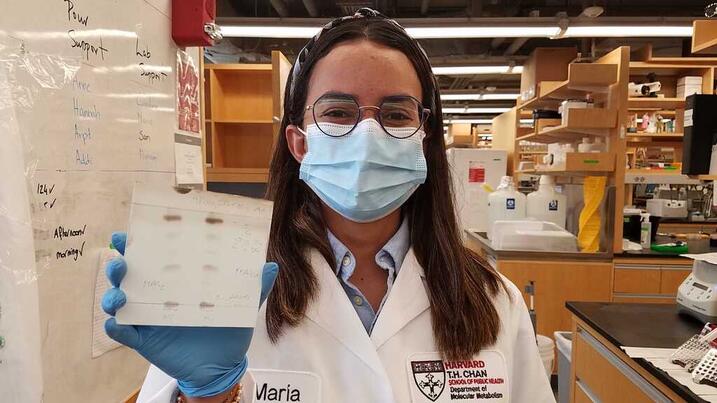
In the Mair Laboratory of Harvard’s T.H. Chan School of Public Health, Maria Perez-Matos, PhD ’25, set out to understand why certain individuals live longer, healthier lives than others.
“Some people within the same environment, within the same kind of context, or even twins – they live for different times,” Perez-Matos says. “So we wanted to understand, is there something that explains it? If so, how can we say that based on these biomarkers, this or that type of intervention would be better for you?”
For Perez-Matos, the question of aging is not just about adding years to life, but about adding healthy years. She notes that the average American’s quality of life declines sharply over the last decade. Rather than pursuing a goal to live to 200 years old, she hopes to ensure individuals can experience a good quality of life until their final day.
The Splice of Life
To study longevity, Perez-Matos turned to C. elegans, tiny transparent worms that self-fertilize and reproduce nearly identical versions of themselves. Despite having identical genetics and living in highly controlled conditions, some worms aged faster than others.
“They all eat exactly the same,” Perez-Matos says. “And even with that, there's heterogeneity.”
Focusing on molecular “splicing factors,” or proteins that regulate how RNA (ribonucleic acid, the messenger molecule that helps turn DNA instructions into proteins) is cut and assembled, Perez-Matos discovered differences that correlated with lifespan. Using fluorescent tags, she watched individual worms’ cells and saw which splicing patterns persisted into midlife. Those maintaining a “young” pattern tended to live longer.
Digging deeper, she examined what distinguished these longer-living worms. By analyzing over 500 lipids, she discovered that the worms that aged more gracefully had consistently higher levels of oleic acid, a fatty acid found in olive oil.
What is amazing about Maria’s work is that she kept both [genetics and environment] the same, yet still some animals aged much more slowly than others.
–Professor William Mair
“There's so much literature about people in the Mediterranean eating a lot of olive oil and aging better, even centenarians,” Perez-Matos says. “But it’s meaningful to see it in the context of a controlled experiment where all the worms ate the same diet, and yet those that age better just have more oleic acid.”
Her findings suggest that aging isn’t determined solely by genes or environment. Subtle molecular differences, like patterns in RNA splicing or fat content, can influence how long and how well an organism lives. Understanding these differences may guide interventions to keep humans healthier for longer.
“Most variation between how different individuals age is due to differences in their genetics, their environment, or a combination of the two,” says William Mair, professor of molecular metabolism at the Harvard Chan School and Perez-Matos’s faculty advisor. “What is amazing about Maria’s work is that she kept both of those things the same, yet still some animals aged much more slowly than others. So, the big question is: Why? Is it luck? Is it random? Maria’s work, alongside another former graduate student, suggests the differences lie in how different individuals process lipids. If this turns out to also be true in humans, it might have real therapeutic value for older adults.”
By investigating these mechanisms, we move one step closer to not only extending but also improving human quality of life.
Bedside Perspective
Perez-Matos traces her fascination with the human body to her childhood in Bucamaranga, Colombia, a medium-sized town where “everybody knew everybody” and she could walk to school. Her parents were both physicians, so she overheard snippets of their conversations about medicine throughout her upbringing. She recalls the excitement she felt when her dad was on call for work, and how she’d beg to go to the hospital with him.
“Take me with you,” she would say. “I want to understand. I want to go!”
Perez-Matos’ interest in science cemented as a middle schooler the first time she opened a textbook and encountered an illustration of a cell with organelles drawn in. Then, she watched an animation of intercellular movement.
“Everything was so beautifully organized,” Perez-Matos says. “How is it possible that we have so many things happening right now [in the body], and things work out? There are so many processes. The human body is just amazing, and that’s something I’m going to carry with me forever.”
Motivated by curiosity, Perez-Matos completed medical school in Colombia before starting as a research fellow at the Harvard-affiliated hospital, Beth Israel. There, she used mouse models to study how liver disease happens, and realized she wanted to pursue research at a deeper level.
“It was super captivating,” she says. “I wanted to dedicate myself to research.”
As a PhD student at Harvard’s Kenneth C. Griffin Graduate School of Arts and Sciences, she found alignment with her lab’s ethos of addressing aging itself as a process in order to provide more effective interventions for multiple age-related diseases.
“There's a ton of research to try to understand heart disease, osteoporosis—all these things that happen in the aging population,” Perez-Matos says. “But the main risk factor is aging. So, if we target the aging process itself, we would make all of it better.”
Reflecting on her path, she emphasizes the importance of connecting research to real-world impact, noting how easy it can be to get lost in the details of basic science as well as the importance of remembering what matters most.
“Being a physician at the bedside gave me perspective,” she says. “I needed to always ask—how is this going to impact someone's life and make it better? I always want to carry that idea, even if I'm just playing around with worms now.”
There's a ton of research to try to understand heart disease, osteoporosis—all these things that happen in the aging population. But the main risk factor is aging. So, if we target the aging process itself, we would make all of it better.
–Maria Perez-Matos
Telling the Truth
Perez-Matos’ research shows that even genetically identical worms in controlled environments age differently, pointing to subtle molecular factors that could inform human interventions. Looking forward, she hopes her discoveries will contribute to personalized interventions that ensure the final years are as healthy and vibrant as possible.
“There are always so many more questions that you could ask,” she says. “How does oleic acid regulate aging? How is the level of oleic acid regulated to begin with?”
Today, Perez-Matos has moved into healthcare consulting, but she brings the same rigor, problem-solving, and curiosity to her work. She credits Professor Mair with teaching her the importance of communicating science clearly.
“That’s something the world needs a lot,” she says. “To be able to communicate science and get people excited with the truth. He’s really good at that, and that's something that I definitely tried to learn from my time with him.”
Having completed her PhD, Perez-Matos embraces the potential to explore the possibilities that lie ahead.
“I feel very free right now,” she says. “I honestly feel I accomplished my childhood dream. Now I get to see what comes next.”
Maria Perez-Matos’ research was supported by the Ruth L. Kirschstein National Research Service Award Individual Predoctoral Fellowship from the National Institutes of Health.
Banner photo courtesy of Harvard T. H. Chan School of Public Health.