September 16, 2024
Talking Points: Summer/Fall 2024
Catch up on the latest news from Harvard Griffin GSAS, including a major boost to PhD student financial aid, efforts to foster inclusion at FAS, Harvard Horizons highlights, and alumni Kavli Prize winners.
A Boost to Graduate Student Financial Aid
Dean Emma Dench last winter announced a substantial enhancement to financial support for Harvard Kenneth C. Griffin Graduate School of Arts and Sciences (Harvard Griffin GSAS) students. Beginning with the 2024–2025 academic year, the annual 12-month stipend for all PhD students will increase to at least $50,000. On July 1, 2024, the monthly stipend rose to $4,083, with future increases taking effect on July 1 annually. In response to student needs, the Harvard Griffin GSAS Summer Research Award will also reflect the new stipend rate. Academic year-only stipends, such as the dissertation completion fellowship, will be adjusted to $40,830 for a 10-month period. Additionally, a new "top-up" policy for teaching supplements will offer a guaranteed fixed amount of $7,265 per term, irrespective of teaching commitments. This flexible approach acknowledges the diverse ways students support themselves in their G3–G6 years.
These changes, informed by the 2023 Harvard Griffin GSAS Admissions and Graduate Education Working Group report, underscore the School's commitment to enhancing financial stability for graduate students. Expressing gratitude to the group of University leaders whose support made the enhancements possible, Dench wrote, "This direction is critical to our mission: to cultivate an environment where every student can be successful."
Fostering Dialogue and Inclusion at FAS

Last February, the Faculty of Arts and Sciences (FAS) announced two moves to enhance the academic environment. The Classroom Social Compact Committee led by professors Maya Jasanoff and David Laibson aims to foster civil discourse and academic freedom through conversations about classroom dynamics. At the same time, efforts to promote inclusion and belonging were also strengthened with the appointment of Brenda Tindal, the new senior adviser on academic community engagement, who will develop programs encouraging dialogue and collaboration among diverse groups within FAS. The moves complement ongoing civil discourse and artificial intelligence projects, demonstrating, as FAS Dean Hopi Hoekstra wrote to the community, "we have the wisdom and insight we need to make FAS and Harvard stronger when we move forward together."
From the Colloquy Podcast
"People who understand how to work with words and how conceptually to play in spaces are going to really excel at using large language models, ChatGPT, and generative AI, in general." — Tufts University Professor James Intriligator, PhD '97, on the Colloquy podcast.
Alumni Named Kavli Prize Laureates
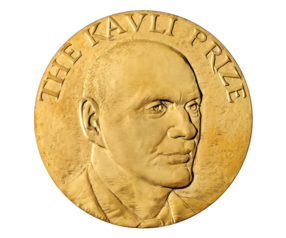
Three Harvard Griffin GSAS graduates were among the eight recipients of the 2024 Kavli Prize, which "honors outstanding researchers doing fundamental science that moves the world forward." Harvard Professor David Charbonneau, PhD '01, and Sara Seager, PhD '99, each earned a share of the prize for astrophysics. Doris Ying Tsao, PhD '02, was one of three laureates in the field of neuroscience. The three alumni and their five cohorts will each receive a portion of the $3 million awarded by the Norwegian Academy of Science and Letters.
Horizons Symposium Highlights Student Research
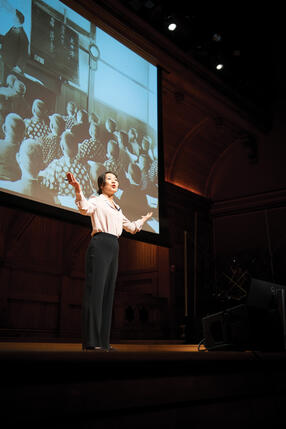
How can physics transform fashion? Are "forever chemicals" more widespread—and more toxic—than previously thought? What sort of data do policymakers need to improve the lives of incarcerated mothers and their children? Some of Harvard Griffin GSAS's most brilliant scholars presented their groundbreaking research addressing these and other fascinating questions during the annual Harvard Horizons Symposium at Sanders Theatre on April 9. The event was the culmination of a months-long process that provided eight students personalized coaching sessions with faculty mentors and the Derek Bok Center for Teaching and Learning to enhance their presentation skills. "The 2024 scholars exemplify the research impact of thousands of alumni who have graduated over our more than 150-year history," Dean Emma Dench said. "All power to the Harvard PhD."
Find complete coverage of Harvard Horizons here.
Curcio and Vélez-Ruiz Join Leadership
Harvard Griffin GSAS welcomed two new leaders to its administration last winter. Tony Curcio joined the School in January as its inaugural director of financial aid. Known as an innovator, Curcio developed a technologically integrated financial aid system for students in his previous role at Harvard Law School. In February, Dr. Gisselle Vélez-Ruiz became the School's new director of equity, diversity, inclusion, and belonging. Vélez-Ruiz previously led the Office of STEM Engagement and Inclusion at the Broad Institute of MIT and Harvard. At Harvard Griffin GSAS, she will develop strategic initiatives to support an equitable, diverse, and inclusive environment for students and enhance efforts to recruit and retain members of minoritized groups.
New Deans of Science and Humanities
Faculty of Arts and Sciences (FAS) Dean Hopi Hoekstra appointed two new divisional deans at FAS last April. Professor Jeff Lichtman, a neuroscientist who researches the dramatic rewiring of neural connections that takes place in early postnatal mammalian development, was named divisional dean of science. Professor of Philosophy Sean Kelly, who explores aspects of the phenomenological and cognitive neuroscientific nature of human existence, was tapped as the new divisional dean of arts and humanities. "Jeff brings people together in genuine collaboration to advance the frontiers of knowledge," Hoekstra wrote in her announcement about Lichtman. "[Sean] is known for his... ability to build community around issues of genuine significance," the dean wrote in her note about Kelly. Lichtman and Kelly began their new roles on July 1.
Photos by Tony Rinaldo, Niles Singer