June 24, 2026
From Peacocks to Penguins: How the Plain Suit Helped Shape American Democracy
Explore the hidden history of menswear with historian Chloe Chapin, PhD ’23, and learn how plain suits became a powerful political statement during the American Revolution.

What can a black suit tell us about the American Revolution? For fashion historian and former Broadway costume designer Chloe Chapin, the answer is: quite a lot. In her new book, Suitable: The Sartorial Revolution and the Fashioning of Modern Men, Chapin, PhD ’23, argues that the shift in men’s dress from colorful, ornate ensembles to plain dark suits between the American Revolution and the Civil War is a political story in addition to a fashion story.
Drawing on years in theater, deep archival research, and the technical eye of a maker, Chapin traces how figures like George Washington, Benjamin Franklin, and Thomas Jefferson used clothing to negotiate ideas of democracy, equality, and American distinctiveness. In this video and edited conversation, Chapin discusses how she came to the history of menswear, why the Founders were more fashionable than we think, and why the modern suit is such a powerful image.
You originally worked in costume design. How did that background shape the questions you ask as a historian in this book?
I worked professionally as a costume designer for over 20 years. I was not trained as an academic at all; I had been to art school twice! But I stumbled upon this question about men’s suits that I thought was really interesting. That question ultimately led me back to graduate school to figure out why men dressed so similarly.
This book started as an investigation of men’s formalwear, looking at the pre-history of the tuxedo. But while I was doing research, I kept finding different kinds of evidence that pulled my attention earlier and earlier, back into the 18th century. That was how I ran into the Founding Fathers, who were not at all initially a part of the project.
Suits never evolved into something else, and that’s a real outlier in the history of fashion.
So, why do men dress so similarly?
That is the big question! It started when I was doing research for a show as a costume designer, for which there was a big fancy‑dress ball. The question was, what should the male chorus be wearing in 1850? If it was the end of the 19th century, they would all be wearing standard white tie—black tailcoats, a white bow tie, and a white waistcoat. But what about 50 years earlier?
Then I wondered, when did they start wearing black and white? I scrolled back to the 18th century and realized nobody was wearing black and white at all, but then fifty years later, they all were. That was so weird. By the middle of the 19th century, it had become a standard uniform, especially for evening dress, but also for daytime suits. So there were two main questions. As a costume designer, my primary question was, when did men start wearing black and white for evening dress? But the more interesting question was, why?
Fashion is all about being weird and pushing boundaries, so men suddenly adopting a uniform of black suits isn’t all that surprising. What’s weird is that this fashion stopped changing. Suits never evolved into something else, and that’s a real outlier in the history of fashion.
You’ve said that “colorful to plain,” or “peacocks to penguins,” is one of the basic tenets of the book. Can you explain that?
I look at the shift in men’s style between the American Revolution and the Civil War, where men went from colorful, varied, ornamental dress to plain, dark, and uniform dress. This is the shift I call “peacocks to penguins”. You can see a big difference between this roughly 75‑year period, but you can even see evidence of this shift in some men’s lifetimes. If you look at early portraits of James Madison, James Monroe, or Alexander Hamilton—especially the miniatures, which tend to be more fashionable—they’re not wearing dark clothes. The colors are muted, but they’re very light: pastels, pink, patterned waistcoats, and very fashionable collars. Later, especially when Madison and Monroe become president, they’re suddenly wearing plain black suits. I think this has a lot to do with George Washington. I was really surprised to discover how impactful his clothing choices were to other American men at the time.
I was really surprised to discover how impactful [George Washington’s] clothing choices were to other American men at the time [of the Revolution].
What role does George Washington play in your book, and what surprised you most about him in your research?
The first surprising thing was learning that his pants never fit.
My dissertation was initially focused on male formal dress between about 1820 and 1850, but I was having a hard time finding juicy characters. I started my dissertation research right at the beginning of the pandemic, when all of the archives were closed. I was a fellow at the Smithsonian, but the archives were shut the whole time I was there. It was so disappointing, but it turned out to have a silver lining. Because I needed to do research online, I discovered that the Founding Fathers’ documents were all digitized and keyword searchable, and that was exactly what I needed, just because of the circumstances.
Right away, I found a series of letters George Washington wrote to his tailor in London, complaining that his pants didn’t fit. For like 10 years! That was archival gold. It’s very hard to find evidence of men talking about their clothes and how they felt about them.
Finding those letters helped convince me to move the book’s time frame earlier, in order to incorporate the American Revolution and the Founding Fathers. I couldn’t believe how much of the contemporary sartorial codes about plainness and uniformity, which are now built into American cultural identity, were invented almost on the fly by Washington, Benjamin Franklin, John Quincy Adams, and others, as they tried to define themselves against aristocratic London fashions.
What about colors and types of fabric–how did those material issues shape what the Founders wore?
There’s one chapter in the book where I focus on the material culture of suits. I look at the shift from silk to wool, from linen to cotton, and from handmade to machine‑made.
People today love to describe Washington’s inaugural suit as “plain brown wool,” but I don’t think people back then had the same association with “plain” and “brown” that we do today. In fact, I think one reason we see brown as plain is because of that suit. Washington didn’t care what color it was; he just wanted the best quality American‑manufactured wool he could get his hands on. His friend Henry Knox found him the fabric from a new woolen mill in Hartford, CT. Knox ordered many different colors to find the best quality–Washington’s inaugural suit was almost bottle green!
Right after the inauguration, people complained that Washington’s suit was made from imported fabrics, which wasn’t true. They just saw a suit they thought was too fine to have been made in America. That tells us how literate men were in textiles at this time —they could look at Washington from a distance and judge the quality of the wool of his coat. Americans’ idea of “homespun” wasn’t intentionally rustic like we might think of it today. When they said homespun, they meant domestic manufacture that would someday be as good as any English textile.
Black is another part of the story. Washington wears a brown wool suit at his inauguration, but we mostly associate him with black suits. Shortly after his first inauguration, his mother died, and he dressed in black suits, because they were mourning dress.
Every subsequent president’s portrait shows him dressed in a black suit, probably emulating Washington. Later, black became associated with political service more broadly. In the New York City Hall portrait collection, for instance, nearly every man up to about 1900 who isn’t in military uniform is wearing a black suit.
What I call the “sartorial revolution” is the shift that occurred between the American Revolution and the Civil War, when men went from wearing colorful clothes to plain clothes, and they connected that shift to democracy, equality, and modernity, while banishing “fashion” to realms of femininity and frivolity.
How does your “sartorial revolution” explicitly relate to the American Revolution?
What I call the “sartorial revolution” is the shift that occurred between the American Revolution and the Civil War, when men went from wearing colorful clothes to plain clothes, and they connected that shift to democracy, equality, and modernity, while banishing “fashion” to realms of femininity and frivolity. Those gendered ideas about fashion are still very rooted in American culture, politics, and even academic discourse.
Of course, men were also adopting suits in France, London, and across the Western world, so I’m not arguing that Americans invented suits. But I felt the American story hadn’t yet been told—that surely, plain, uniform suits meant something different in a republic than they did in a monarchy.
I don’t think we’ve really told the story of how fashionable the Founders were, and how important fashion was both to their identity as provincial Americans and, after independence, as leaders who needed a new sartorial presence to announce their difference to the world.
How did your work in theater inform your research?
I wasn’t a historian who discovered suits in an archive; I was an expert on suits who went into the historical archives to try to explain a phenomenon I already knew was interesting.
I wasn’t specifically trained as a tailor, but I know a little about tailoring, and I’ve worked with both contemporary and historical tailors. I know how a tailor looks at a body and a garment. I know how garments are constructed. I have a maker’s eye. When I look at a historical portrait, I look through the eyes of a costume designer who might want to recreate it: What weight of fabric would you need for the hang of those trousers? What understructure would give the shape of that skirt? Where are the closures? How much padding is in the chest of that coat?
I brought those designer questions into my analysis. Reviewers of the book have commented on that; they say my attention to detail is interesting, and they always want to know more about how I see paintings. Writing this book meant putting into words things I knew about garments. I had to remind myself that other people didn’t see them the same way I did.
My dissertation advisor, Jennifer Roberts, who is an amazing art historian, was very good at reminding me, “You know more than you’re writing down—tell us more.” She helped me highlight the embodied, material knowledge I was bringing to this historical research.
Two of my main goals in turning the dissertation into a book were to make it as readable as possible for a general audience and to bring more of my experiential knowledge onto the page for those readers.
You did a lot of hands-on research with actual garments. What did that look like?
I got a grant from the Weatherhead Center for International Affairs here at Harvard that allowed me to travel all over England to look at menswear in their dress collections. I was able to bring a historical tailor with me, whose material knowledge surpasses mine. He would look at minor construction details that I wouldn’t have noticed, like how the cloth was stretched over a shoulder seam, how the collar was rolled, and the differences in interlinings. Once he pointed things out, sometimes I could see them; sometimes I still couldn’t! I see myself as a translator between the expert and the novice. I know enough about tailoring to ask experts really good questions, and then I try to explain their knowledge in a way a layperson can understand.
After spending so many years on this topic, what keeps you fascinated by it?
One thing is how surprised people are to learn something new about the American Revolution. People think, “We know everything there is to know about the Founding Fathers,” but we’ve never really looked at them through the lens of fashion before.
I’m also passionate about highlighting the value of dress history as a critical aspect of cultural history, even though fashion has long been marginalized and overlooked as a serious avenue of inquiry. For example, there are countless art history departments in American universities, but very few fashion history departments, and most fashion courses are in design schools that train students for the theatre and fashion industries. Would we only teach art history to future artists? Fashion is such an important part of culture, yet it has been so egregiously overlooked—in large part because of its historical associations with women and the feminized labor of textiles.
I think it’s important to write fashion histories back into national histories. One thing I hope this book does is help people in other fields see that there are still discoveries to be made, even about “old” topics, when you look at history through the language of clothing.
The plainness of suits isn’t natural or neutral—it was carefully constructed.
What do you hope readers rethink after reading Suitable?
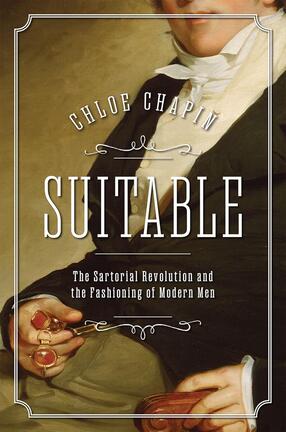
A comment I hear a lot is, “Wow, I never noticed how prevalent suits are. It’s such common sense, but I never had the eyes to see it before.” That’s important to me. There’s this thing out there that we haven’t been able to see because it was designed to be invisible. The book points to it and says, "Here’s why we haven’t been able to see it.” The plainness of suits isn’t natural or neutral—it was carefully constructed.
I think that many women, nonwhite men, non‑Western people, and non‑heteronormative people (and even some straight white men!) feel a kind of gaslighting when people insist that fashion is silly or frivolous. We all know how much time, thought, labor, and money go into clothing and adornment—and not just getting dressed, but working out, getting your hair dyed, doing your nails.
By not treating fashion as a valued form of cultural or historical inquiry, we’ve lost out on so much knowledge. When I first started this project, I thought the people most interested would be women like me, who gravitate toward a more traditionally masculine style. But I was surprised by the strong emotional responses I got from older white men—my dad’s generation—who said things like, “I fought the man; I never wanted to be a suit.” In some ways, this book is a love letter to many different kinds of people, offering them a new way to think about the relationship between their clothing and their identity.