June 24, 2026
Liberty’s Daughters
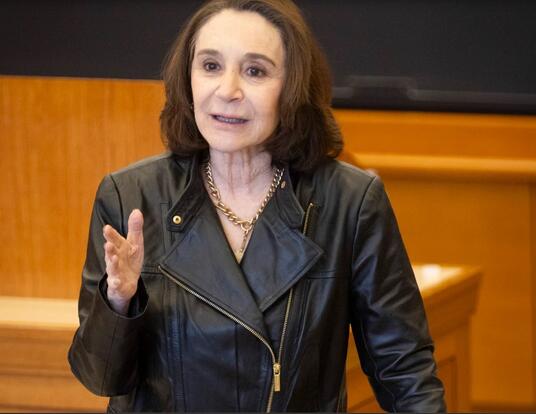
Historian Mary Beth Norton brings readers face-to-face with the women of the American Revolution.

On March 31, 1776, Abigail Adams wrote a letter to her husband, John, who was in session at the Second Continental Congress in Philadelphia. John Adams and his peers were actively thinking up the new form of government the future United States of America would take, and Abigail’s letter included a fervent request: “Remember the Ladies.”
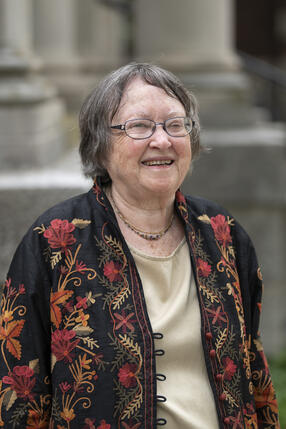
“Be more generous and favourable to them than your ancestors,” Abigail continued. “Do not put such unlimited power into the hands of the Husbands. Remember all Men would be tyrants if they could.” In these few pithy lines, Abigail forwarded the idea that the country’s founders should abandon British law, in which married women lost all their rights, and instead provide them with legal protections, particularly from abusive husbands.
Abigail Adams’s appeal is well-known; her husband’s response, less so.
“John treated it as a joke, saying it was dangerous,” explains the historian Mary Beth Norton, PhD ’69, Mary Donlon Alger Professor Emeritus of American History at Cornell University. “He said it was the beginning of revolt from all the underlings: the servants and the enslaved people will be revolting with all the women. He doesn’t take her seriously.”
Norton became intimately familiar with the Adams family’s correspondence when researching her groundbreaking book Liberty’s Daughters: The Revolutionary Experience of American Women, 1750-1800. By painstakingly combing through the diaries and letters of 18th-century families, Norton came face to face with the women who played a key role in the founding of the United States, revealing their growing role in revolutionary society despite the enduring limitations of the era.
Absent from the Declaration, Present in Political Life
The false assumption that women left few historical traces in the Revolutionary period was fostered by women’s complete absence in the country’s founding document, the Declaration of Independence.
“Men didn’t really think about women being possible members of the political community,” Norton explains of this absence. But more interestingly, Norton found in Liberty’s Daughters, women also stated that they should not talk politics—and then frequently went on to do so.
Do not put such unlimited power into the hands of the Husbands. Remember all Men would be tyrants if they could.
–Abigail Adams
“One of the most fascinating things I discovered is how many women said, ‘I should not be talking about politics. That is not my sphere, that is not my role.’ And then that was a preface to them going on and talking about politics!” Norton says. A favorite example comes from Benjamin Franklin’s daughter Sally. “She would say, ‘I know I shouldn’t be saying this, but everybody is talking about it, so I need to talk about it too.’”
This pattern—prefacing the topic as forbidden before discussing it—illustrates women’s determination to participate in the country’s political life despite the strictures of their time. Norton’s further investigation into the Adamses’s correspondence, for instance, revealed that when Abigail and John stopped discussing the question of women’s rights, Abigail complained to friend Mercy Otis Warren that John hadn’t treated her with respect. Moreover, Norton finds evidence that Abigail’s entreaties did make an impression on her husband. John Adams wrote separately, musing over what might happen if women were given the vote.
“Now, he never intended to do that,” Norton clarifies, “but he did, in fact, give it some thought.”
From “Your Farm” to “Our Farm”
Even if women are not mentioned explicitly in the Declaration of Independence, the Constitution, or the Bill of Rights. Norton finds the era’s more private documents provide insight into the roles they did play, and how their lives changed in the upheaval of revolution.
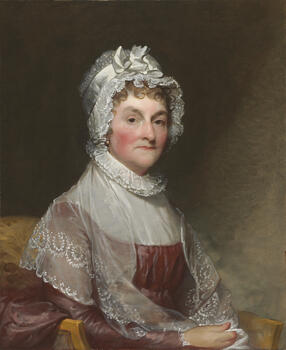
“One of the great things about working on women in the Revolution is that husbands and wives were separated, so they wrote letters to each other. It’s not just John and Abigail,” Norton recalls of her research. “The most interesting correspondence comes in families where the husbands and wives are separated for long periods, so you can watch the evolution of the relationship over time.”
In tracing this evolution through marital correspondence, Norton noted a standard pattern. When a man first left home to serve in the war, he would send his wife instructions on how to run the household—what to plant on the farm or whether to sell the horse, for instance—which she would dutifully carry out. After months of separation, however, the women wrote more assertively about household decisions, even speaking against their husbands’ suggestions. This pattern was especially pronounced in the use of pronouns in letters.
“When the women start writing, they’ll say ‘your farming business,’ when they write to the husband, and he’ll write back and say ‘my farming business,’” Norton explains. “Then, in some women’s letters, it turns to ‘our farming business.’” In the case of Abigail and John Adams, it changed completely from “his farming business” to “her farming business.”
Women Taking Charge
As in the World Wars of the 20th century, separation due to service in the Revolutionary War meant that women filled roles traditionally reserved for men in running the business and household. In another parallel, this shakeup to the traditional gender order held lasting ramifications even after the war had ended and the men had returned home.
“When daughters were growing up, they saw their mothers taking charge of things that women didn’t usually take charge of,” Norton noticed. “I was especially struck when I was reading courtship correspondence of young couples in the 1790s as opposed to in the 1760s. The women seemed much more self-assertive in the 1790s.”
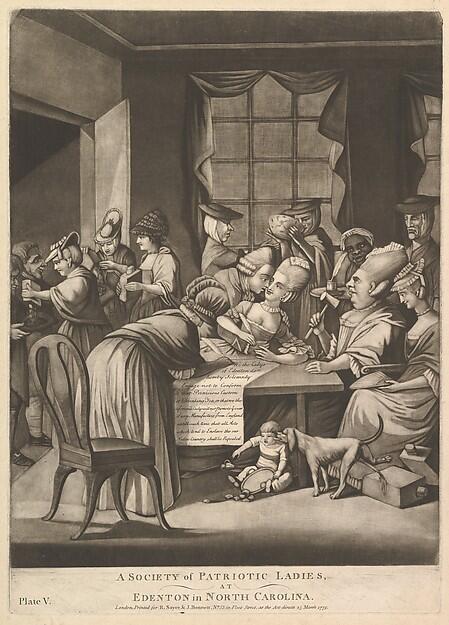
While US family law did not significantly change after the war, one aspect of women’s lives changed significantly: the gradual development of education.
“The direct connection to the revolution is the long-term issue of the education of women in this country,” Norton says. Since the new United States was a republic, children were to be raised as citizens of a country where every boy could, in theory, become president of the United States. “So every republican boy’s mother had to be sufficiently educated to make that possible.”
This meant that after the war, women began to be educated in small schools and sometimes advanced ones, equivalent to today’s high school. The women who attended then opened the first women’s colleges in the 1820s and 1830s, such as Mount Holyoke in western Massachusetts.
When daughters were growing up, they saw their mothers taking charge of things that women didn’t usually take charge of. I was especially struck when I was reading courtship correspondence of young couples in the 1790s as opposed to in the 1760s. The women seemed much more self-assertive in the 1790s.
–Mary Beth Norton
A Walk through Women’s History
Norton set out to focus on the role of women in early US history, a topic then unexplored, following her dissertation research on Loyalists opposed to the American Revolution as a Harvard history PhD student in the 1960s. “When I started to work on women in the Revolution, people told me I couldn’t do it, that there wouldn’t be enough sources,” Norton recalls. “In the end, there were collections that I never had a chance to look at, because I got so much material.”
In her close reading of correspondence and diaries from the 18th century, Norton became attached to women across history. “With family correspondence, you really feel as though you get to know the people. You get caught up in the details, even though they lived hundreds of years earlier,” Norton explains. She recalls how lively and interesting many women writers were, and how limited they also were by the times in which they lived. After reading strings of letters and diaries, Norton would become saddened when the trail stopped short because the writer died in childbirth.
Others expressed the limitations set upon them because of their gender. Norton recalls one young woman who attended a new women’s school after the war. “She wrote ‘I wish I could be a lawyer, but it’s impossible because I’m a woman,’” Norton remembers. “When you’re a historian, you’re just really sad she wasn’t born 200 years later, so that she could have maybe fulfilled her aspirations. It makes you happy that you are living at a much later time.”
Through her scrupulous and insightful navigation of historical sources, Norton cleared a path to understand the story of women during the American Revolution, which was previously ignored. Historian Heather A. Huyck, who interprets American women’s history for public audiences, describes the experience of reading Liberty’s Daughters as taking a walk through American women’s history, with Norton as your guide.
“Norton cleared a trail so we can encounter women’s fascinating stories, unaware of all the archival brambles and intellectual puzzles she removed for us,” Huyck enthuses. “We can explore the American Revolution’s uncertainty and complexity for the women who lived through it—and its generational effects. I highly recommend the book. It’s hard to put down.”
In her pioneering work, Norton established women’s history as a vital field in the study of early America and the revolutionary period. “Mary Beth Norton’s work in early American history, women’s and gender history in particular, has been nothing less than foundational,” says Kate Haulman, associate professor of history at American University and Norton’s former student. “Her research helped define a field, centering the lives of women of the past on their own terms. Liberty’s Daughters, as well as [her later book] Founding Mothers and Fathers, inspired me to pursue women’s and gender history, study with Mary Beth in graduate school, and informed my own work.”
[Norton’s] research helped define a field, centering the lives of women of the past on their own terms.
–Professor Kate Haulman, American University
Timeless Principles
Two hundred and fifty years after Abigail Adams wrote her plea to John to “Remember the Ladies,” Norton remains optimistic about the founders’ core tenets, despite their flaws.
“I’m not an originalist. The nation has to evolve, people have to evolve. I don’t think we have to follow anything in particular that was decided in the 18th century,” she reflects. “But I do think that the principles that were laid out are pretty timeless. That was Thomas Jefferson’s intention, and the intention of the people who worked with him in amending his words of Independence. So I do think that the principal goals there, and in the Constitution, are worth thinking about, and they shouldn’t be discarded.”