June 12, 2026
A Revolutionary Career
For two generations, historian Gordon Wood shaped how scholars understood the origins of the United States.

The moment to which the late Gordon Wood, PhD ’64, referred as his “two seconds of fame” took place when Matt Damon, a then-little-known actor, name-checked the historian during a scene in the 1997 film Good Will Hunting. Damon’s character, a high-school dropout with a genius-level intellect, exposes an arrogant Harvard graduate student as a fraud for “regurgitating Gordon Wood, talkin’ about, you know, the pre-revolutionary utopia and the capital-forming effects of military mobilization.”
“More kids know about that than any of the books I have written,” laughed Wood in a 2015 interview with the History News Network.
The observation would be a shame, if true. While Harvard College alumni Damon and Ben Affleck won an Oscar and a Golden Globe Award for Good Will Hunting, Gordon Wood’s raft of honors included a Pulitzer Prize; Columbia University’s Bancroft Prize; the National Humanities Medal; and the Harvard Kenneth C. Griffin Graduate School of Arts and Sciences' Centennial Medal, the school’s highest alumni honor. Often called “the dean” of historians of the 18th-century United States, Wood shaped the way scholars understood the country’s founding for over 60 years before his death in June 2026 at the age of 92. It is a legacy worthy of much more than two seconds of fame, and it began with his PhD dissertation at Harvard Griffin GSAS.
Note: The quotes from Gordon Wood in the following article were drawn from an interview with the School conducted shortly before his death.

The Power of the Press
The product of Massachusetts public schools, Wood was the first in his family to attend college. He arrived at Harvard in 1958 after earning his undergraduate degree from Tufts University and serving three years in the US Air Force. He initially aspired to join the State Department’s diplomatic corps, until his military service provided the opportunity to read a wide range of history—and get a taste of government work.
“I sat in the orderly room and read books and had no duties whatsoever except to come in and sign what was essentially attendance at 7:30 in the morning,” he remembered. “I realized at that point, if this is what working for the federal government is like, I am going to apply to graduate school in history. So that’s what I did. I applied to Columbia and Harvard. Harvard gave me more money than Columbia, and so I went to Harvard.”
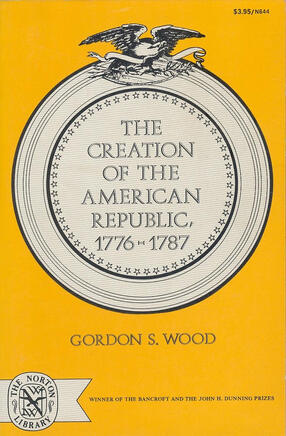
The path that would lead to Wood’s first book, The Creation of the American Republic, started with a lecture for history graduate students by the distinguished Harvard scholar Bernard Bailyn, PhD ’53. Bailyn noted that there was very little work on the efforts to create state constitutions in 1776. A PhD student in search of a dissertation topic, Wood took Bailyn’s words to heart. The research challenge, he soon discovered, was the absence of the sort of notes at state conventions that founder James Madison took during the making of the US Constitution years later.
So, Wood looked to the press.
“There was a good deal of discussion [of state constitutions] in newspapers,” he said. “I had quite a bit of material. Then I thought I might look ahead ten years to see what the people around the federal Constitution were taking from the debate there. When I read those arguments, I said, ‘Oh, there’s my dissertation.’”
In fact, Wood read virtually everything—pamphlets, newspapers, sermons, and more—printed in the British colonies between 1774 and 1789 relating to the state and federal constitutional conventions. What Wood found was a radically new concept of representation and governance that emerged in North America during the late 18th century—one that vested sovereignty directly in the people.
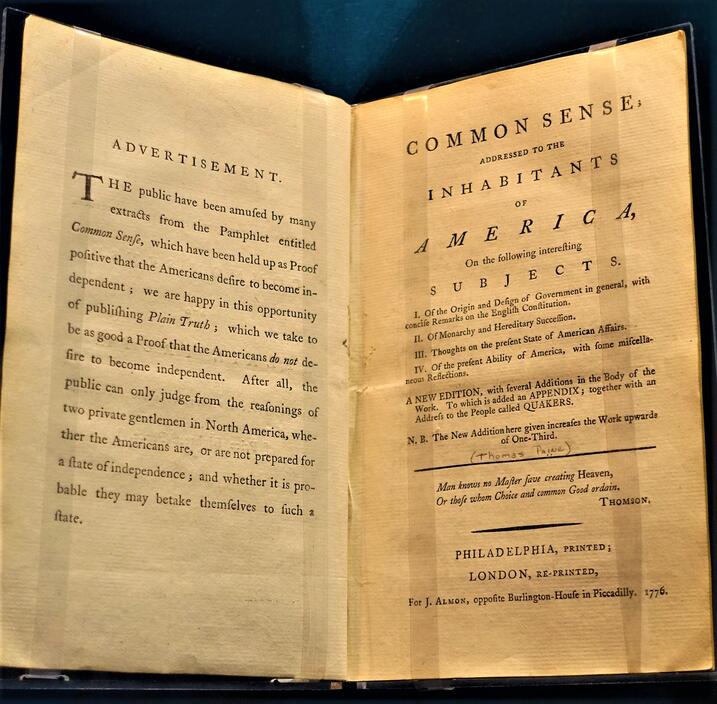
There was a good deal of discussion [of state constitutions] in newspapers. I had quite a bit of material. Then I thought I might look ahead ten years to see what the people around the federal Constitution were taking from the debate there. When I read those arguments, I said, ‘Oh, there’s my dissertation.’
—Professor Gordon Wood
Breaking with Empire
Wood noted that the British political system in the 18th century put little emphasis on how a member of Parliament (MP) got to the House of Commons. In fact, most British citizens could not vote at the time of the American Revolution, and seats in Parliament were not allotted in proportion to the population they represented. “The idea was that MPs in the Commons—wherever they came from—would look after the good of the whole society.”
For Americans, on the other hand, the electoral process was central to the idea of representation. “Colonists could remember when a new town was created in Massachusetts, for instance, and suddenly had two representatives sent to the General Court,” Wood said. “They had a clear understanding of how representation could work. The British had a very different history. That accounts, I think, for the two contrasting notions of representation.”
These dramatically different ideas of representation also explain why colonials denounced taxes such as the Stamp Act of 1765, which imposed duties on printed materials, as illegitimate. British MP Thomas Whately defended the law he authored, arguing that colonists were “virtually represented” by a Parliament that looked after the interests of all British subjects. Americans rankled.
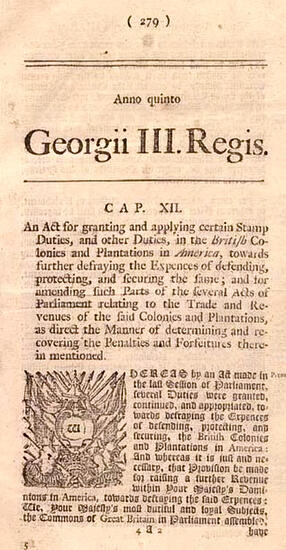
“The colonists said, ‘Well, that may be applicable to you people in Britain, because if a tax is voted, even if you don’t elect the person, everyone will feel that tax equally,’” Wood said. “But [because the Stamp Act applied only to the colonies], you’re taxing us and not taxing yourself at the same time. Since we cannot have any representation in the House of Commons because of distance, we simply cannot allow the Stamp Act to go through, because suddenly we would be, as they said, slaves of the British Parliament.”
Though the Stamp Act was repealed, it was followed by the Townshend, Tea, and Coercive acts. In response, the colonists rejected Parliament’s authority to govern them while affirming their allegiance to the king.
“They were sort of anticipating the modern Commonwealth, which was created in 1931 by the Statute of Westminster, where Australia, Canada, and New Zealand all have a common monarch, but are not under Parliament’s authority,” Wood noted. “That was the American position. It was intolerable to the British. So, sovereignty became the issue that broke the empire.”
Power to the People
Sovereignty remained a flashpoint after the War of Independence and the failure of the Articles of Confederation, as the young nation struggled to establish a functioning federal government. In The Creation of the American Republic, Wood chronicled the founders’ attempts during the Constitutional Convention of 1787 to find a solution to the problem of divided power. Contending that sovereignty belonged to the individual states, Anti-Federalists like the Virginians Patrick Henry and George Mason could not accept a constitution that gave supreme authority to a central government. Conversely, Federalists like New Yorkers Alexander Hamilton and John Jay believed a powerful central government was critical for order, prosperity, and national security.
Britain did not put much emphasis on how a member of Parliament (MP), the representative, got to the House of Commons. The idea was that MPs . . . wherever they came from—would look after the good of the whole society. For Americans, on the other hand, the electoral process was central to the idea of representation. Colonists could remember when a new town was created in Massachusetts, for instance, and suddenly had two representatives sent to the General Court . . . That accounts, I think, for the two contrasting notions of representation.
—Professor Gordon Wood
“The Federalists kept saying, ‘No, no, we’re going to divide power. The states are going to have some power, and the federal government is going to have some power,’” Wood said. “But the Anti-Federalists kept coming back to this issue, invoking the notion of sovereignty outlined by Sir William Blackstone in his Commentaries on the Laws of England. Since there must be, in every state, one final supreme lawmaking authority, they said, it’s going to end up being the federal Congress.”
It fell to the lawyer and scholar James Wilson, who would become one of the original six Supreme Court justices appointed by President George Washington, to break the logjam. In two Philadelphia speeches, Wilson conceded the Anti-Federalists' point about the need for an ultimate lawmaking authority, but made the extraordinary argument that this power was vested entirely in the people themselves.
“This suddenly made every elected official—whether on the federal, state, or local level—a representative of the people,” Wood explained. “The people were doling out their pieces of power on always-recallable loan, remaining the final lawmaking authority. When Madison heard Wilson’s idea, he said, ‘Oh my God, that’s great. That solves all our problems.’”
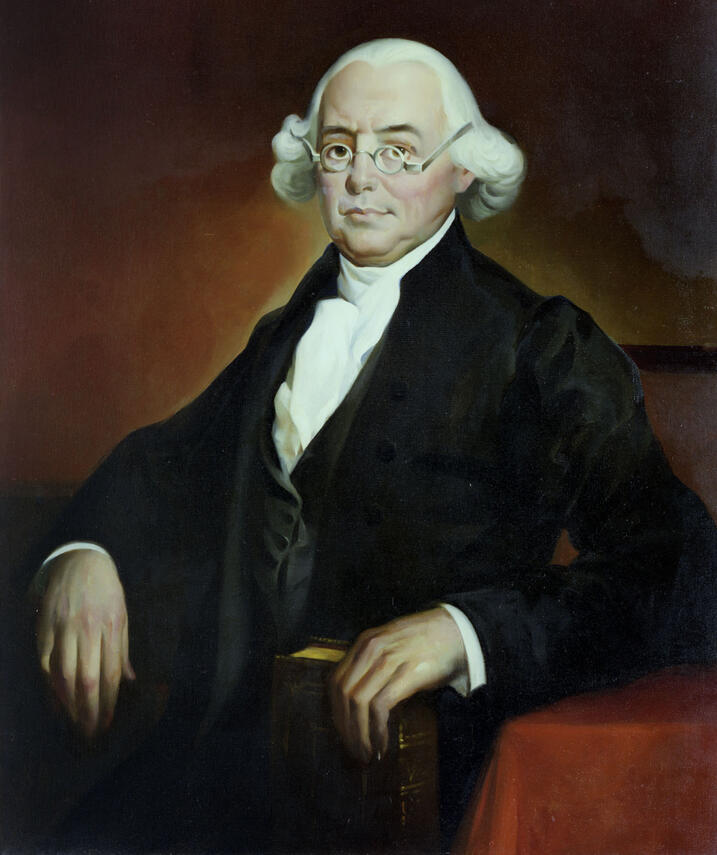
The notion that all members of government were and ought to be representatives of the people initially redounded to the benefit of Federalists like Hamilton, who argued, for instance, that the New York legislature should be subject to the rulings of the state’s courts because judges, too, were the people’s representatives. Soon, though, this reasoning would be turned on its head and used to contend that anyone who represented the people ought to be elected by them—much to Hamilton’s chagrin.
“The argument started in the early 19th century, right after Hamilton,” Wood said. “People began thinking, ‘Well, let’s elect the judges.’ It doesn’t really take off until the Jacksonian era. Now we have, I think, 39 states that elect judges.”
By the early 19th century, Americans were beginning to argue, to the dismay of conservatives like John Adams, that the whole society was democratic.
“They talk about it as a democratic republic,” Wood said. “Pretty soon, the more progressive people would argue, ‘No, we are just a democracy.’ So, the two words blended by the early 19th century. Today, some people like to say, ‘Well, we’re a republic, not a democracy,’ but that’s just no longer true. That transformation took place. The argument might have been correct in 1776, but it is not correct today.”
The Creation of the American Republic won Columbia University’s Bancroft Prize in 1970 and was a finalist for the National Book Award—an astonishing achievement for a first book. Stanford University history and political science professor Jack Rakove, PhD ’75, who also took Bailyn’s seminar as a graduate student at Harvard, says that Wood's work stands out even when compared to that of his distinguished peers.
“Among all the works that emanated from the Bailyn seminar—or more directly, from his mentorship and the example of his own scholarship—Gordon Wood’s first book was by far the most ambitious and impactful,” Rakove says. “Like the two concluding chapters of Bailyn’s greatest work, The Ideological Origins of the American Revolution, Wood’s Creation conveyed a dramatic sense of movement and change, of the ferment of ideas and their complicated interaction with other aspects of American life.”
Today, some people like to say, ‘Well, we’re a republic, not a democracy,’ but that’s just no longer true. That transformation took place. The argument might have been correct in 1776, but it is not correct today.
—Professor Gordon Wood
A Social Transformation
If the establishment of a new, radically more democratic form of government had been its only achievement, the founding of the United States would still have been a tectonic shift in human history. But in his Pulitzer Prize–winning 1992 book, The Radicalism of the American Revolution, Wood laid out the dramatic social and cultural changes that accompanied the break from empire.
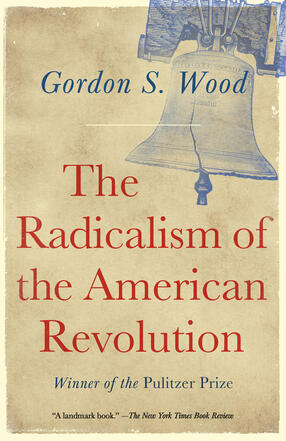
We often think of the monarchical system under which seventeenth- and 18th-century British colonists lived in terms of the legal structures that organized power. But Wood’s research highlighted the way monarchy shaped the social arrangements and culture of British society, a framework he called "worlds of deference."
“Monarchy implies a whole world of hierarchy and patronage, where authority flows from the top down,” Wood explained. “All of the king’s underlings have their own hierarchies beneath them. Everybody is looking up and looking down. They don’t look alongside themselves. Their focus is on, Who is my superior? To whom do I owe deference? There is a high degree of unfreedom in such a society, not just in America with slavery, but with a whole host of people who are in various kinds of subservience to others, whether for ten years, five years, or otherwise.”
The British system of “mixed” government—representing the monarchy, the aristocracy in Parliament’s House of Lords, and the people in the House of Commons—was considered the epitome of enlightened rule in the 18th century. At the same time, however, republicanism was emerging as a countercultural notion, eroding monarchical life even within Great Britain.
“Many people were calling Britain a republic, mainly because it had a House of Commons, and no major state in Europe had anything comparable,” Wood said. “There was a lot of republican sentiment as part of the Enlightenment.”
In many ways, republicanism was to the 18th century what Marxism was to the 19th: an intellectual and cultural revolution. “If you look at the 1780s, the French aristocracy is singing praises to America,” Wood observed. “They watch [Mozart’s opera] The Marriage of Figaro, which mocks the aristocracy. They go to see [Jacques-Louis] David’s painting The Oath of the Horatii, a picture set in antiquity, where Roman men are going off to fight, and the women are off in the corner, weeping. Those kinds of values—being willing to fight for your country—are eroding monarchical views.”
When Thomas Jefferson wrote “all men are created equal” in the Declaration of Independence—"the most important five words in US history,” according to Wood—he drew on the epistemology of the English philosopher John Locke: the notion that human beings are all born a blank slate upon which experience and the senses etch character.
“This is a widespread view shared by many enlightened people,” Wood observed. “Jefferson is not making it up. He’s drawing on that conventional wisdom.”
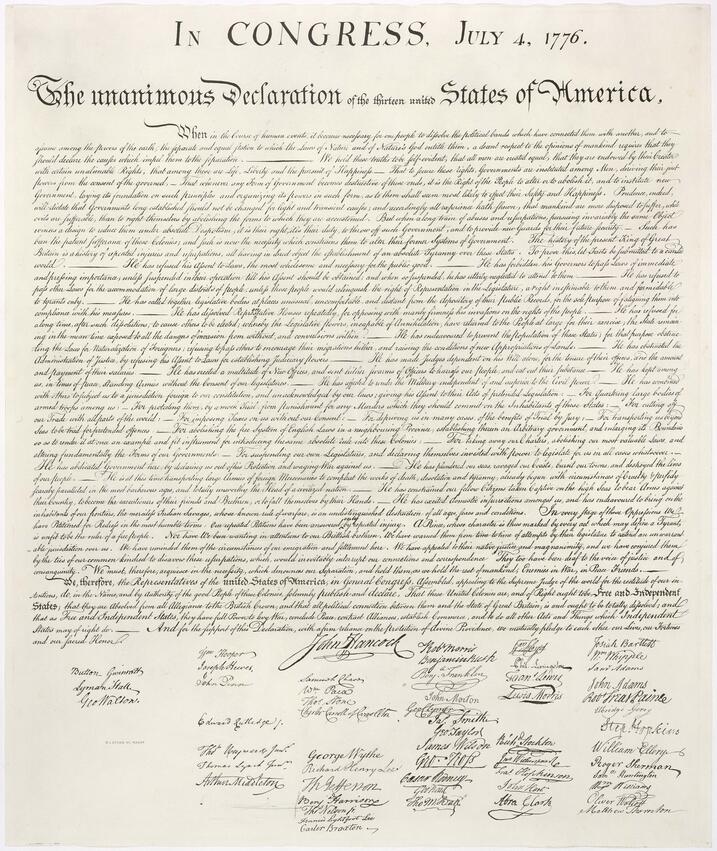
The result, Wood said, was radical social change in the United States and throughout the West. “Suddenly, environment is everything,” he explained. “It’s all nurture, no nature. The implications of that are tremendous. Who your father was, who your ancestors were—that really doesn’t matter anymore.”
The Revolution made education crucial, Wood argued, and helped foster a sense of moral responsibility among leaders. “They say, ‘Look, the downtrodden of society—if we change their circumstances, then they would have a different life,’” he said. “It’s why you have an outburst of humanitarian reforms, including antislavery or anti-poverty movements, for example. If you look at the humanitarian societies in Britain and America, it’s extraordinary. Even the Society for the Prevention of Cruelty to Animals is created.”
Boston University professor Brendan McConville, a former PhD student of Wood’s at Brown University, says The Radicalism of the American Revolution effectively resolved the great debate that raged among early Americanists over the final decades of the 20th century.
Suddenly, environment is everything [after the Revolution]. It’s all nurture, no nature. The implications of that are tremendous. Who your father was, who your ancestors were—that really doesn’t matter anymore.
—Professor Gordon Wood
“Wood postulated that a series of paradigmatic shifts in American political culture—from a monarchical colonial system to a republican culture in the revolutionary period, and later to an emergent democratic culture in the 1810s and 1820s—was the central axis of change that produced the middle-class, capitalistic democratic order of the 19th century that we have inherited,” McConville says. “Using social science and linguistic theory to great effect, Wood situated this change in a distinct material reality of population growth, migration, social atomization, and economic scrambling. The forceful and clear writing in Radicalism made the book accessible to broader audiences. It’s no wonder it was awarded the Pulitzer Prize for history in 1993.”
Influence and Controversy
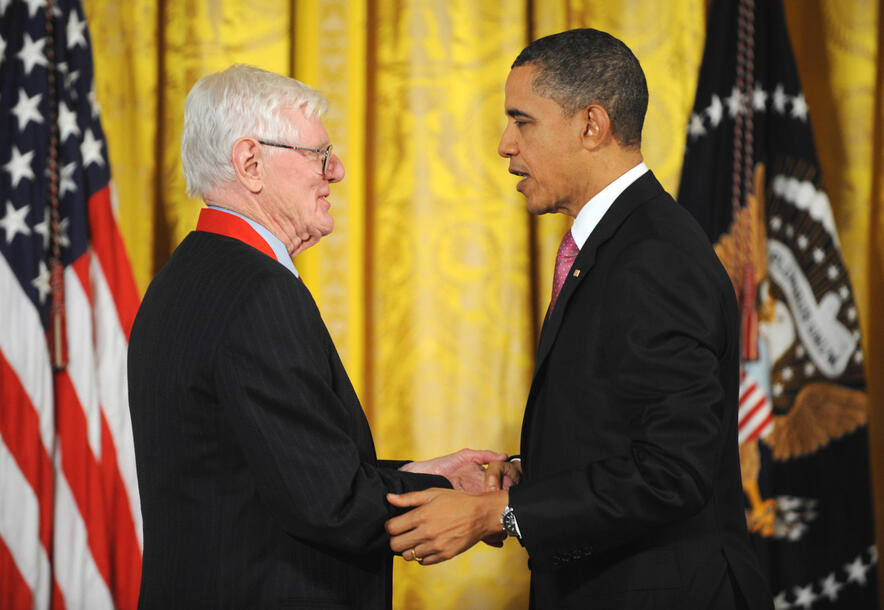
Wood’s impact on the study of early American history was summed up in the citation for the 2010 National Humanities Medal, bestowed on him by President Barack Obama in a White House ceremony on March 2, 2011: “For scholarship that provides insight into the founding of the nation and the drafting of the US Constitution.”
“Through his teaching, scholarship, and popular articles, Wood has reached a wide audience, keeping alive one of the most revered periods in all of American history,” wrote Matthew Dallek in his profile of Wood for the National Endowment for the Humanities website. “It is his skills as a researcher, his fresh and passionate insights into the shifting character of Revolutionary-era society, and his uncanny ability to capture the sense of turbulence and vast transformation that defined early America that have made him one of the most influential historians of his generation.”
Still, Wood’s career was not without controversy. He was a frequent critic of the decades-long effort to recenter historical scholarship entirely around marginalized perspectives. He argued that most of the country’s founders wanted to abolish slavery—including some who were slaveholders themselves. He attributed the devastation of Indigenous communities between the Appalachian Mountains and the Mississippi River to a spontaneous “demographic movement” of colonial settlers, calling it “one of the tragedies of history” but “not genocide in the sense that the government endorsed this.” These positions frequently put him at odds with younger generations of academics.
The greatest ire directed at Wood, however, was in response to his criticism of The 1619 Project, an initiative by the New York Times to “address the marginalization of African-American history in the telling of our national story and examine the legacy of slavery in contemporary American life.” Wood joined Princeton’s Sean Wilentz and James McPherson, Texas State University’s Victoria Bynum, and the City University of New York’s James Oakes—all esteemed historians—as signatories of an open letter to the Times. The group praised the project for “raising profound, unsettling questions about slavery and the nation’s past and present,” but expressed dismay “at some of the factual errors in the project and the closed process behind it,” which they argued, “suggest a displacement of historical understanding by ideology.”
The Times’ editor-in-chief, Jake Silverstein, rejected the historians’ claims of factual inaccuracies in a long open letter of his own. (Months later, the Times did issue a “clarification,” adjusting the phrasing of a passage to clarify that protecting slavery was a primary motivation for some of the colonists, rather than a blanket motivation for all of them.) Many academics sharply criticized Wood and his colleagues for the note. In a 2021 debate between Wood and University of South Carolina historian Woody Holton, hosted by the Massachusetts Historical Society, Holton condemned Wood’s letter as an attempt to discredit The 1619 Project, playing into the hands of political actors who wanted to suppress conversations about the structural primacy of slavery.
“That’s great, to criticize each other,” Holton said during the debate. “But you didn’t just do that. You did an open letter putting that project beyond the pale, outside the wire, and making it vulnerable to attack by these demagogues. . . . You killed The 1619 Project in a way that opened it up to censorship. You are a founding father, Professor Wood, of a massive campaign of censorship.”
“[The letter criticizing The 1619 Project is] politics,” wrote City University of New York Graduate Center professor David Waldstreicher in a 2020 essay for the Boston Review, “and all the more dangerous when it claims to have all the ‘facts,’ as Wilentz and Wood do.”
To the end of his life, Wood held that The 1619 Project was an exercise in “popular memory” rather than “accurate history,” and he lamented an “anachronism plaguing [the writing of history] right now.” Too often, he claimed, contemporary scholars hold those in the past to the standards and sensibilities of the present, indicting them when they fall short.
“You have to be able to get into the minds of people who are very different from you, who think very differently from you,” Wood said. “That is a challenge, and it requires historical imagination. When I was teaching, I quoted the epigraph in L. P. Hartley’s great novel The Go-Between: ‘The past is a foreign country: they do things differently there.’ The students seemed to understand that better.”
Hope for Today
Despite his resistance to drawing straight lines between historical eras, Wood was often asked what lessons could be mined from the past for the present. This was especially true in the last years of his life as citizens across the political spectrum looked for precedents to an era of governance that seemed increasingly polarized and unstable—one where trust in the institutional checks and balances constructed by the founders was in steep decline.
While mindful of his concerns about anachronism, Wood believed that the challenges of the modern moment are not entirely unprecedented. “Our time is often compared to the Jacksonian era, where the same kind of leadership existed, in a sense,” he said. “People came out of nowhere. Central to [President Andrew Jackson’s] platform was the idea that anyone could hold political office. It didn’t require wealth, it didn’t require a college education, it didn’t require any prerequisites—just getting elected.”
Founders like Thomas Jefferson, often thought of as a progressive, found Jackson’s ascent terrifying. “Jefferson was appalled that this man, who was a military man and had never been to college, had come so close to winning the presidency in 1824,” Wood said. “Fortunately, Jefferson died before Jackson actually took office in 1829.”
Moreover, Wood noted that the Jacksonian era was its own kind of “epistemological crisis,” much like today. “There were lots of hoaxes,” he said. “They didn’t have modern media, but there was the penny press. Edgar Allan Poe wrote hoaxes in the newspapers. People had doubts about what truth was. It was a scary time. Lots of people thought the world was coming to an end with someone like Jackson and the Jacksonians.”
Democracy is a powerful force, Wood noted, and one that can be dangerous at times. Demagogues who exploit the system to acquire power are rarely eager to relinquish it. “Politicians don’t like to be defeated,” he said. “That’s their career.”
Cautioning that “historians should never predict,” Wood remained fundamentally hopeful about the future of the constitutional system he spent his life analyzing.
“My explanation for the Constitution was that the 1780s were going wild with political excesses, and that’s how Madison saw it,” he said. “The Constitution was a brilliant solution to that problem. By dividing up power and creating all kinds of alternatives, it protected us from demagoguery. At this particular time, we’ve got a serious problem, but I do think we’ll survive. I’m confident the system will hold.”
Banner image: Tony Rinaldo, 2015