March 23, 2026
The Power of Looking
Photographs by Kathleen Dooher
Cécile Fromont uses art to interrogate what societies choose to see—or ignore.

“Are you a monster?”
The large language model (LLM) to which Harvard History of Art and Architecture Professor Cécile Fromont, PhD ’08, posed the question in preparing the syllabus for her first-year Harvard College seminar, Making Monsters in the Atlantic World, responded defensively. Why would she call it a monster, the LLM wanted to know. And what did she mean by “monster” anyway?
“It was imitating a human affect,” she says. “It needed to create a distinction between what it was and what a monster was, right? In that way, it was such a good reflection on the subject matter of the seminar itself, which explores different ways of challenging or changing our idea of what—and who—a monster is and what—and to whom—the notion of monster does.”
Inspiring students and scholars to look in new ways at questions, imagery, and themselves is central to Fromont’s research and teaching at Harvard’s Faculty of Arts and Sciences. Studying the visual, material, and religious cultures of Africa, Latin America, and Europe in the early modern Atlantic world, Fromont uses art and visual culture to interrogate what societies choose to see—or ignore. In so doing, she hopes to make visible often overlooked aspects of history and enable communities shaped by cultural difference to interact based on a common understanding of the past.
Invisible Traces
Just as an object can change our thinking, Fromont says our thoughts and life experiences can also change the way an object exists in the world. “In some cases of Chinese scroll paintings, for instance, the commentaries of viewers actually become part of the work,” she explains. “Even when you don’t have viewers writing their experience of seeing in ways that become physically attached to an object itself, that history of encounter and interaction becomes part of the texture and the patina of that object. A lot of my work is about finding those often invisible traces.”
Fromont focuses on how global exchange—through the intertwined histories of Christianity, empire, and the slave trade—shaped artistic practices and ideas about power, identity, and spirituality across continents. “What I’m interested in at the core is how looking at images, objects, and visual and material culture allows us to understand better how people meet, and how in meeting they find ways of establishing commensurability so that they can have a conversation about everything from the relative value of trade goods to the shape of the cosmos,” Fromont says. “By looking at the ways images and objects move from one context to the other, interact with different environments and people, I am able to see one situation, one set of circumstances morphing into another. In other words, paying close attention to material and visual culture helps me better map and understand historical change.”
Objects and images play a critical role in enabling these exchanges of perspective across cultures in a more sophisticated way. “The abstract can only come into play in a conversation through something concrete,” Fromont says.
Spaces of Correlation
In her 2014 book, The Art of Conversion: Christian Visual Culture in the Kingdom of Kongo, Fromont looked to the early modern period to find traces of how objects were changed by new ways of seeing. Hoping to find new trading partners—as well as precious metals and Christian converts— Portuguese merchants, missionaries, and government officials traveled to the Kingdom of Kongo in Africa, bringing with them their sacred objects. The elite of the African kingdom appropriated the new religion and its imagery, mixed and merged them with local thoughts and artifacts, creating an entirely new genre of Christian art.
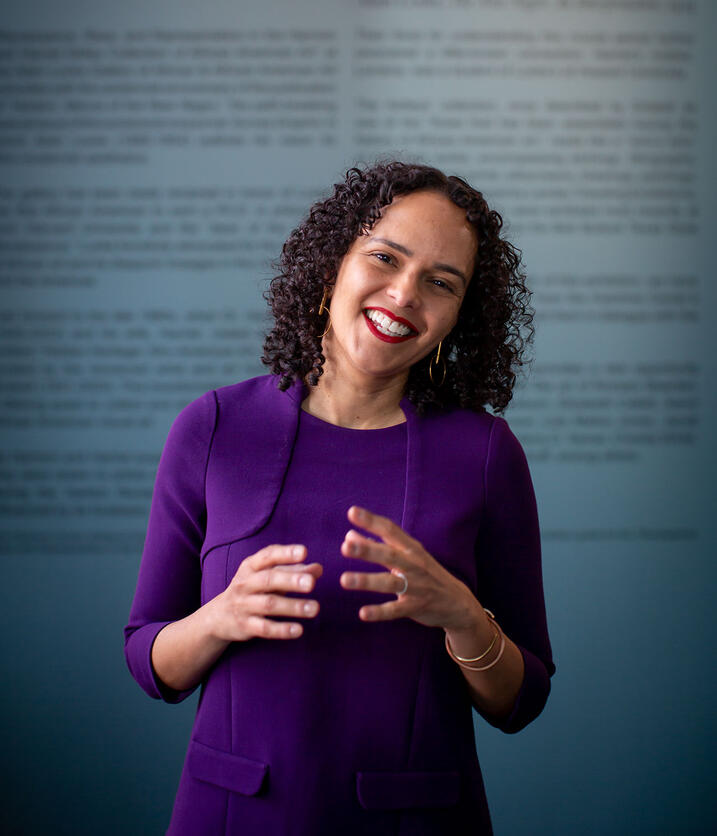
Even when you don't have viewers writing their experience of seeing in ways that become physically attached to an object itself, that history of encounter and interaction become part of the texture and the patina of that object.”
—Cécile Fromont
“Embedded in a crucifix, for example, is the idea that Christ is dead,” Fromont explains. “So, the crucifix is also a reliquary because it holds the space of death. Ancillary figures surrounding Christ suggest the idea that some intercessors going between life and death are part of the crucifix.” Kongo people combined centuries of local cosmology with new faith in the Christian story, using their shared notion of cyclical life and death. “The new sacred objects they created functioned as spaces of correlation, mixing, merging, and redeploying the once distinct and now interrelated elements. And once the Kongo crucifix is created, all of the other crucifixes of Christianity change because the perimeter of what it means to be Christian has changed.”
Elements from different cultures that come together by choice and for a particular purpose to create something entirely new create what Fromont calls “a space of correlation.” Joseph S. Koerner, Harvard’s Victor S. Thomas Professor of the History of Art and Architecture, says his colleague’s concept is critical for understanding global art history.
“Spaces of correlation bring together stories, material artifacts, visual images, ideas, forms, and ritual and political performances belonging to entirely different realms,” he says. “As in the spaces of a political assembly, the parts can confront and potentially contest each other, but in the process they assemble new systems, and these systems can travel to new spaces of correlation.”
The Congado festival of Brazil, for instance—one of many related historical festive traditions existing across the Americas from Argentina to New York—grew out of a political ceremony in the Kingdom of Kongo in which rulers engaged in a mock battle to defeat “heathens” and claim their status as Kongo Christian kings or governors. “This worked very well with the European history of the Roman Emperor Constantine making the empire Christian, or St. James Santiago defeating Muslims in the Portuguese Battle of Ourique (1139 CE) or the Spanish Battle of Clavijo (844 CE), reinforcing Christianity,” Fromont notes, “but it also worked with Central African foundation myths in which you have a newcomer with a new philosophy or a new religion coming in and then conquering a new land.”
In Latin America, the ceremony has become both a festival celebration of the Christian church and a declaration of sovereignty by Afro–Latin Americans. In that new context, Fromont explains, “The gesture of affirming sovereignty on the part of the descendants of Central Africans in Latin America creates a new part of the Latin American church that is Afro–Latin American—a Black church that has its own perimeter connected to, but not controlled by, the Latin American. church. The objects that they’re using—European crowns, musical instruments—are integrated with the already mixed Kongo Christian ceremony to become that important festival that is still being staged today.”
Threads of History
Fromont’s current project, The Discrete Charm of the Old Indies, takes on a set of baroque tapestries considered monuments of French decorative arts. The tableaus feature tropical plants and animals mixed with figures that are either indigenous to the Americas or African. Threaded between the late 17th and late 18th centuries, the seductive scenes support France’s colonial ambitions—including slavery. “It’s a way of giving visual form to an ideology where those ambitions seem naturalized and also less vulgar,” she says. “In the tableaus, exploitation takes on a seductive, perniciously charming guise.”
The tapestries’ flattering depiction of colonialism and chattel slavery in the Americas appeared in French public spaces around the world as late as the 2020s, including the French Academy in Rome, where artists and scholars study, and diplomatic events take place. In recent years, however, there has beena debate in France and in Italy about whether these tapestries should be shown in that context.
“This is an important question to ask and to answer,” Fromont says. “As a society, we all need to be able to see what is being pictured in those objects— or at least understand what others are seeing—so that we can make a decision about whether we want to show them or live among them.”
Creating common ways of seeing and understanding is a complicated endeavor; objects contain layers of meaning that often contradict one another. The Old Indies tapestries, for instance, reflect not only France’s colonial ambitions, but also, at a level that is harder for contemporary viewers to identify, the sovereignty of the Kingdom of Kongo, according to Fromont.
“The figures presented as enslaved people are actually drawn from portraits of Kongo ambassadors to Dutch Brazil and Holland,” she says. “Aristocrats from Kongo were received at European courts with all of the honors of being diplomatic envoys from a powerful, independent Christian kingdom. So, the tapestries are also documents about Kongo sovereignty and about its activities of diplomatic and self-representation in the Atlantic worlds.”
Fromont says that a recognition of these layers can create opportunities for Europe and Africa to redefine their relationships today. “The relationship between the Kongo and Europe at the time could be an inspiration for a new future that we imagine. We don’t have to start from scratch. We can draw from a history that is more complex than we think.”
One herald of that future could be Rethreaded Indies, Fromont’s collaboration with Sammy Baloji, a contemporary artist from the Democratic Republic of the Congo. Commissioned by Framer Framed in Amsterdam as part of the Shapeshifters: On Wounds, Wonders, and Transformation exhibition (October 15, 2025–January 11, 2026), the duo’s project recreates the Old Indies tapestry to tell a very different story from the original.
“The tableau we’ve created depicts the reception by the King of Kongo of a set of ambassadors from Holland in 1642, which is an event that actually happened,” Fromont says. “It’s the same technique or very similar technique as the original tapestry, using its visual language in terms of the color palette and the framing. And so, the fantasy of the 17th- and 18th- century French tapestry is countered by a historically accurate depiction of the relationship of power in that moment when the king received in majesty the Dutch officials.”
Learning to Look through the Eyes of Black Artists
Fromont brings her approach to art and history to campus not only as a teacher in courses like Making Monsters in the Atlantic World, but also as the inaugural faculty director of the Alain Locke Gallery of African & African American Art at Harvard’s Hutchins Center for African & African American Research. Robert Woods Bliss Professor of Latin American History and Economics Alejandro de la Fuente says that his Faculty of Arts and Sciences colleague is uniquely well prepared to lead the gallery, which is named after the African American educator, philosopher, and scholar who received his PhD from Harvard in 1918.
“Like Alain Locke, Cécile’s art historical interests transcend geographical and temporal boundaries, connecting objects, and the social worlds they contain, in novel, frequently unexpected ways,” he says. “The gallery is a diasporic art historical space; you need a scholar with singular vision and ambition to lead it.”
For Fromont, the classroom and the gallery are parallel discovery spaces. “As an exhibition space on campus, the Locke Gallery is a place where students, faculty, and the public at large can encounter a visual argument about an object, a moment in history, or an aesthetic set of propositions,” Fromont says. “That kind of exploration can enrich a wide variety of thinking in our community on many different topics.”
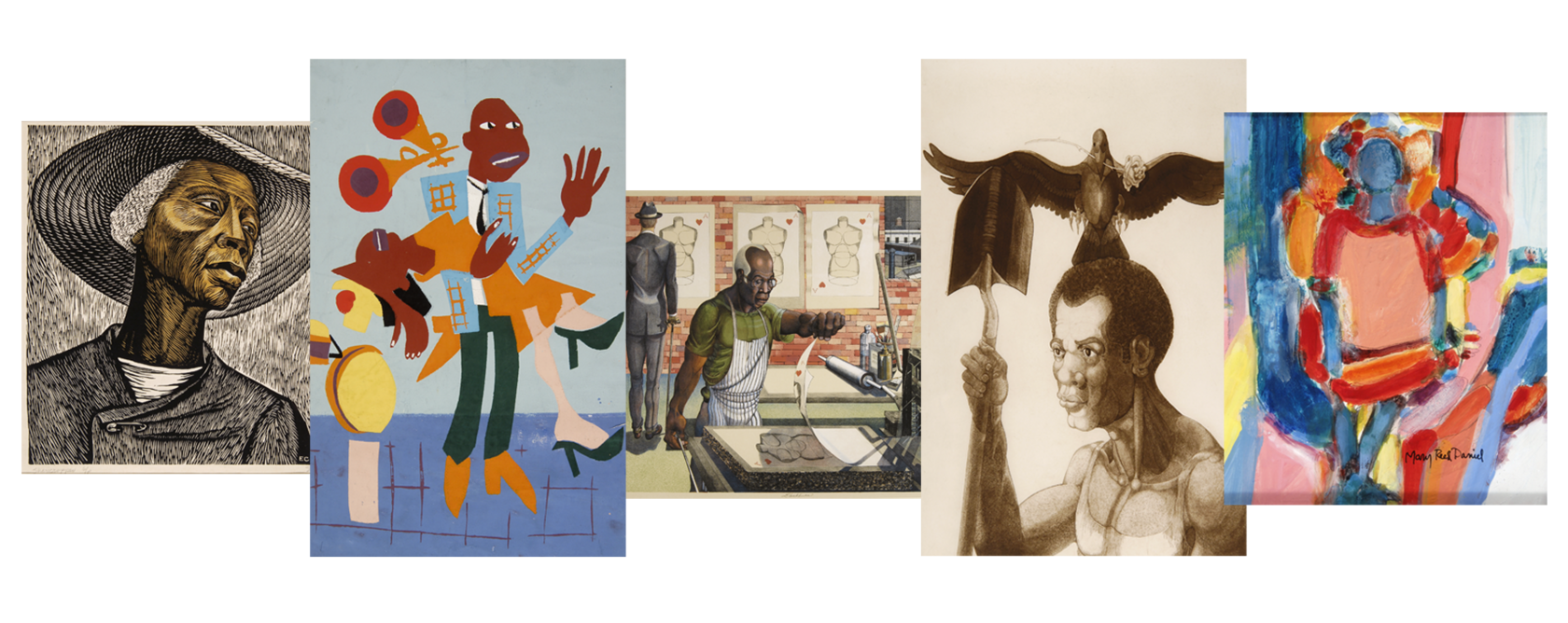
The gallery’s current show, Renaissance, Race and Representation in the Harmon and Harriet Kelley Collection of African American Art, on view through June 6, 2026, includes works on paper that coincide, according to the visual artist Dell Hamilton’s curatorial statement, “with the centennial anniversary of the publication of ‘Harlem, Mecca of the New Negro,’ the path-breaking special issue of the social science journal, Survey Graphic, in which Alain Locke outlines his vision for Afro-modernist aesthetics.”
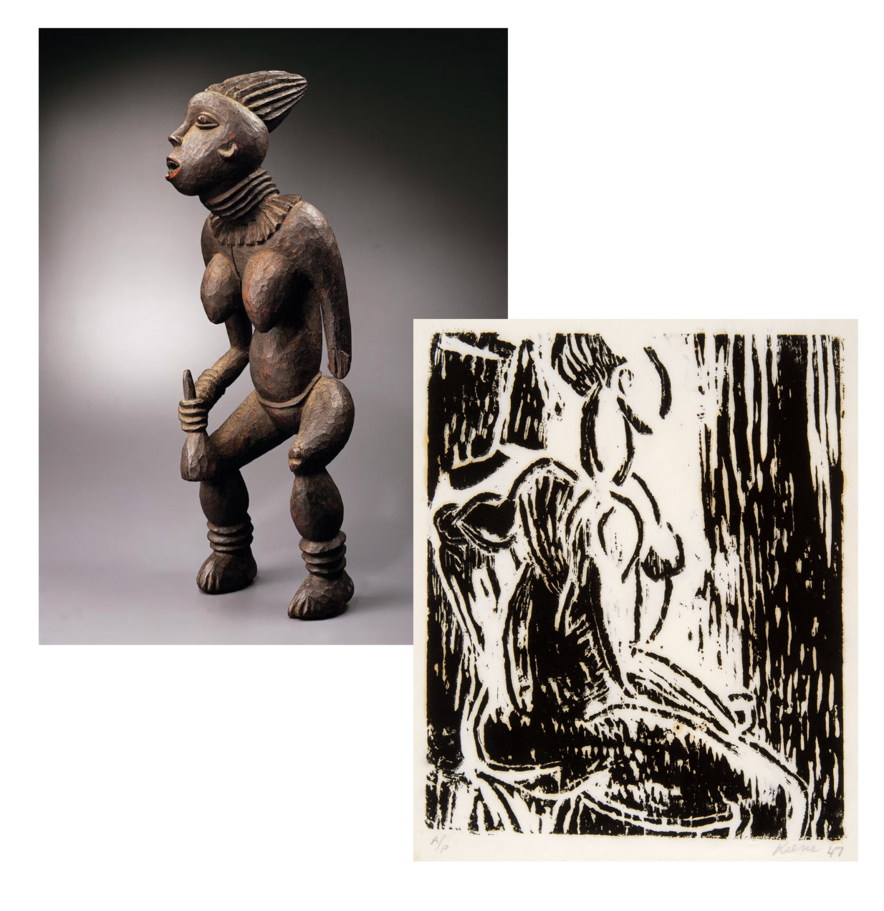
As someone whose expertise is in an area other than early 20th-century US visual art, Fromont says she takes great pleasure in approaching the exhibit with fresh eyes. One piece that captured her attention was a print by the artist Paul Keene (1920–2009) of a seated female figure. Fromont immediately saw the work as a take on the so-called Bangwa Queen, one of the most well-known African sculptures, which was the subject of a 1934 work by the photographer Man Ray.
The relationship between the Kongo and Europe [in the early modern period] could be an inspiration for a new future that we imagine. We don’t have to start from scratch. We can draw from a history that is more complex than we think.”
—Cécile Fromont
“It comes from one of the Bangwa chiefdoms of western Cameroon, whose title-holders are now seeking its return from France,” she says. “At a formal level, it has this long, striated headdress and features that are very strong. The sculpture stands dynamically, but we can recognize her in the print as the seated figure. So, you can approach Keene’s image as one of an African or African-American woman that is sitting with dynamism, beauty, and grace. But you can also think of it as a sophisticated expression of the multifaceted connection of the diaspora to the African continent. It’s one of my favorite works.”
During a fall term meeting of Introduction to the History of Art, a course she co-teaches with colleagues in her department, Fromont and her students visited the exhibit for a discussion of printmaking and the idea of the Black Atlantic. The undergraduates were fascinated in particular by the sophistication and playfulness of another work: Ron Adams’ lithograph, Blackburn, a depiction of the African American master printmaker Robert Blackburn at work.
“It’s a print about printmaking where you see a lithograph being made,” Fromont observes. “It’s a self-aware image that shows what it is and what you see. It immediately captured students’ attention, and they brought into it so many layers and connections from what we had discussed during the term.”
Students delighted, for instance, at the playful ambiguity of the cityscape at the corner of the print. “Ostensibly, the view from a window, the rectangular portion of the lithograph also functions as a tableau in itself, recalling similar visual effects we had encountered earlier in the class in the works of Jan van Eyck and early Netherlandish panel painting.”
Inspiring Wonder
Fromont says her students’ experience at the Kelley Collection exhibit underscores the power of art to create community and conversation and to inspire wonder—even in a digital age of short attention spans and fleeting gratifications.
“Students are bombarded by imagery and demands on their attention constantly—as I am too,” she notes. “Our looking labs are moments where we’re all together, in person, engaging with a work of art. If you spend time with these objects, these images, these artworks, you find they do offer you something right away. But the more time you spend with them, the more they reveal themselves. And that is tremendously rewarding.”
Like the gallery’s namesake, Fromont tries to model how educators, scholars, and champions of the arts can have an impact on the academy—and beyond.
“We can create conversations with faculty, researchers, and students; with our colleagues here and at other institutions; and with the larger community,” she asserts. “All of these conversations reach different people in different ways. Then they carry forward, stretching the perimeter of what community means for us on and off campus, and of the nature of knowledge.”
Koerner, the chair of the Department of the History of Art and Architecture, says Fromont’s research, teaching, and curatorship model what scholars mean—or ought to—when they say the words “global art history.”
“It encompasses more than what traditional art history understood as art,” he says. “It includes actions and social arrangements, as well as material things. Cécile’s work engages with all of these, and also powerfully with images, the stuff of most art history, as indicated by the title of her second book, Images on a Mission. I wish I had read Cécile sooner. But now that she’s with us, I can learn from her, as I know we all will today.”
Professor Cécile Fromont is just one of the many Harvard Griffin GSAS alumni expanding the boundaries of knowledge. Discover more about their impact—including an entrepreneur using AI to empower rather than replace human workers—in the Winter/Spring 2026 issue of the School's alumni magazine, Colloquy, dropping in mid-March alongside a brand-new website!
Banner photo by Kathleen Dooher