March 23, 2026
A Measure Short of War
Historian Jill Kastner explores why states engage in subversion and why they are unlikely to stop

When US intelligence agencies concluded in 2017 that "Russian President Vladimir Putin ordered an influence campaign in 2016 aimed at the US presidential election... [in order] to undermine public faith in the US democratic process," both voters and elected officials were outraged. The Justice Department launched an investigation into Russian interference headed by former Federal Bureau of Investigation Director Robert Mueller. Beginning in 2018, Congress appropriated more than $1 billion in Election Security Grants to help states modernize voting infrastructure. The event set off a wave of concern about election integrity on the political right and left that still echoes nearly a decade later.
While she certainly supports the measures taken to improve election security, Jill Kastner, PhD '99, a historian and visiting research fellow at King's College London, confesses she was a bit chagrined by much of the "hand-wringing" in the United States. "Those of us who have studied the Cold War for a long time were sort of scratching our heads and wondering what all the fuss was about," she says. "It was like people had forgotten what things were like before the fall of the Soviet Union. If you dial back and look at the way things played out in the decades and centuries before, you realize that this sort of thing has been happening forever".
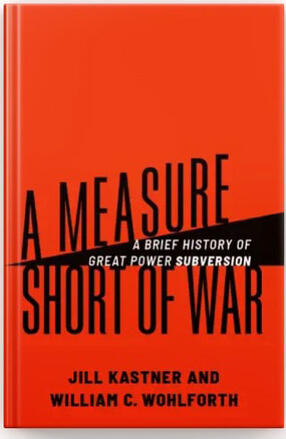
To refresh the collective memory, Kastner and her co-author, Dartmouth government professor William C. Wohlforth, wrote the 2025 book, A Measure Short of War: A Brief History of Great Power Subversion. In it, the two scholars trace how states have employed subversion alongside diplomacy and open warfare as a tool of statecraft from ancient Greece through the digital age. Kastner says that, while technology has changed, great powers continue to engage in subversion for the same reasons their ancient predecessors did: it's a better option than war.
The Space Between Diplomacy and War
Kastner defines subversion as "targeted, hostile action by a state on the territory of its rival with the intent of weakening it or changing its foreign policy somehow". While such action is hostile, she insists that it is best understood as a morally neutral instrument of statecraft, distinct from both warfare and diplomacy but overlapping with each.
"Subversion is not open warfare," she explains. "Conventional war is organized state armies using conventional weapons and tactics—it's organized violence. And subversion is not diplomacy. Diplomacy is the management of international relations by negotiation and representation; it's transparent and not covert. It might be aimed at public opinion in the target state, but it doesn't act covertly on the territory of the target. Subversion occupies the space between diplomacy and war—it's all measures short of war, from information ops to funding the opposition to sabotage".
While technologies have evolved, the basic methods of subversion have largely stayed the same throughout history: information operations like propaganda and disinformation, support for opposition groups, bribes, election meddling, sabotage, assassinations, and paramilitaries, among others.
Of course, subversion carries risks: the possibilities of retaliation, escalation, or reputational damage. Democracies in particular can face "domestic blowback" when the public discovers what their government has been up to. So why do nations continue to engage in subversion? Cost and flexibility.
Subversion is not open warfare. [It's] targeted, hostile action by a state on the territory of its rival with the intent of weakening it or changing its foreign policy somehow.
– Jill Kastner
"It's much cheaper than massing troops on the border or lobbing artillery across it," Kastner says. "And it's flexible for both the subverter and the victim. If things start heating up, a subverter can dial back the subversion to avoid retaliation. If the public doesn't yet know they've been targeted, leaders have space to decide how to respond".

Between great powers, she says, constraints generally keep subversion to a simmer. "You tend to see mostly information operations—propaganda, disinformation, that sort of thing—because the costs of escalation are just too high," Kastner says. "But when there's a power asymmetry, a big state subverting a smaller one, the gloves come off. The Cold War is like a greatest-hits album of great powers having their way with weaker ones".
Kastner's co-author William Wohlforth, the Daniel Webster Professor of Government at Dartmouth College, says leaders can sometimes blunder and overdo subversion, believing it's a magic bullet for cheap strategic gains. Generally, though, they attempt it when they think it will advance their rational state interests. "They nudge, harass, and push each other through domestic meddling, scoring some gains here and there while avoiding major retaliation," he says. "Ideology matters, for sure, helping determine whom to support inside your rival and sometimes providing the impetus to subvert, as when Protestant and Catholic rulers supported fellow believers in each other's countries, and communists, fascists and even democratic states did the same".
Subversion Across the Centuries
If you grew up watching James Bond movies or laughing at Get Smart reruns on TV, it can seem like subversion began with the Cold War. One of the revelations of Kastner and Wohlforth's research, however, is how long great powers have been trying to get the better of one another through fair means and foul. In fact, because of the persistence of war in their era, ancient states may have engaged in subversion more frequently than modern ones.
"In classical Greece, which we devote a full chapter to, you had constant conflict," Kastner says. "The more war you have, the more subversion you see. Rivalry opens opportunities". The methods employed by Athens and Sparta, for instance, would be recognizable to any modern student of subversion: bribery, support for internal factions, secret payments to orators to sway public opinion. "History is littered with examples of someone being bribed to open the city gates to an invading army," Kastner notes. "There was even fear of fifth columns (groups of enemy agents working to sabotage a country from within) 2,000 years before the phrase was coined".
History is also littered with examples of subversion's failures. One of the most prominent is the conflict between early modern European powers England and Spain. King Philip II of Spain became the titular king of England when he married Queen Mary I. Mary produced no heirs, though, and when she died, Philip lost his crown—and the Catholic Church's hold over England—to Mary's Protestant half-sister, Elizabeth I. Determined to bring England back into the Habsburg dynasty, of which he was a member, Philip was constrained by geography and politics. "The English Channel was a big obstacle—it made England a hard target. So, for a while, he pursued diplomacy—marriage negotiations, alliances," Kastner explains. "But when those failed, he turned to subversion: fomenting Catholic uprisings, plots to overthrow or assassinate the queen".
Elizabeth retaliated, supporting Dutch rebels fighting Philip in the Netherlands. Eventually, war broke out between the two powers. "The Spanish Armada of 1588—Philip's attempt to invade England and restore Catholicism—was the result of subversion not working," Kastner says. "Neither side could get what it wanted. It's the classic pattern: when subversion fails and the issue sparking the conflict is considered existential by both parties, war follows".
When subversion succeeds, however, it can forestall war. Kastner points to the 19th-century German chancellor Otto von Bismarck as an example. "Bismarck used a press and propaganda campaign, augmented by well-placed bribes, to nudge the French public toward keeping a republic in the 1870s," she says. "He thought a restored monarchy would be dangerous to the newly unified German state. In the 1880s, he tried to discredit British Prime Minister William Gladstone the same way". Bismarck also used his notorious slush fund—the aptly named Reptilienfond or reptile fund—to buy journalists and newspapers. "It's a perfect illustration of how subversion can work on the cheap. It's like fertilizer if you're a farmer: you can't always tell how much it matters, but it can tip the balance".
For Kastner, Bismarck's tactics highlight both the power and ambiguity of subversion. Sometimes, she says, subversive activity can have positive consequences. "Any subversion that prevents war is a huge success. [War] is the last thing you want, and if you can head it off by nudging a narrative or funding an opposition group, that's a win".
Ideology, Virtue, and the Digital Age
In the 20th century, ideology—specifically the struggle between capitalism and communism—replaced religion and nationalism as the dominant justifications for meddling. Despite rhetoric championing national self-determination after the First World War—and support for the United Nations after the second—the United States engaged vigorously in covert action to achieve policy goals, often with disappointing results. "Look at the 1980s," Kastner says. "The Reagan administration spent treasure and diplomatic capital trying to overthrow the Nicaraguan government of Daniel Ortega. After years of clandestine flights and arms shipments, ex-Marine Eugene Hasenfus gets shot down [delivering weapons to the Contra rebels], the whole thing unravels—and who's president of Nicaragua today? Daniel Ortega".
Undertaken jointly by the US Central Intelligence Agency and the British secret intelligence service MI6, the 1953 operation to overthrow the democratically elected prime minister of Iran, Mohammad Mosaddegh, was initially a success. The pro-US Shah was restored to power, resulting in 25 years of strategic advantage. Then came the Islamic Revolution of 1979, the hostage crisis, and 45 years—and counting—of enmity. Similarly, US efforts to support the mujahideen in Afghanistan helped push the Soviets out in 1989. But the vacuum left behind gave rise to the Taliban. "Every time you intervene, you have to remember: if you break it, you own it," Kastner says.
The 1990s brought a new twist to international statecraft: subversion in the name of virtue. "After the Berlin Wall fell, non-governmental organizations were suddenly doing overtly what the CIA had done covertly," Kastner recalls. "Media training, democracy assistance, support for civil society—all things we see as good. But from Moscow's perspective, especially under Putin, it looked like subversion".

The "Color Revolutions" that toppled authoritarian regimes in Georgia in 2003, Ukraine 2004, and Kyrgyzstan 2005 each produced Western-leaning governments. But from Russia's viewpoint, Kastner notes, the march of democracy looked like a brilliant active-measures campaign marching inexorably toward Moscow. "It doesn't make [the Russian's] reaction right, but it makes it understandable," Kastner says.
Today, cyber tools and social media make it possible for great powers to reach into each other's information spheres quickly, cheaply, and with devastating results. But while the technology has changed, Kastner says that the calculus for subversive acts hasn't. "In 2016, Russia was confronted by an implacable rival, an existential issue around Ukraine, a new technology promising great advantage, and the US asleep at the wheel after 25 years of unipolarity," she says. "It was the perfect storm". But if Moscow's goal was to weaken the United States or shift its foreign policy, Kastner believes the effort largely failed. "Exposure led to better cybersecurity, new institutions, and a stronger security culture. Technology isn't really a game changer in the long term because whatever is used to subvert is also used to defend. You'll always be on the back foot if you're the good guy, but tech is our friend as well as our foe. Democracies are more robust than we give them credit for".
Democracies need to get the level of threat right. Underestimate subversion and face strategic losses at the hands of autocratic rivals; exaggerate it, and you'll end up subverting yourself by needlessly repressing suspected subversives and foreign agents.
– William Wohlforth
Learning from History
Kastner and Wohlforth's colleague Dr. Michael Poznansky, author of In the Shadow of International Law: Secrecy and Regime Change in the Postwar World, says the way the duo puts in context contemporary events like Russia's election interference is a model for how to do applied history. "It would be natural to assume that the 2016 election heralded a new and frightening glimpse into how state-on-state competition looks in the 21st century," he says. "But Kastner and Wohlforth convincingly show that, while the methods may have been novel, the act itself was not. Their framework for thinking through the different types of subversion, its pros and cons as a tool of statecraft, and the surprising resilience of democracies when they are targeted should help decision-makers craft smarter policy".
Students of international relations often imagine a straight-line progression from diplomacy to subversion to war. With A Measure Short of War, Kastner wants them to embrace a more dynamic metaphor. "It's tempting to picture a ladder," she says, "but when you climb a ladder you leave the lower rungs behind. In reality, these tools stack. You can have diplomacy without subversion, but if you start subverting, you're still doing diplomacy. And you can't have war without subversion—it's always there, running alongside the kinetic fight".
Wohlforth notes that such clear-eyed understanding of subversion and its history can ultimately strengthen democratic institutions. "Democracies need to get the level of threat right," he says. "Underestimate subversion and face strategic losses at the hands of autocratic rivals; exaggerate it, and you'll end up subverting yourself by needlessly repressing suspected subversives and foreign agents and undermining free speech and the rule of law. The historical perspective our book provides helps avoid both errors by putting today's subversive statecraft in perspective. We've been there, done that. Don't freak out but keep vigilant!".
Photos of Kastner by Muqing Xu