March 23, 2026
Better Together
Rohan Murty partners workers with artificial intelligence and brings classics of Indian literature to modern readers

By now, most of us are familiar with artificial intelligence (AI) as a one-to-one helper: the chatbot that summarizes an article or answers a question, the virtual assistant that sets a reminder or sends a text, the embedded copilot that cleans up a document or spreadsheet. But what if AI worked alongside rather than for us? What could it reveal about the complex nature of office work, and what could we accomplish together?
These are the kinds of questions that inspire Rohan Murty, PhD ’11, the founder of two companies focused on leveraging the power of AI to improve office work. "For the last 100-plus years, manufacturing has had a very detailed, scientific way of optimizing how we produce things," Murty observes. "Office work, on the other hand, has not had a scientific way of understanding and improving it."
Today, there is widespread anxiety about what the future of AI holds, including fears that it will displace human workers. Murty has a different outlook. Rather than viewing AI as a rival, he sees it as a partner that can give us a deeper understanding of how we work—and how, with the right information and context, we can move past our current limitations and do better.
AI as Team Player
Traditional management consulting has long been the go-to solution for corporate leaders who are looking to improve business practices in their organizations. But consultants are often forced to gather data through surveys, which are completed by only a tiny fraction of a company’s total workforce. This can result in recommendations that are largely guesswork, without a robust connection to the specific details of how employees across the company actually get things done.
That’s where Murty and his business partners come in. "We realized that if you use AI to directly tap into how humans and machines inside an organization interact with each other—keeping things anonymous, without tracking who does what—you could reverse engineer the underlying patterns and flow of work," he explains. "You could turn the art of understanding how office work happens into a detailed science and create the first computational discipline for improving it."
Soroco, the first startup that Murty founded after completing his PhD in computer science at the Kenneth C. Griffin Graduate School of Arts and Sciences (Harvard Griffin GSAS), was designed to do exactly that. The company created Scout, an AI platform that reveals how work gets done in an organization by mapping and analyzing anonymous user interactions across software systems, accurately identifying inefficiencies and bottlenecks at a scale that would have been previously unimaginable.
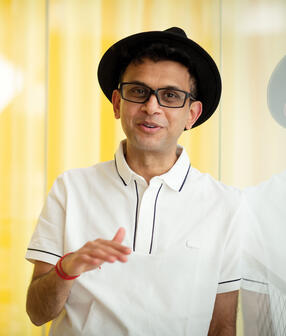
"AI can help us learn how an entire 100,000-person company works, just by directly seeing how they use software," Murty explains. For example, if staff at a large insurance company are resolving claims in a hundred different ways, through diverging processes and various workarounds, Scout can identify this issue and help diagnose the problems driving it.
"With this hard data, we can help leaders determine whether they should invest in training, whether they should automate something, whether they should invest in technology, whether a process should be redesigned," Murty says. "Without this kind of data, it’s very hard to make those decisions—and you may not get them right."
Soroco’s success in the corporate world—across hundreds of clients, including a significant number of Fortune 500 companies—led Murty to a critical realization: for AI to be truly useful, it needs to be grounded in the nuances and patterns of work particular to each company.
For the last 100-plus years, manufacturing has had a very detailed, scientific way of optimizing how we produce things. Office work, on the other hand, has not had a scientific way of understanding and improving it.
"One thing we learned in our Scout journey is how different every organization is," Murty says. "You could be two companies in the same industry, building the same products, but internally, you work in totally different ways." This is why generic AI solutions on the market today—like AI agents designed to help with sales, or finance, or operations, broadly speaking—tend to fall short of expectations: they don’t "know" the idiosyncratic ways that work actually gets done in the organizations where they are deployed.
"We realized that by leveraging the technology we invented through Soroco to understand how specific organizations work, we could do this last-mile grounding of AI models inside organizations," Murty says. "By learning from how teams work, we can get AI to behave like a member of the team."
This insight was the genesis of Murty’s second startup: Workfabric AI. The company offers a platform, Context Fabric, that learns how work gets done in a specific organization and then trains AI agents to join teams within that organization. Just like any new coworker, the AI goes through an onboarding period, learns the ropes—and then becomes a source of institutional knowledge, task support, and collaboration for the whole group.
For Murty, this technological leap opens a new way of thinking about the potential of AI. "Can AI accelerate entire teams?" he asks. "Can it be a productive member of a team? Can it be a colleague you can rely on?"
According to Ravi Kumar, the head of Cognizant, a Fortune 500 multinational information technology services company that uses Workfabric AI, the answer is a resounding yes. Cognizant’s partnership with Workfabric is helping them build an emerging discipline called context engineering, focused on ensuring that AI has the right data and structure to perform complex, multi-step tasks—paving the way for AI agents that can work independently, effectively, and securely.
"The greatest potential of this type of technology is that it’s not about replacing jobs: it’s about augmenting and amplifying human capability," Kumar says. "We’re at an inflection point where software is no longer just a tool for organizing work; it’s becoming a participant in how work is done. With the right context embedded, AI systems can reason with purpose and collaborate with human teams to unlock new categories of services and economic value."
This focus on value and the power of teamwork is a through-line for Murty. "When you accomplish great things, it’s never because of a single individual," observes George Nychis, who co-founded both Soroco and Workfabric AI with Murty; the two have been working together since graduate school. "It’s always because of a team of individuals coming together to produce something. Once you start thinking about how AI can unlock team productivity, it becomes something much greater. That’s one of the things that I’ve learned from working with Rohan: he’s always had a very sharp focus on making sure that what we do drives value for teams and organizations."

Unexpected Journeys
Murty’s career launching Soroco and Workfabric AI might seem like a natural extension of his PhD at Harvard, but in fact it was a radical departure. "I was quite certain, by the time I was in sixth or seventh grade, that my life path was to get a PhD, and then to become a professor," Murty says.
He grew up in India, the child of two computer scientists, in a household where teaching was, as he puts it, the "family business." "For six or seven generations on my mother’s side, and for four generations on my father’s side, my family have been teachers," Murty says. "My grandfather was a professor of medicine and a gynecologist, one of the earliest ones in my state in India. The environment in which I grew up was very academic. My father would talk to me about mathematicians like Alan Turing and George Boole; I would spend hours doing math with my mom. So, I thought, that’s it: being a professor is the best form of existence."
Something unexpected happened when Murty was finishing his PhD. "I began to realize that an academic career was not what I wanted," he says. "I had never before questioned whether I wanted to do something else; the first time I started asking that question was when I was literally in the middle of my academic job interviews."
After a year as a postdoc at MIT and two in the Society of Fellows at Harvard, his interest in a life outside academia had not abated, and the idea for Soroco was born. "Through a series of accidents, and talking to some of my friends, we came up with this question: Could we build automated consultants using AI? I had a vision, I latched onto it, and I didn’t look back."
A New Perspective
Murty’s career shift was not the only time he was inspired to venture off the beaten path at Harvard Griffin GSAS. "I had an unusual experience as a graduate student," Murty says. "Most of my friends were not from my department—they were in history, philosophy, economics, math—and the more I hung out with them, the more I was exposed to other ways of thinking that otherwise I would not encounter."
Through these connections, Murty befriended Parimal Patil, Wales Professor of Sanskrit and Professor of Religion and Indian Philosophy, and took several courses with him. He was typically the only computer science student in the class, but Patil was supportive. Murty gained his first exposure to classical Indian philosophy—and a deeper appreciation for the humanities.
"That experience, perhaps more than anything else, opened my eyes to different schools of thought, different ways of making arguments, and made me an even better researcher in computer science," says Murty. "In India, our educational system is heavily geared towards STEM, so I didn’t have an appreciation for most of these things growing up. And in my first year at Harvard, I was a very intense grad student; I was in my office seven days a week. But somewhere along the way, for the first time, I started to ask myself: Why am I doing this?"
He went on to take many courses in history, art history, and philosophy at Harvard, much to the surprise of his academic advisor. "The humanities started to give me a multidimensional perspective of life," Murty explains. "Until then, for me, the reason to solve a problem was because I found the problem interesting. And sometimes that’s perfectly reasonable. But through my study of the humanities, I began to feel that was not enough. What is the value of my work? What is its impact? What difference does it make to someone’s life? Does it make other people’s lives better? I felt like I finally had a better perspective on how I should approach life."
The humanities started to give me a multidimensional perspective of life. Until then... the reason to solve a problem was because I found the problem interesting.... Through my study of the humanities, I began to feel that was not enough.

Expanding the Pantheon
Murty’s experience with the humanities in graduate school helped create what is perhaps destined to become his most enduring legacy: the Murty Classical Library of India, published by Harvard University Press through an endowment Murty established.
Inspired by the Loeb Classical Library, the Press’s definitive collection of Latin and Greek texts, the Murty Classical Library is dedicated to publishing great works of Indian literature—written in 14 different languages over the course of millennia—with original texts in their original scripts presented alongside new English translations.
At the outset of the project, most people, including translators, typesetters, book designers, and sales partners, thought it was an impossible challenge. "They were right, of course," quips Sharmila Sen, editorial director of Harvard University Press, who has been involved with the series since its inception 15 years ago. "It is a form of madness to publish such a complex series that involves so many languages, so many different writing systems, so many people, and aims to attract readers around the world."
But the Murty Classical Library—with 50 volumes published to date—has enjoyed success across India, the United States, and Europe. Murty recalls that, when he was growing up in India, it was more common to read great works from the Western canon than India’s own literature. "We read Shakespeare: two years of Merchant of Venice, and two years of Hamlet," he says. "We read Tennyson’s 'Ulysses': 'To strive, to seek, to find, and not to yield.' We read Whitman’s 'O Captain! My Captain!' but we had no cultural understanding of what any of this meant. And when I came to the US, in my undergrad and PhD days, I met students from around the world who seemed to know so much about their cultures, their classics, their poetry, their literature. I kept thinking: we don't seem to know as much about our heritage today in India."
This is an imbalance that he hopes the Murty Classical Library will help shift. "My ultimate hope for these books is twofold: for India, and for the world," Murty explains. "For the world, I would love to see Indian texts included and celebrated in the pantheon of classics, along with Greek and Latin. And for India, my hope and ardent desire is that these classics are read by students in India as examples of the wonderful intellectual history and environment we all come from—that it adds to a collective national confidence."
The Loeb Classical Library is now 114 years old and more than 550 volumes strong. Murty describes the Murty Classical Library similarly, as a "100-year-project," and one founded on the deep appreciation for the power of universities and education that he has carried with him since childhood.
"I was very clear from the beginning that I didn't want this to be a two- or three-year project," Murty says. "Our goal is to make these classics accessible to the entire world, and in doing so, broaden the very definition of classics. If you're going to do this, it should be built as an institution that should outlive all of us. And the best way to do that is to bet on the university."
Murty’s path has wound through very different kinds of knowledge work, but his AI companies and the Murty Classical Library both rest on the same belief: that education is a collaborative act. By asking what we might do with more context, more memory, and more time, he invites us to imagine a future in which technology is not a force of isolation or replacement, but a partner in widening the circle of who gets to participate—in meaningful work, in shared stories, and in the long, collective project of understanding the world.
A Hundred-Year Project
Published by Harvard University Press through an endowment Murty established, the Murty Classical Library (MCL) presents great works of Indian literature with original texts alongside English translations. With 50 volumes published to date, the MCL has enjoyed success across India, the United States, and Europe.

Banner image by Kathleen Dooher