September 16, 2026
Being Brave
Photo by Evgenia Eliseeva
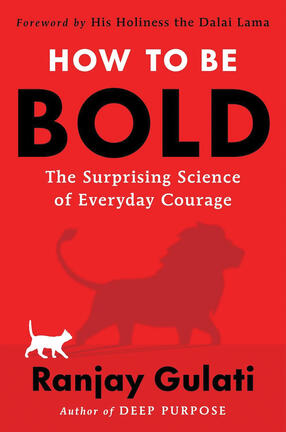
Harvard Business School professor Ranjay Gulati, PhD ’93, discusses the science of everyday courage, managing fear, and leading through uncertainty in his new book, How to Be Bold.

Ranjay Gulati, PhD ’93, an expert on leadership strategy and organizational growth, has thought a lot about courage. It is not fearlessness, the Harvard Business School professor writes in his new book, How to Be Bold: The Surprising Science of Everyday Courage, but the ability to make sense of situations in helpful ways and also see ourselves as strong, capable people who can control our destinies. Most of all, he says that courage is a learned behavior. With evidence-based tools—and with practice—leaders of all kinds can put themselves on the path to developing a courageous mindset.
How do you define boldness? Is it the same as courage?
[The South African leader] Nelson Mandela said courage is not the absence of fear; it is resourcing yourself in the face of fear, usually toward a noble cause. That is how I define courage and boldness in my book.
What's the difference between courage and recklessness?
The ancient Greek philosopher Aristotle reflected on this question in the fourth century BCE. He distinguished cowardice from recklessness and put courage in the middle. It's where there is deliberate, thoughtful action. In the case of one of my former MBA students, Frances Haugen, who became a whistleblower at Facebook and essentially blew up her career as a high-tech executive with a Harvard MBA, she spent a year deliberating over whether she was going to do this. It was not something she did off the cuff.
In some cases, you have the luxury of time, but in others, you do not. In 2009, for instance, Captain Chesley Sullenberger was piloting a US Airways flight from New York's LaGuardia Airport to Charlotte when a bird strike disabled his engines. He had seconds to decide whether he was going to turn the plane back and try to get to LaGuardia, go straight to Teterboro Airport in New Jersey, or land in the Hudson River. He did the math in his head. He took the third option. All 155 passengers survived.
You have a formula for becoming more courageous: the Nine Cs. What are some of them?
The first C, "calm," talks about dialing down the fear. For the longest time, humankind has prayed to a higher power, and it works. Also, it turns out checklists are calming devices that focus you on the task at hand. The first thing Captain Sullenberger did when he had to land the plane in the Hudson was make a checklist. Another thing people use is ritual. Adele, the famous singer, is terrified of public singing. What does she do? She has a ritual. She looks at Céline Dion's picture before she sings. Céline Dion is her hero, and it calms her down.
Another "C" is confidence. This comes from research done by a Stanford professor named Albert Bandura. He recruited students who were terrified of snakes and said, "I am going to make you look at pictures and slowly expose you to snakes. Over time, however, you will get comfortable with the snake, and maybe you will hold one." Many students dropped out during the course of the study, but the ones who stuck around later said not only that they could hold a snake, but also that it had given them a general confidence about their lives. If they could deal with the snake, they could deal with anything.
One more "C" is conviction. Most of us hold on to some beliefs that are sacred to us, meaning that if they are violated, we will do anything, even at our own physical or emotional cost. For example, the Russian dissident Alexei Navalny was poisoned. He was evacuated to Germany and had a miraculous recovery. He had a wife and two kids. What did he do? He turned around, got on a plane, and went back to Russia, knowing they would arrest him and ship him to Siberia, which is exactly what they did. He knew that he might die, but he said, "I do not have a choice." That feeling of being morally compelled is conviction.
Finally, you write in the book that, if there was ever a time to enhance our ability to control or manage fear and show more everyday courage, this is it. Why is boldness so important now?
The point of origin of courage is fear. The point of origin of fear is uncertainty. If ever there was a time of uncertainty, it's right now. It's not easy, but as a professor of business, I see many illustrations of turnaround and transformation. In 2009, for instance, Boston Scientific bought Guidant for a record sum of $28 billion, though Boston Scientific itself was worth only $27 billion. It turned out to be a complete disaster. They had FDA recalls, quality issues, and regulatory issues. The collective market cap dropped from around $56 billion or $60 billion to $8 billion.
The company offered the job to a new CEO, Mike Mahoney, who hired a consulting firm to advise him on how bad the situation was and whether he should take the job. The consultants came back and told him it was really bad, and that he should not take the job. He took it and turned a failing company with an $8 billion market cap, going down fast, into a $150 billion market cap company. In medical devices, Boston Scientific is now considered a juggernaut.
How do you do that? You see instances where a leader steps up. Mahoney faced down impossible odds. So did Anne Mulcahy, who became CEO of Xerox many decades ago, and turned it around when it was an almost bankrupt company. I think the world needs leaders like that.