September 16, 2026
What Makes a "Worthy" Immigrant?
Combining data from a hundred studies, a new Harvard-led paper examines which newcomers are viewed most favorably in host countries around the world.

Imagine you are an immigration official. You can admit only one of the following two people into the country: a man with an elementary school education who is fleeing violence, or a woman with a graduate degree who is seeking employment. Which one would you choose?
To measure public opinion about immigration, political scientists have asked variations of this question to hundreds of thousands of people all over the world. A new study in Science Advances, led by Harvard Griffin GSAS PhD student Marco Aviña, combines data from a hundred of these studies for a large-scale examination of who makes a "worthy" immigrant in the public eye.
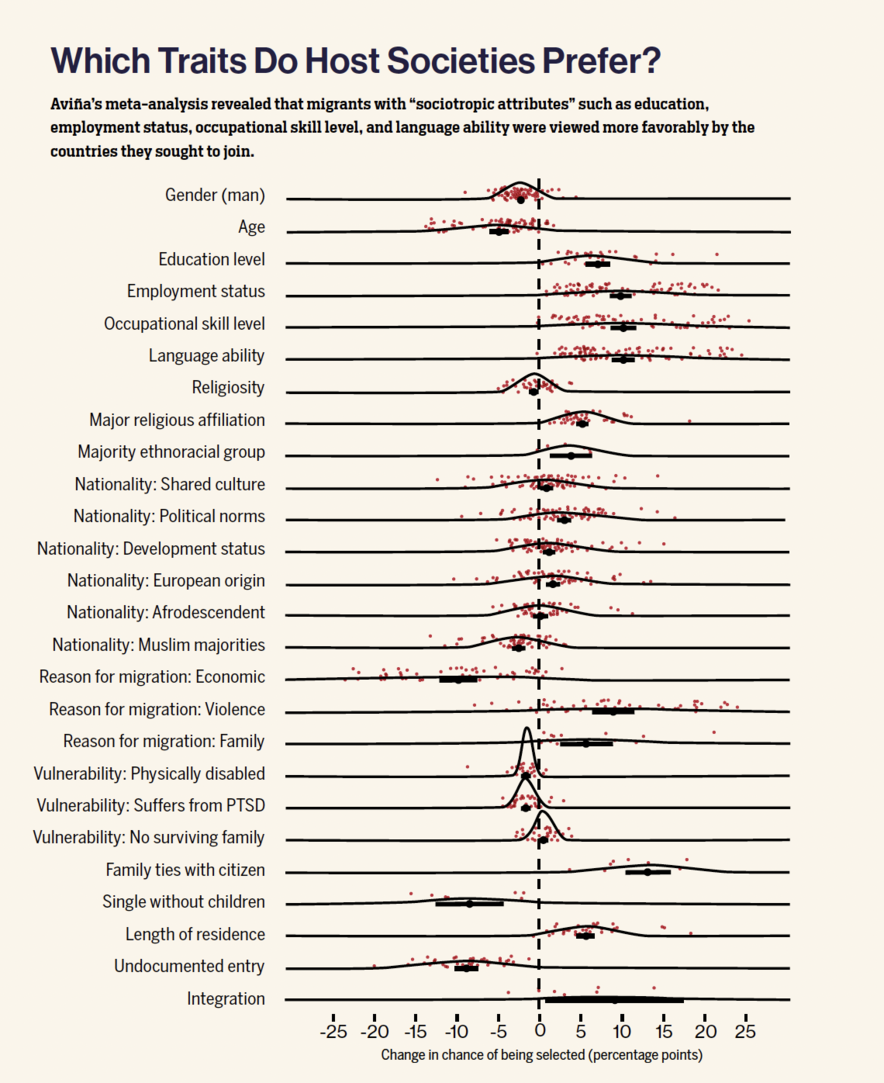
Across 36 countries, the paper reports that host citizens generally prefer immigrants with attributes associated with economic contribution, such as those possessing advanced degrees or strong language skills. It also warns of profound political polarization—while conservatives place great weight on cultural similarity, liberals largely do not.

Motivated by Experience
Aviña’s curiosity about immigration and public opinion stems from his own experience immigrating from Mexico to Canada as a child and coming to the United States for graduate school.
"My family was seeking asylum in Canada, so I had the experience of being a little uncertain about the future when we first arrived," he says. Even once his family secured permanent status, cultural challenges remained. "I had to learn a new language (French). I had to incorporate into the culture here in Quebec. Then again, going into a PhD in the United States, I had to go through the same thing, doing it all in my third language."
Throughout this journey, Aviña has witnessed many changes to immigration policy. Some have affected him firsthand, including, most recently, President Donald Trump’s efforts to revoke international student visas at Harvard. As an undergraduate, he decided to turn these observations into research questions.
"I started my undergrad in 2017, right after Trump was elected president. Immigration was definitely salient back then," he says. "I wanted to understand why it was so contentious—why people are either very favorable or very opposed to immigration, when we know that immigration has very positive aspects."
Putting the Pieces Together
As a PhD student, Aviña looked at studies called "conjoint experiments," which randomly assign attributes like gender, education, and country of origin to two hypothetical immigrants. Survey respondents then decide which immigrant they would prefer to admit into their country. When repeated enough times, robust patterns emerge in which types of people are more likely to be accepted.
"What’s great about conjoint experiments is that you have multiple attributes, and the analysis holds all other attributes constant when estimating each effect. For instance, the effect of gender is calculated net of every other attribute," Aviña explains. "This creates really good conditions to have clean estimates, so you can be sure that this gender effect takes into account other attributes that were included in the experiment."
Rather than compare hundreds of separate—and sometimes contradictory—sets of findings, Aviña and his team of five other Harvard colleagues (one now based at Brigham Young University) asked an ambitious question: What if we combined them all?
"Every study is a little bit different—a different context, a different population, different attributes," Aviña says. "But across all these slightly different studies, there’s also quite a bit of overlap. This creates a great opportunity for assessing generalizability."
The research team systematically searched the political science literature for immigration-focused conjoint experiments from 2012 to 2024 and contacted authors to obtain replication data and materials where needed. Since the project predates the widespread adoption of artificial intelligence tools, this manual data collection effort took three years. In total, their combined dataset included over 1.4 million immigrant profiles that had been assessed by 142,817 survey respondents in 36 countries.
I wanted to understand why immigration was so contentious—why people are either very favorable or very opposed to immigration, when we know that immigration has very positive aspects. —Marco Aviña
The Global Immigration Consensus
Even with such a broad geographic scope and time range, Aviña and his team uncovered remarkable consistency in which immigrants tended to be viewed favorably.
"The most important characteristics are what we call 'sociotropic attributes'—things like education, employment status, occupational skill level, and language ability that signal the contributions that an immigrant will make to the host society," he says. "These had by far the clearest, largest effects."
The immigrant’s level of attachment to the host society, such as having friends or family members already living in the country, was another important factor. People also tended to prefer immigrants who were fleeing violence rather than seeking economic opportunity.
"Whether they are in North America, Western Europe, or Eastern Europe, there seems to be a consensus in what people prioritize from potential immigrants," Aviña says, emphasizing that the scarcity of data from the Global South makes it hard to generalize beyond the Global North.
While these findings were stable across countries, they did vary across time. "Sociotropic attributes tend to matter more over time," Aviña notes. "For employment status, occupational skill level, and language ability, recent studies find larger effects than the older studies."
Narratives of Worthiness
Sociotropic attributes took precedence over race, ethnicity, and cultural characteristics in Aviña’s analysis, but this does not mean that citizens’ evaluations were racially neutral. According to Judit Kende, an assistant professor of social psychology at Tilburg University who published a commentary on Aviña’s study, attributes like educational credentials or legal status carry racialized connotations in many cultures.
"For example, one of the most penalized attributes is irregular entry into the country or undocumented status. While these attributes could be interpreted as simply a question of legal status, [this] is strongly tied to race and ethnicity," Kende says. "Thus, while it could appear that citizens do not evaluate immigrants by their race, ethnicity, or culture, a more careful unpacking of immigrant characteristics reveals racialized evaluations."
Similarly, Aviña acknowledges that political narratives about immigration—which are often racialized—may also shape public ideas about potential new entrants’ worthiness.
"Increasingly, you have politicians emphasizing that immigrants maybe don’t contribute their fair share, or that immigrants might be a burden," he says. The cultural impact of such messaging could be one explanation for the growing importance of sociotropic attributes. "This rhetoric, it reaches people. We see here one indication that people might be swayed by this sort of discourse."
In fact, political beliefs emerged as a key driver of immigration preferences. While the researchers found no variation across standard demographic variables like age, gender, and even one’s own immigration status, preferences differed sharply in several cases between anti-immigrant or conservative people and their pro-immigrant or liberal counterparts.
"Conservative people . . . prioritize cultural similarity and nationality effects. Shared culture, political norms, development status, whether the country is European, Afro-descended, or Muslim—these cultural characteristics associated with nationality matter quite a bit," Aviña says. "For pro-immigration respondents, cultural similarity has little influence; in some analyses, the pattern even points in the opposite direction."
These findings held up regardless of whether the researchers measured political beliefs using the labels "liberal" and "conservative" or simply asked people if they were generally for or against immigration. Aviña was surprised to see such consistent, strong disagreement.
"The consensus in the literature was that there was widespread agreement among the public on immigration. So going in, I wasn’t expecting to see these differences based on political predispositions," he explains. "But now that we’ve established this finding, it makes complete sense—if you’re anti-immigrant, then you’re not going to care about the same [attributes of] potential immigrants as if you’re pro-immigrant."
"We didn’t expect this—it’s a new finding for this literature," he says.
With fertility dropping across many countries and geopolitical instability and war creating more forced migrants, we need to develop ways to match potential immigrants with countries that need all kinds of people.
—Harvard Sociology Professor Mary Waters
A Leap Forward
Aviña’s simple, polished findings conceal just how difficult it was to collect and analyze this data. After creating the extensive list of studies and obtaining permission to use each dataset, his team faced challenging measurement decisions.
"Some studies might include four age categories, others might include two, and it’s the same idea for other attributes," he says. "We had to sit down with all these studies and find a way to code them that’s comparable across studies. This standardization work was a huge undertaking."
But after three years of hard work, Aviña hopes this study will help scholars make a leap forward in a field where progress has been slow and incremental for over a decade.
"We provide very definitive answers about what matters, what doesn’t, and even answers that we didn’t know about previously, like this heterogeneity across people based on their predispositions toward immigration," he says. "With this paper, I hope the literature can move forward in a more substantial way."
The paper also has much to contribute beyond political science. Across campus in Harvard’s sociology department, Professor Mary Waters, herself an immigration expert, sees applications for this work in other academic disciplines—and even outside of academia.
"With fertility dropping across many countries and geopolitical instability and war creating more forced migrants, we need to develop ways to match potential immigrants with countries that need all kinds of people," she says. "Understanding what drives attitudes toward immigration is an important question across the social sciences, and this paper makes an important contribution to this endeavor."
As public opinion about immigration continues to shift, influencing the direction of policies across the world, Aviña’s work has much to offer. "If journalists or politicians want to understand what people prioritize in immigration, they can look to this paper for a really strong set of answers," he says.
Aviña hopes his paper and future studies like it will provide a template for gleaning new discoveries from existing data, even beyond the field of immigration.
"Taking everything that we know about these issues, sitting with the findings, and trying to assess what this collection of studies teaches us that we hadn’t figured out yet. That was the idea for this paper," he says. "And we found pretty surprising results."
Banner image: Adobe Stock