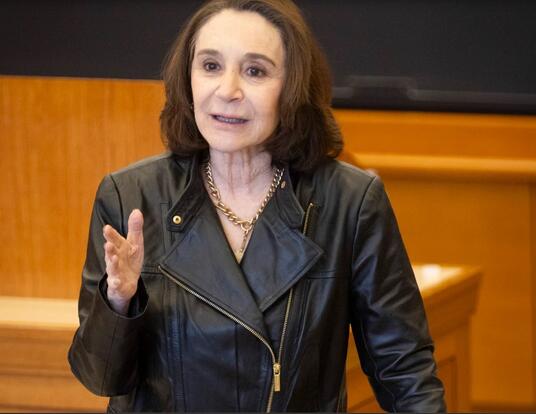
Now a postdoctoral fellow at the University of Notre Dame, Thomas Blakeslee’s research traces narratives of the Black father and family back to stereotypes that emerged alongside emancipation after the Civil War. Building on decades of scholarship that chronicled the resilience of the Black family, Blakeslee, PhD ’25, illustrates how fatherhood gave rise to "radical paternity"—acts of resistance and new versions of masculinity in the African American community that emphasized care and service while rejecting domination and violence.
You had a nontraditional path to Harvard, a big part of which was fatherhood. Can you describe it?
I grew up in the Philadelphia area, part of a large extended family. I have two sisters and a brother. None of us went the academic route. Like my father before me, I was a blue-collar worker with an intellectual interest in books, documentaries, and good music. At one point, I thought I was going to take the creative professional route because I did visual art and music production. As it turned out, I did nearly every sort of menial labor that was available to a young man: warehouse work, construction, masonry, security guard, delivery guy—all of those things.
I married my wife in my early 20s. We had two kids. We moved to California in 2008. I drove trucks up and down the West Coast. My wife started taking classes at community college, and I helped with her homework. That encouraged me to go back to school too. She transferred from community college to UC Davis, and I went to UC Berkeley. We took night classes, worked, and raised our children.
Since my wife and I took that path in life, I got my PhD and she received her master’s degree. She’s now a psychologist and behavioral therapist. One of our adult children has a bachelor’s degree. Another is now in a PhD program. So, I think the decision that we made over 10 years ago has panned out in many good ways.
The idea of the lack of Black patriarchy . . . was part of the excuse for why Black men should not have political power, gain the franchise, or have the vote. —Thomas Blakeslee
You study the social history of Black fatherhood in the United States from the mid-19th to the early 20th century. How were African American fathers portrayed during that time?
The idea of the lack of Black patriarchy goes back to the moment of emancipation, and maybe even a little before that. It was part of the excuse for why Black men should not have political power, gain the franchise, or have the vote: because they were not the heads of households, they were not leaders, and they needed the strong governing hand of a white slave master to function in society. The argument was that once you removed that, there would be nothing but chaos among men and women.
This is also the birth of many stereotypes. For women, there was the Sapphire caricature, the mammy, and Jezebel. On the male side, there were Sambo, the City Dandy, and other characters that showed a supposed lack of mature masculinity and an inability to be a leader of a family, a provider, or a protector.
What was the reality?
The Princeton University historian Tera Hunter’s work on Black marriage shows how committed Black families were to adhering to the social norms of the time: becoming legitimate, as they saw it, as married couples and starting nuclear families in the period immediately following slavery. You can trace that through Black populations moving during the Great Migration into northern cities and the Midwest.
Still, the criticism of Black families as dysfunctional continued until the 1960s with the Moynihan Report, which came out in 1965. Moynihan, who was a sociologist and at that time a government researcher, produced a study called The Negro Family: The Case for National Action. The consensus at that time, even among the Black scholars he cited, was that a lack of Black patriarchy was at the root of much social dysfunction, poverty, and unrest among Black populations, especially in the urban North.
After that, scholars really started to respond. The late Herbert Gutman, a historian at the City University of New York, showed that the trajectory Moynihan presented—the idea that Black families did not like to orient themselves in the nuclear sense—was false. As far back as they could find, the nuclear family was actually the norm among Black families.
One of your contributions to the field is the concept of "radical paternity." What is it?
It describes the ways in which African American men resisted racist ideologies by embracing fatherhood as a site of dignity, responsibility, and political commitment. So much of what I have uncovered, especially among Black intellectuals, is that many of these fathers were trying to resist mainstream ideas of patriarchy. They did uphold the service and care aspects of it, but they rejected the domination and violence aspects.
I look at certain studies, especially among Black intellectuals who fought against and debated eugenicists. In one study I came across, a pro-eugenics scholar interviewed interracial couples and found that the Black husbands of white wives were reported by their wives to be more caring than the white husbands they had before. This was in the 1920s. It was still rare at the time, but these women reported that their husbands were more caring toward their children, more gentle toward their wives and family members, and more caring and gentle toward the vulnerable members of their households than what they had experienced in white society.
CURRICULUM VITAE
University of Notre Dame
Provost’s Postdoctoral Fellow, History Department
2025–Present
Harvard University
PhD, History, 2025
University of California, Berkeley
BA, History, 2017
Solano College
AA, History, Social Science, and Elementary Teacher Preparation, 2014